Perth’s landscaping industry moves fast. One day you’re tendering on a commercial site in Joondalup, the next you’re hauling a Ditch Witch to a residential project in Rockingham. Your equipment doesn’t just sit in one place, and when it needs to move, you can’t afford delays, damage, or a truck that shows up three hours late.
We’ve spent over 15 years moving everything from ride-on mowers to 8-tonne excavators for landscaping crews across the metro area. The challenges are unique: tight residential access, delicate turf to protect, machinery covered in mud and debris, and schedules that shift by the hour.
Landscaping equipment towing isn’t just about hooking up a trailer and driving away. It’s about understanding the weight distribution of a loaded Bobcat, knowing which streets in Subiaco won’t handle a tilt tray, and getting your kit where it needs to be without scratching a client’s driveway. This isn’t a service you want to gamble on. Your reputation, and your project timeline, depends on it.
Why Landscaping Equipment Needs Specialised Transport
Equipment is Built for Work, Not Road Transport
Landscaping machinery isn’t built like a family sedan. It’s compact, heavy, often tracked, and designed for rough terrain, not smooth bitumen. A skid steer loader might weigh 3 tonnes but sit on tracks narrower than a car tyre. A mini excavator could have a swing radius that makes loading it onto a standard trailer a nightmare.
Then there’s the issue of hydraulics, attachments, and the fact that most of this gear spends its life covered in soil, rocks, and vegetation. Standard towing methods don’t cut it. You can’t winch a Bobcat onto a hook truck without risking the undercarriage or damaging the hydraulic lines. You can’t drag a trencher up a steep ramp without someone getting hurt or the machine tipping sideways.
Why Professional Landscaping Equipment Towing Matters
Tilt tray towing solves this. The bed lowers completely flat to the ground, creating a safe, stable platform for winching even the most awkward machinery. No steep angles. No risk of rollovers. No stress. Think of it like this: trying to load a skid steer onto a standard trailer is like asking someone to walk up a ladder while carrying a fridge. It’s possible, but it’s risky and inefficient. A tilt tray is the ground-floor ramp that makes the whole process smooth and safe.
Common Landscaping Equipment Types and Towing Challenges
Compact Excavators (1-8 Tonnes)
Mini diggers are the workhorses of site prep, trenching, and demolition. They’re also awkward to transport, tracks can damage driveways, and their weight is deceptive. We use tilt tray services to load them safely, even in tight residential streets where a standard truck and trailer combo won’t fit across Perth.
Mini excavators need restraint systems designed for tracked equipment. The tray must lower completely for safe winching. Any slope increases tipping risk, which is why professional excavator transport is non-negotiable.
Skid Steer Loaders (Bobcats)
These machines are compact but dense. A typical skid steer weighs between 2 and 4 tonnes, and their tracked or wheeled base means they need a completely flat loading surface. We’ve moved hundreds of them, often from muddy sites where the ground won’t support a heavy trailer.
Bobcats represent the core of landscaping equipment towing across Perth. The challenge isn’t just weight, it’s the precision required to avoid damaging the undercarriage, hydraulics, or control arms during loading.
Ride-On Mowers and Turf Equipment
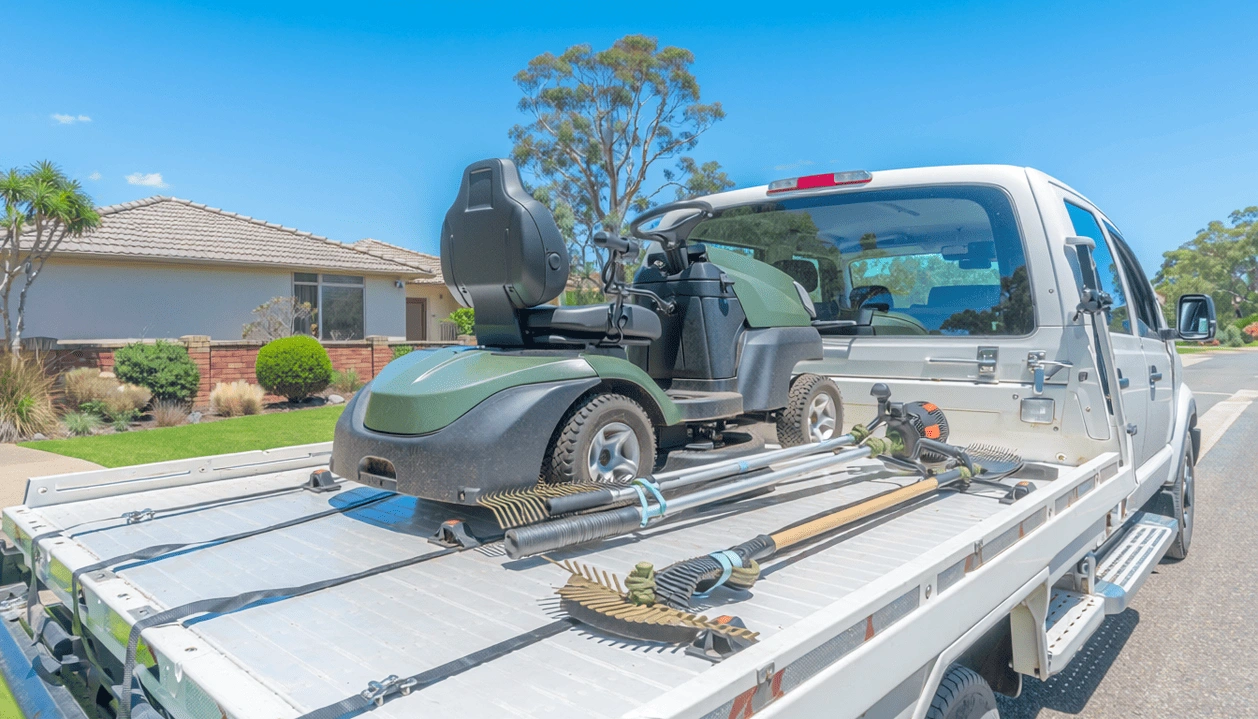
From zero-turn mowers to aerators and rollers, turf maintenance gear needs careful handling. These machines are lower to the ground and more prone to scraping during loading. Our tilt tray services ensure they’re loaded without a single scratch, protecting your business reputation with clients.
Turf equipment is often higher-value than its size suggests. A quality zero-turn mower costs $15,000+. One careless loading can destroy that investment.
Trenchers, Stump Grinders, and Attachments
Specialised tools like trenchers and grinders are expensive and often awkward to move. We secure them properly, protect hydraulic hoses, and make sure attachments don’t shift during transport. These machines require custom securing strategies based on their specific design.
Attachments, like augers or cutting heads, add complexity. They can’t be secured to the machine itself; they need independent restraint to prevent projectile hazards during transport.
Trailers and Tippers
Sometimes it’s not the machine that needs moving, it’s the trailer itself. We handle plant trailers, tippers, and even small tipping trailers that need relocation between job sites or back to your depot. Trailer transport requires different securing techniques than loose machinery.
The Risks of Amateur Equipment Transport for Landscapers
Damage Costs Far Exceed Transport Fees
Most landscapers understand the financial reality: hiring professional equipment relocation costs between $200 and $600 for most local moves across Perth, depending on the machine’s size and distance. But getting it wrong costs infinitely more.
Damaged machinery, a ruptured hydraulic line costs $2,000+. A bent chassis or damaged tracks can run $10,000+. Insurance won’t cover you if you’re found to have transported equipment improperly. And if someone is hurt during loading or transport, you’re personally liable.
The $300 you save by doing it yourself isn’t worth the $15,000 risk. We’ve seen landscapers learn this lesson the hard way.
Regulatory and Insurance Implications
Western Australia’s transport regulations treat load restraint seriously. If you transport equipment on an undersized or improperly secured trailer and get pulled over, you’re looking at fines starting at $500, with potential court action if there’s been an incident.
Your insurance won’t cover you if they find out you transported machinery improperly. Claims are denied. You’re personally liable. That’s the real cost of amateur transport.
How Tilt Tray Towing Differs from Standard Trailers
The Physics of Safe Loading
You could technically move a Bobcat on a trailer, but it’s not the safest or most efficient method. A tilt tray lowers completely to the ground. That means we can winch the equipment on without lifting it, reducing the risk of damage or injury. It’s like rolling a heavy object up a ramp instead of trying to hoist it into the air.
Once the equipment is on the tray, it’s secured at ground level. There’s no need for a crane, forklift, or manual lifting. The tray tilts back to horizontal, and we’re ready to go. It’s fast, safe, and eliminates the need for additional equipment on-site.
Why Slope Matters
Standard trailers often require steep loading angles, 15 to 30 degrees. For compact excavators and Bobcats, this is dangerous. The centre of gravity shifts backward, and the machine can flip. We use low-angle tilt trays (under 10 degrees) to eliminate this risk entirely.
This difference isn’t academic, it’s the distinction between safe transport and expensive damage.
Preparing Equipment for Safe Transport
What Landscapers Should Do Before We Arrive
A little preparation on your end makes the whole process faster and safer. Here’s what helps:
- Clean off excess mud and debris: We don’t expect your machines to be showroom-clean, but removing heavy mud clumps and debris makes loading easier and safer.
- Secure loose attachments: If your machine has a bucket, grab, or auger attached, make sure it’s locked in place or removed entirely.
- Check fuel and fluid levels: A full tank isn’t necessary, but we do need enough fuel to start the machine for loading (if it’s operational).
- Provide access details: If the pickup or drop-off site has tricky access, tight gates, or specific entry requirements, let us know when you book.
- Have keys and documentation ready: If the equipment is being dropped at a workshop, make sure we have the keys and any paperwork the mechanic might need.
These simple steps prevent delays and reduce the risk of damage during equipment relocation across Perth.
Residential Access and Tight-Space Challenges in Perth
Perth’s Older Suburbs Weren’t Designed for Heavy Equipment
Perth’s older suburbs weren’t designed for 8-tonne excavators. Narrow driveways, overhanging trees, heritage-listed streetscapes, and neighbours who’ll complain if you so much as touch their verge, it’s a minefield. We’ve developed a process for navigating these challenges in suburbs like Subiaco, Mosman Park, and Perth itself.
We’ve navigated hundreds of tight-access jobs. Before we dispatch a truck, we check the access using Google Street View and satellite imagery. If a full-size tilt tray won’t fit, we’ll use a smaller truck or coordinate with you to meet at a more accessible location.
Protecting Client Property During Transport
Landscaping businesses live and die by their reputation. If our truck tears up a client’s lawn or cracks their driveway, that’s on you. We use ground protection mats when needed, plan our entry and exit routes carefully, and always assume the client is watching from the window (because they usually are).
This commitment to property protection is standard in professional landscaping equipment towing across Perth, it’s not optional.
Timing and Discretion
Some jobs need to happen early or late to avoid traffic or minimise disruption. We’ve moved machinery at 5am to beat school drop-off traffic and relocated equipment after dark to avoid blocking a main road during peak hour. Your project’s needs drive our scheduling.
When You Need Equipment Moved (And Fast)
Landscaping Projects Don’t Run on a 9-to-5 Schedule
You might finish a job in Mandurah and need your excavator in Ellenbrook by 7am the next morning. Or a machine breaks down mid-job and you need a replacement on-site within hours. That’s where 24-hour emergency towing becomes critical. Breakdowns happen. Hydraulic lines burst. Engines overheat. When your Bobcat goes down in the middle of a commercial project, you can’t wait until Monday for a tow. You need someone who’ll pick up the phone, dispatch a truck, and get your machine to a workshop or back to the depot, fast.
We’ve pulled machines out of muddy parks at 11pm, recovered a stump grinder from a residential driveway after a hydraulic failure at dawn, and relocated an entire fleet of mowers between sites on a public holiday. It’s not glamorous, but it’s what keeps your business moving.
The Cost of Equipment Downtime
Every hour your equipment sits idle costs money. You’re paying crew wages, losing billable hours, and potentially facing penalties for missed deadlines. That’s why speed matters in professional landscaping equipment towing.
When you contact us for emergency service, we’ll give you an honest timeframe. If we say we’ll be there in 45 minutes, we mean it. If we’re running late (traffic, road closures, or another job taking longer than expected), we’ll call and update you.
On-Site Equipment Recovery from Difficult Terrain
Beyond Standard Towing
Landscaping sites aren’t always flat and paved. We’ve recovered machines from muddy parks, steep embankments, and half-finished retaining walls. If your gear is stuck or immobilised, we’ll assess the safest way to extract it without causing further damage.
For equipment stuck in soft ground, we use steel plates and hydraulic jacks to stabilise the recovery point. For machines on slopes, we use additional winching equipment and anchor points to prevent sliding during extraction.
Coordinating with Your Team
We understand that a breakdown affects your entire schedule. We’ll keep you updated throughout the process and work around your timeline as much as possible. Our professional accident recovery team handles equipment incidents with the urgency they demand.
Transporting Attachments, Trailers, and Ancillary Gear
More Than Just the Main Machine
It’s not always the main machine that needs moving. Sometimes it’s the attachments, buckets, augers, grabs, forks, or the trailers and ancillary equipment that support your operation. We’ve moved:
- Plant trailers loaded with tools and small equipment
- Tipping trailers that need relocation between job sites
- Pallets of pavers, turf rolls, and bulk materials (when combined with machinery transport)
- Water tanks, generators, and site sheds used for temporary site offices
If it’s part of your landscaping operation and it needs to move, we can handle it. Our specialised towing solutions cover just about anything that doesn’t fit neatly into a standard category.
Compliance, Safety, and Insurance
Professional Standards Protect Your Business
Transporting heavy machinery isn’t just about having a big truck. It’s about doing it legally and safely. All our drivers hold the appropriate licences for the vehicles they operate. Our trucks are regularly serviced and inspected. We carry full public liability insurance and comprehensive cover for the equipment we transport.
If something goes wrong, and it rarely does, you’re protected. We also follow all WA transport regulations, including load restraint standards, weight limits, and route restrictions. Some roads in Perth have weight limits or height restrictions that affect tilt tray trucks, and we plan our routes accordingly.
Why Perth Landscaping Businesses Choose All Out Towing
Understanding Your Industry
We’re not the only towing company in Perth, but we’re one of the few that genuinely understands the landscaping industry. We know your margins are tight, your schedules are unpredictable, and your equipment is expensive. We’ve moved machines for one-person operations and multi-crew commercial landscapers, and the same principles apply: show up on time, handle the gear with care, and don’t create more problems than you solve.
Our team has experience with heavy machinery towing, which means we’re comfortable with everything from a 1-tonne mini digger to an 8-tonne excavator. We carry the right straps, chains, and winching equipment, and we know how to distribute weight properly on a tilt tray to keep everything stable during transport.
We also offer roadside assistance if your work ute breaks down on the way to a job, flat battery, blown tyre, or fuel issues. We’ll get you back on the road or tow your vehicle to a workshop, whichever makes more sense for your business.
When to Book (And When to Call for Emergency Service)
Advance Booking for Scheduled Moves
If you know you’ll need equipment moved, say, you’ve just won a new contract and need to relocate your fleet to a different depot, book in advance. We can lock in a time that suits your schedule and make sure the right truck is available.
But if something breaks down or you need urgent relocation, don’t wait. Call our 24/7 team and we’ll dispatch a truck as soon as possible. We’ve handled same-day emergency moves more times than we can count.
Building Long-Term Relationships
Why Repeat Clients Trust All Out Towing
Landscaping is hard enough without equipment transport adding to the stress. Whether you’re moving a Bobcat between job sites, recovering a broken-down excavator, or relocating your entire fleet to a new depot, the process should be straightforward, safe, and reliable.
We’ve built our reputation on showing up when we say we will, handling your gear like it’s our own, and solving problems instead of creating them. That’s what All Out Towing has always been about, being the calm, competent voice on the other end of the phone when things go wrong.
Your equipment is expensive. Your time is valuable. Your reputation depends on delivering quality work on schedule. We get that. And we’re here to make sure your machinery gets where it needs to be, safely and on time, every single time.
Ready to book equipment relocation for your landscaping business across Perth? Call All Out Towing at 0418 959 216 for fast, professional landscaping equipment towing that keeps your projects on schedule.