When a 12-tonne excavator shifts even 30 centimetres during transport, it doesn’t just damage the trailer, it can flip the entire rig. That’s not a scare tactic. It’s physics, and it’s why Western Australia’s Heavy Vehicle Services (HVS) regulations treat load restraint as seriously as drink-driving laws.
We’ve moved thousands of heavy loads across Perth and regional WA, from bobcats heading to Kalgoorlie mine sites to shipping containers destined for Broome. Every single one required meticulous restraint planning, not just to tick compliance boxes, but to ensure everyone on the road gets home safely.
The difference between a secure load and a catastrophic failure often comes down to understanding three things: the forces at play, the equipment needed, and the legal framework that governs it all. This guide explains how to secure heavy loads for HVS compliance in WA so you understand what’s required and why it matters.
Why Load Restraint Isn’t Optional in WA
The Physics of Road Transport
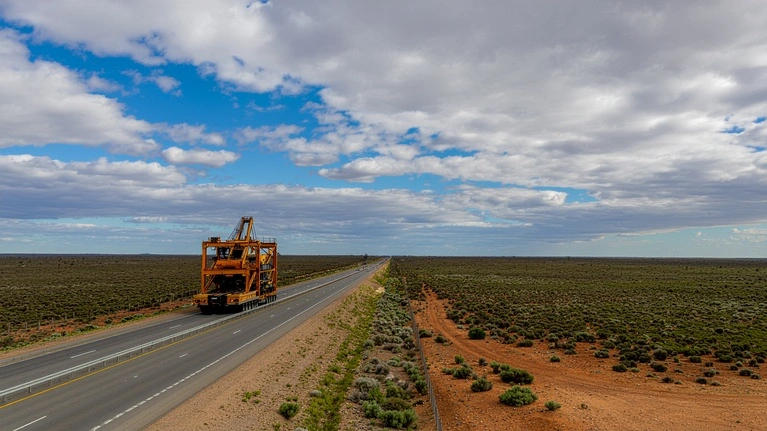
Western Australia’s roads present unique challenges that make proper load securing non-negotiable. Our highway speeds are higher, distances are longer, and road conditions can shift from smooth bitumen to corrugated gravel within kilometres. A load that seems stable in a depot can become a lethal projectile after 400 kilometres of vibration and lateral forces.
The Heavy Vehicle National Law (HVNL) applies across WA, and it’s unambiguous: the Chain of Responsibility (CoR) means everyone involved in the transport process, from the loader to the driver to the consignor, shares legal liability if a load fails. You can’t point fingers when an unsecured generator rolls off a tilt tray and kills someone. The law holds you accountable.
HVS Enforcement and Random Inspections
HVS inspectors don’t need a reason to pull you over. Random roadside checks are common, especially on major freight routes like Great Eastern Highway or Brand Highway. If your restraints don’t meet the Load Restraint Guide 2018 standards, you’re looking at immediate defect notices, fines exceeding $5,000, and potential prosecution if there’s been an incident.
This is why understanding heavy load securing for HVS compliance in WA is essential for anyone moving machinery, containers, or heavy plant equipment across the state.
Understanding the Forces That Want to Move Your Load
Forward Forces During Braking
Think of your load as constantly trying to escape. Not because it’s malicious, but because physics demands it. Every time you brake, accelerate, or corner, forces act on that machinery or container. Your restraint system exists to counteract those forces.
Forward forces occur during braking and are typically the strongest, up to 0.8g (80% of the load’s weight) on sealed roads. That 10-tonne excavator? It’s pushing forward with 8 tonnes of force when you hit the brakes hard. Your chains and lashings need to hold that force.
Rearward and Lateral Forces
Rearward forces happen during acceleration, though they’re usually weaker (around 0.5g). Still, a 5-tonne bobcat accelerating generates 2.5 tonnes of rearward force. Ignore it, and your load slides backward uncontrollably.
Lateral forces come from cornering and road camber. These are often underestimated. A roundabout taken at even moderate speed can generate 0.5g sideways. On a 15-tonne shipping container, that’s 7.5 tonnes trying to tip or slide your load dangerously.
Vertical Forces and Cumulative Effects
Vertical forces from bumps and potholes add another layer of complexity. WA’s regional roads can be brutal, and every jolt lifts your load momentarily, reducing friction and testing your restraints severely. The Load Restraint Guide requires your system to withstand forces from all directions simultaneously. It’s not enough to chain the front and hope for the best when securing heavy loads for HVS compliance.
The Legal Framework: What HVS Actually Checks
The 0.8g Rule and Performance Standards
HVS compliance isn’t about guesswork. Inspectors follow the National Transport Commission’s Load Restraint Guide 2018, which provides specific performance standards for different load types. When they pull you over, they’re checking whether your restraint system meets those standards, and they know exactly what to look for.
The 0.8g rule is fundamental. Your restraint system must prevent movement in the forward direction under a force equal to 80% of the load’s mass. For lateral and rearward forces, the standard is 0.5g (50% of the load’s mass). Vertical forces require restraint against 0.2g (20% of the load’s mass).
Here’s what that means in practice: a 6-tonne forklift needs restraints capable of resisting 4.8 tonnes forward, 3 tonnes sideways and backward, and 1.2 tonnes upward. You can’t eyeball those numbers. You need rated equipment and proper calculations for heavy load securing.
Chain of Responsibility Laws
Chain of Responsibility (CoR) laws mean ignorance isn’t a defence. If you’re the driver, you’re responsible for checking restraints before departure and during the journey. If you’re the business owner, you’re responsible for providing proper equipment and training. If you loaded the machinery, you’re responsible for securing it correctly. Everyone shares the liability.
Penalties are severe. Individual fines can exceed $10,000, and corporate fines can reach $50,000 per offence. If a load failure causes injury or death, criminal charges become possible. We’ve seen businesses shut down after a single catastrophic restraint failure in WA.
Choosing the Right Restraint Equipment for Heavy Loads
Grade 80 Chain: The Minimum Standard
Not all chains are created equal, and using the wrong equipment is one of the fastest ways to fail an HVS inspection. Every component in your restraint system, chains, straps, shackles, binders, must be rated, marked, and appropriate for the load.
Grade 80 chain is the minimum standard for heavy machinery. It’s marked with an “8” or “80” on the links and has a working load limit (WLL) clearly stamped. A 13mm Grade 80 chain has a WLL of around 4 tonnes. Never exceed the WLL, and never use unmarked or damaged chain. We replace chains at the first sign of stretching, kinking, or wear.
Ratchet Straps vs. Chain for Heavy Loads
Ratchet straps have their place, but not on 10-tonne loads. They’re suitable for lighter cargo (up to 2-3 tonnes) when used correctly, but they’re vulnerable to abrasion, UV damage, and over-tightening. For heavy machinery, chain is almost always the better choice. If you do use straps, check the WLL label, inspect for cuts or fraying, and never tie knots, they reduce strength by up to 50%.
Shackles, Hooks, and Load Binders
Shackles and hooks must match the chain grade. A Grade 80 chain with a Grade 40 shackle is only as strong as the weakest link, literally. We use bow shackles for most applications because they distribute load more evenly than D-shackles. Always install the pin so it carries the load, not the body.
Load binders (lever or ratchet type) tension chains to eliminate slack. Lever binders are faster but can over-tension if you’re not careful. Ratchet binders give more control but take longer. Either way, the binder itself must be rated for the load. A 2-tonne binder won’t safely tension a chain holding 5 tonnes of heavy machinery.
Attachment Points: Where You Connect Matters
Structural Integrity is Critical
The strongest chain in the world is useless if it’s attached to a weak point on your trailer or load. Attachment points must be structural, rated, and positioned to counteract the forces discussed earlier. This is fundamental to heavy load securing for HVS compliance.
Trailer anchor points should be welded or bolted to the chassis, not the deck. We’ve seen operators loop chains around side rails or through bolt holes in the tray, both are non-compliant and dangerous. Proper anchor points are clearly marked with their WLL and inspected regularly for cracks or deformation.
Using Equipment Tie-Down Points
Machinery attachment points are often built into the equipment. Excavators have lifting eyes, forklifts have frame tie-down points, and bobcats have designated restraint locations. Use them. Don’t wrap chain around hydraulic cylinders, buckets, or other non-structural components. If the machinery doesn’t have obvious tie-down points, consult the manufacturer’s manual or attach to the frame.
Angle of restraint affects load capacity significantly. Chains should ideally be at 45 degrees or less from horizontal. Steeper angles reduce the effective restraint force and increase stress on anchor points. If you’re forced to use a steep angle, add more restraints to compensate.
The Four-Point Restraint Rule for Heavy Machinery
Independent Restraint Requirements
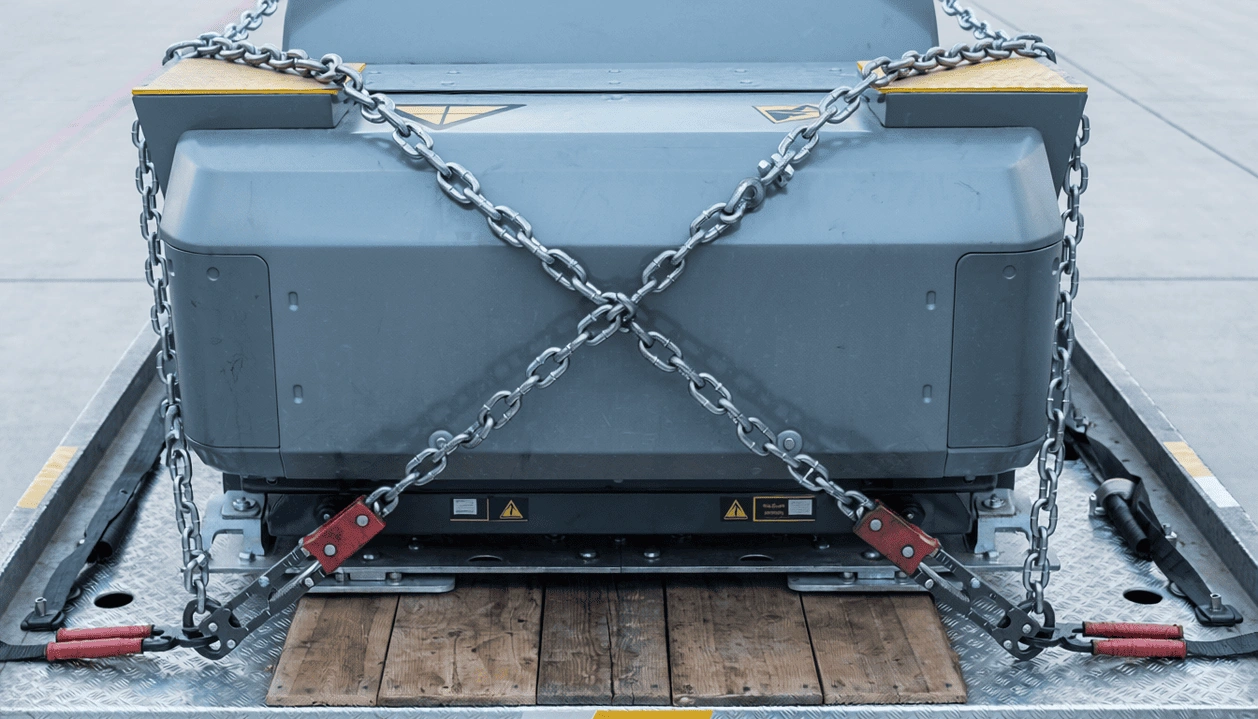
For most heavy machinery, excavators, bobcats, forklifts, generators, the minimum is four independent restraints, one at each corner. This creates a web of forces that prevents movement in all directions. But “four chains” doesn’t automatically mean compliance with load restraint standards.
Independent restraints means each chain must be capable of holding the load on its own if the others fail. You can’t count on combined strength. If you need 4 tonnes of forward restraint and you’re using four chains, each chain must have a WLL of at least 4 tonnes (assuming a 45-degree angle).
Crossed Chains for Lateral Stability
Crossed chains at the front and rear add lateral stability to heavy load securing. Instead of running chains straight forward and back, cross them in an X-pattern. This counteracts sideways forces during cornering and prevents the load from pivoting dangerously.
Redundancy is smart practice. We often use six or eight chains on heavy loads, especially for long-distance transport. If one fails due to vibration or a road hazard, the others keep the load secure. It’s over-engineering, but it’s also how you sleep at night knowing your equipment is safe.
Securing Shipping Containers: A Different Beast
Twist Locks and Corner Castings
Shipping containers are deceptively tricky. They’re heavy (a 20-foot container weighs around 2.3 tonnes empty, 30 tonnes loaded), they have a high centre of gravity, and they’re designed to be lifted, not lashed. Standard tilt tray restraints often aren’t enough for container transport compliance.
Twist locks are the gold standard for container transport. These mechanical locks engage the corner castings (the reinforced corners designed for crane lifting) and prevent vertical and lateral movement. A proper twist lock system uses four locks, one at each corner, and they’re rated for the container’s full weight.
Container Load Distribution
Chain restraints are still necessary, even with twist locks. Chains prevent forward and rearward movement during braking and acceleration. We typically use four chains minimum, two at the front, two at the rear, attached to the corner castings and tensioned with load binders.
Weight distribution is critical for container transport. Containers must be centred on the tilt tray, with the load inside the container evenly distributed. An off-centre load shifts the centre of gravity and increases rollover risk. Before we move a container, we confirm the internal load is secured and balanced.
Pre-Transport Inspections: What We Check Every Time
Chain and Hardware Condition Assessment
A restraint system is only as good as its condition. Before every job, we run through a checklist that’s saved us from failures more times than we can count. This is essential to heavy load securing compliance.
Chain inspection starts with looking for stretched links, cracks, nicks, or excessive wear. We run our hands along every link, feeling for deformities. If a chain has been shock-loaded (dropped or suddenly jerked), we retire it immediately, even if it looks fine. Shock loads create internal fractures that aren’t visible but compromise safety.
Shackle, Hook, and Anchor Point Verification
Shackle and hook inspection focuses on bends, cracks, and thread damage. A bent shackle pin is a red flag, it means the shackle has been overloaded. We check that pins screw in smoothly and that the body isn’t deformed. Hooks should close fully and show no signs of opening up under load.
Anchor point inspection looks for cracks in welds, elongated bolt holes, and rust. We tap welds with a hammer, a dull thud can indicate a crack. Any anchor point showing damage gets repaired or replaced before we load. This meticulous approach is how we ensure every load meets HVS compliance standards.
Load Binder Function Testing
Load binder function is tested by operating each one through its full range. Sticky or seized binders get serviced or replaced. We also check that the hooks engage securely and that there’s no excessive play that could cause slipping during transport.
During Transport: When to Re-Check Your Load
The Critical 50-Kilometre Check
Restraints aren’t set-and-forget. Temperature changes, vibration, and settling can loosen chains and straps during transport. The Load Restraint Guide requires drivers to re-check restraints within the first 50 kilometres and then regularly throughout the journey.
The 50km check is when most issues reveal themselves. Chains settle into position, machinery shifts slightly, and any slack becomes apparent. We pull over, re-tension binders, and confirm nothing has moved. It takes five minutes and has prevented dozens of potential failures for heavy load securing across WA.
Regular Checks on Rough Roads
After rough roads, we check again. Corrugated gravel, potholes, and speed bumps all stress restraint systems severely. If we’ve just driven 100 kilometres of unsealed road, we’re stopping to inspect before continuing across WA.
Visual checks happen constantly during transport. A professional driver glances in the mirrors every few minutes, looking for signs of movement or loose chains. If something looks off, we stop immediately. Better to lose 10 minutes than a load worth thousands.
Common Mistakes That Fail HVS Inspections
Friction Alone Isn’t Restraint
Using friction alone is the classic mistake. Operators assume a heavy load won’t move because it’s sitting on a non-slip surface. Wrong. Friction helps, but it’s not a restraint method under the Load Restraint Guide. You must have positive restraints (chains, straps, or blocking) regardless of friction.
This fundamental misunderstanding causes more HVS compliance failures than any other single issue across WA. It’s an easy mistake to make but a serious one legally.
Over-Tensioning and Chain Damage
Over-tensioning chains seems like it would make things safer, but it actually damages equipment and creates stress fractures. Chains should be tight enough to eliminate slack, but not so tight that you’re lifting the load or bending the trailer. If you need a cheater bar to close your load binder, you’re over-tensioning dangerously.
Mixing Rated and Unrated Equipment
Mixing rated and unrated equipment is non-compliant. One unmarked chain in a system of rated chains means the entire system fails inspection. Every component must be identifiable and rated for HVS compliance. This rule is strictly enforced by roadside inspectors across WA.
Neglecting Vertical Restraint
Ignoring vertical restraint is common with tall loads. Operators focus on forward and lateral restraint but forget that bumps can lift a load. Over-height loads, in particular, need vertical restraint to prevent tipping during transport. The Load Restraint Guide doesn’t allow this oversight.
Training and Documentation: Proving Compliance
Load Restraint Training Records
HVS inspectors don’t just look at your chains, they ask to see your training records, load plans, and maintenance logs. Under CoR laws, you need to demonstrate that you’ve taken reasonable steps to ensure compliance. This documentation is as important as the physical restraints themselves.
Load restraint training should be documented for every person who secures loads. This includes drivers, operators, and yard staff. Training must cover the Load Restraint Guide, equipment selection, and inspection procedures. We run refresher training annually and keep records for seven years, essential for proving compliance.
Load Plans and Maintenance Logs
Load plans are required for complex or high-risk loads. A load plan documents the weight, dimensions, centre of gravity, restraint method, and equipment used. It’s essentially proof that you’ve thought through the physics and chosen appropriate restraints. For a 15-tonne excavator, our load plan includes chain specifications, anchor point locations, and tensioning procedures.
Maintenance logs track inspections and repairs for all restraint equipment. Every chain, strap, shackle, and binder gets an ID number and a service history. When we retire a damaged chain, it’s logged. When we replace an anchor point, it’s logged. This documentation proves we’re maintaining equipment to standard and helps with HVS compliance audits.
When to Call Professionals for Complex Loads
Prestige and High-Value Transport
Some loads are beyond DIY restraint. If you’re moving machinery worth hundreds of thousands of dollars, or if the load exceeds standard dimensions and weights, professional transport is the smart choice. We’ve got the gear, the training, and the insurance to move heavy loads compliantly.
Our heavy machinery towing service includes load planning, certified restraint equipment, and drivers trained in HVS regulations. For oversized or over-mass loads, we handle permit applications and route planning across WA.
Prestige Car and Emergency Recovery
Prestige car towing uses the same restraint principles but with added care for paint, suspension, and undercarriage. Our tilt tray services eliminate the risk of dragging or lifting, and our restraint systems are designed specifically for high-value vehicles.
For urgent situations, a breakdown on-site, a machine that needs to be moved immediately, our 24-hour emergency towing team is equipped to secure and transport heavy loads safely, even in the middle of the night.
The Real Cost of Non-Compliance
Beyond Fines: Legal Liability and Reputational Damage
Fines are one thing. The real cost of a restraint failure is measured in lives, livelihoods, and reputations. A load that shifts and causes a crash doesn’t just destroy your business, it destroys families.
We’ve seen operators lose their licences, their businesses, and in one case, face criminal charges after a poorly secured excavator rolled off a trailer and killed a motorcyclist. The operator had used three chains instead of four, and none were properly tensioned. The court didn’t care that he’d moved hundreds of loads before without incident. One failure was enough. This is why HVS compliance is non-negotiable.
Insurance and Personal Liability
Insurance won’t cover you if you’re found non-compliant. If HVS determines your restraint system didn’t meet the Load Restraint Guide standards, your insurer will deny the claim. You’re personally liable for damages, medical costs, and legal fees. It can bankrupt you instantly.
Final Thoughts on Load Restraint Compliance
Why Professional Standards Matter
Securing heavy loads for HVS compliance isn’t complicated, but it is precise. It requires understanding the forces at play, using rated equipment correctly, and inspecting everything before and during transport. It’s not glamorous work, but it’s the difference between a safe delivery and a catastrophic failure.
We treat every load like it’s the most important one we’ve ever moved, because to someone, a business owner, a site manager, a family, it is. That excavator is their livelihood. That shipping container is their inventory. That generator is keeping a remote site operational. They trust us to get it there safely, and we take that responsibility seriously.
If you’re moving heavy machinery, construction equipment, or oversized cargo in WA, contact All Out Towing for a compliance-focused transport solution. We’ll assess your load, plan the restraint system, and deliver it safely, because that’s what HVS compliance really means. Call 0418 959 216 for professional heavy load securing advice and transport across Western Australia.