Settlement day is one of the most pressure-filled moments in a homeowner’s life. Contracts are signed, removalists are booked, and the clock ticks toward a non-negotiable legal deadline. A vehicle breakdown on this day can threaten far more than your schedule.
Property settlements in Western Australia operate inside strict time windows. Buyers must complete transactions by a fixed hour – typically between midday and 4pm on the agreed date. Miss that window, and the financial and contractual consequences can be severe.
A moving day breakdown isn’t just an inconvenience. It’s a direct threat to an entire property transaction. Settlement documents, property keys, and essential personal items are often inside the vehicle. Standard roadside assistance, with its 60-90 minute response windows, simply doesn’t meet the urgency that settlement deadlines demand. Your vehicle may also be carrying:
- Signed settlement documents and authority-to-complete forms
- Keys to the new property
- Medications and essential items needed immediately on arrival
- Valuables you won’t entrust to removalists
- Family members who need to be at specific locations at specific times
All Out Towing, operating across Perth’s metro area, responds to settlement day towing emergencies every week. Our team understands that property deadlines are fixed – and that every minute between a moving day breakdown and a working vehicle matters.
Why Settlement Day Breakdowns Create Unique Pressure
Most vehicle breakdowns are frustrating. Settlement day breakdowns carry an entirely different weight. The financial, contractual, and logistical consequences can compound rapidly within a few short hours.
Financial Penalties and Contractual Risk
WA property contracts include penalty interest clauses for late settlement. These typically run at 10-12% per annum, calculated daily. On a $600,000 property, that’s roughly $165-200 per day in exposure.
Sellers have the legal right to terminate contracts if buyers fail to settle on time. Most won’t exercise that option for a short delay – but it gives them negotiating leverage. Conveyancer deadline towing services exist precisely because these legal time pressures are real and non-negotiable.
Property settlement vehicle recovery isn’t just about moving a car from one location to another. It’s about protecting a transaction worth hundreds of thousands of dollars from a single mechanical failure.
The Logistical Cascade Effect
Removalists operate on tight daily schedules. If you’re stranded with a broken vehicle, they may deliver furniture to the garage and leave. Alternatively, they may charge storage fees and return another day.
Cleaners, tradespeople, and utility connection appointments all cascade into disorder when the settlement timeline collapses. Fast settlement day towing – with 24-hour emergency towing backed by GPS-tracked trucks and average response times under 30 minutes – can prevent that cascade from becoming unmanageable.
Emotional Pressure Under Deadlines
Settlement day already tests most people’s stress capacity. A moving day breakdown pushes it further. Critical decisions get made in a high-stress state – and that’s when mistakes happen.
Calling the right settlement day towing operator immediately removes one major pressure point. Property settlement vehicle recovery handled by experienced operators means you can direct your focus back to the transaction itself.
Common Moving Day Breakdown Causes in Perth
Settlement day creates predictable vehicle failure patterns. Unusual usage, heavy loads, and the stress of pre-settlement preparation all contribute to higher breakdown rates on moving days.
Battery Failures on Settlement Morning
A vehicle sitting unused for a week while you pack and prepare will slowly drain its battery. Cold Perth winter mornings can push a marginal battery over the edge. Settlement morning, you load the car, turn the key, and nothing happens.
This is one of the most common calls a removalist day tow truck responds to on settlement mornings. Older vehicles and those with dash cams or GPS trackers drawing standby power are especially vulnerable. Our roadside team can often jump-start these vehicles on-site, getting you mobile within minutes.
Overloaded Vehicles and Cooling System Stress
Sedans rated for 400kg of cargo suddenly carry 600kg of boxes, plus passengers. This places serious strain on cooling systems – particularly in Perth’s summer heat. Stop-start traffic in 38-degree temperatures can overwhelm even a well-maintained radiator.
Many overheating vehicles on settlement days break down within 10 kilometres of departure. The combination of excess weight and heat is a reliable recipe for a moving day breakdown.
Transmission Problems From Trailer Towing
Many Perth families hire trailers for settlement day without checking whether their vehicle’s transmission is designed for sustained towing – especially in the city’s hilly suburbs. Automatic transmissions overheat. Clutches burn out on manual vehicles.
These breakdowns require immediate settlement day towing. The vehicle is undriveable. A removalist day tow truck with specialist flatbed equipment needs to reach the scene quickly to prevent further damage.
Tyre Blowouts Under Heavy Loads
The spare tyre under your vehicle may not have been checked in years. Under a full settlement day load, it can fail within kilometres of first use. Carrying extra weight also raises blowout risk on standard tyres that are past their best condition.
Checking your spare tyre pressure and condition before settlement day is one of the simplest prevention steps available. A flat spare is one of the most avoidable causes of a moving day breakdown in Perth.
How Settlement Day Towing Responds to Your Emergency
Settlement day towing requires a fundamentally different response model from routine vehicle recovery. Time sensitivity, destination flexibility, and cargo access all matter more than usual when a property deadline is at stake.
Immediate Dispatch and Priority Assessment
When you call about a settlement day towing emergency, the first question is your settlement deadline. We plan backward from that fixed point. In most Perth metro locations, we arrive within 20-40 minutes – often faster for conveyancer deadline towing situations.
Our dispatch team needs clear information to send the right equipment:
- Your exact location – street address or GPS coordinates
- Vehicle make, model, and drivetrain type (AWD, 4WD, front-wheel-drive)
- Nature of the breakdown – won’t start, overheating, transmission failure, tyre
- Your settlement deadline and how much time remains
- What’s inside the vehicle that you need access to before transport
Each answer shapes the equipment we send and how we handle the job on arrival.
Destination Flexibility During Transport
You might need your vehicle towed to a mechanic near the new property, or directly to the new address to sort out later. Sometimes the destination changes as your settlement situation evolves.
Our professional car towing services are built around flexibility. Experienced operators use certified, damage-free transport methods – and they adapt when circumstances shift mid-job without delay.
Alternative Transport Coordination
If family members are stranded with you while the vehicle is being towed, you still need to reach settlement. Our operators maintain contacts for reliable taxi and rideshare drivers across the areas we service.
We coordinate their arrival while loading your vehicle. Property settlement vehicle recovery shouldn’t leave you standing on the kerb. It should solve the complete logistics problem – not just the mechanical one.
Tilt Tray Transport: The Right Method for Settlement Day
The tow truck method matters enormously when you’re racing a settlement deadline. Tilt tray settlement transport outperforms hook towing in almost every settlement day scenario – for speed, safety, and cargo access.
Why Tilt Tray Beats Hook Towing on Settlement Day
Hook towing lifts one axle while the other remains on the ground. For AWD or 4WD vehicles, this creates serious drivetrain damage. Tilt tray settlement transport keeps all wheels completely off the road throughout the journey.
Our damage-free tilt tray transport protects AWD and 4WD drivetrains by keeping every wheel off the road during transit. This prevents transmission damage and protects manufacturer warranties. It’s also safer for lowered vehicles and for cars carrying suspension stress from heavy settlement day loads.
Fast Loading Times When Minutes Count
Tilt tray settlement transport loads a standard vehicle in five to seven minutes. Hook towing takes fifteen to twenty minutes. On settlement day, that time difference is significant.
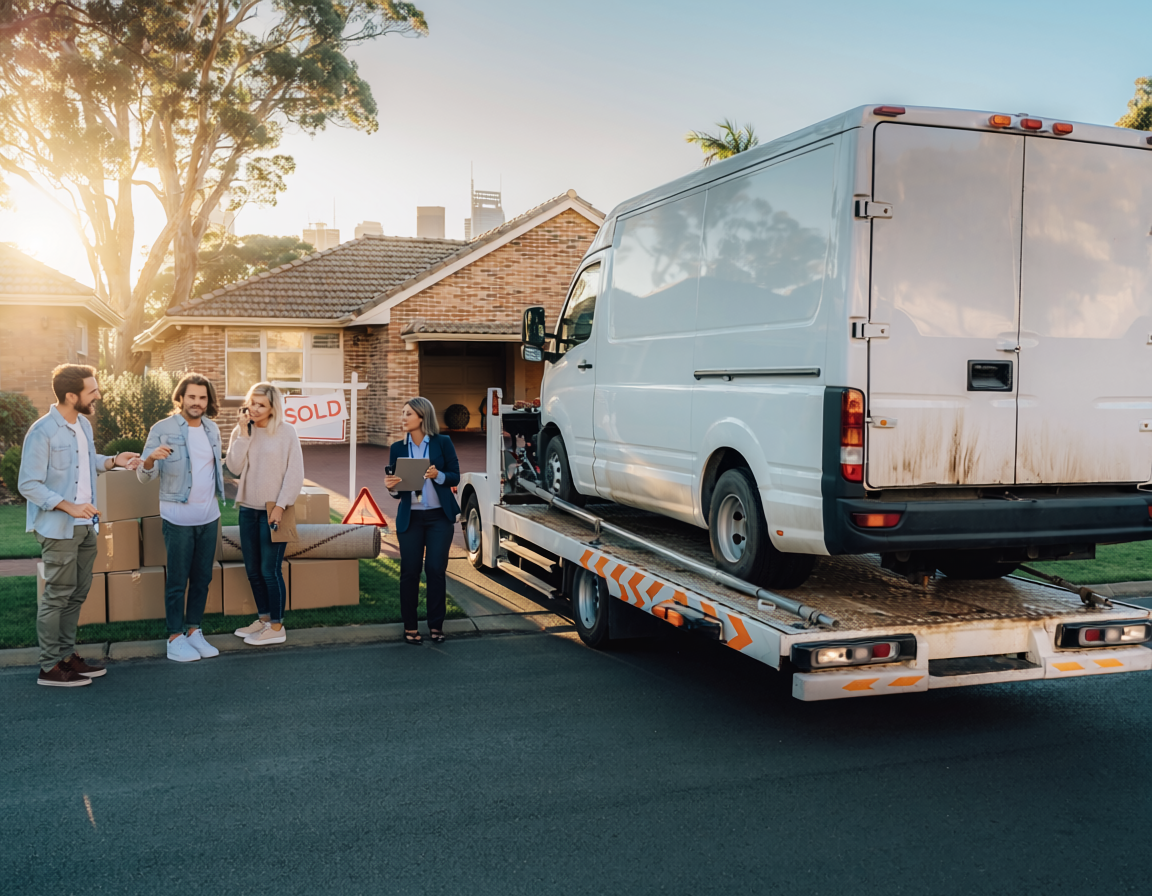
The tray lowers completely flat to ground level. The vehicle is winched on safely and secured at multiple points. No ground clearance risk, and no additional damage from the loading process itself.
Accessing Your Documents During Loading
Settlement documents, property keys, and medications can’t stay inside a vehicle being towed to a repairer. The tilt tray loading process allows safe access to the vehicle before it’s secured and transported.
Our operators pause loading to let you retrieve critical items. This is standard procedure for settlement day towing jobs – because what’s inside the vehicle can be as important as the vehicle itself.
What to Do When Your Vehicle Breaks Down on Settlement Day
Clear thinking becomes difficult under deadline pressure. This checklist keeps you focused on what matters when a moving day breakdown strikes without warning.
Immediate Actions in the First 60 Seconds
- Move to a safe location – off the road, hazard lights on immediately
- Call for breakdown recovery services straight away – mobile mechanics handle battery failures, fuel issues, and tyre changes on-site, often within minutes
- Note your exact location – street name, suburb, or GPS coordinates from your phone
- Check your settlement paperwork for the exact transaction deadline time
Alerting Your Conveyancer Without Delay
Call your conveyancer or settlement agent as soon as emergency assistance is arranged. Explain the situation clearly: your vehicle has broken down, towing is on the way, and you need a short time extension.
Conveyancer deadline towing situations are manageable when communicated early. A one to two-hour extension is usually achievable through direct negotiation. Most sellers will agree rather than risk the entire transaction collapsing.
Document the breakdown with photos and retain the towing invoice. This demonstrates the delay was genuine – not negligence or poor planning. Most parties respond reasonably to documented emergencies.
Gathering Critical Items Before the Tow
Before the tow truck loads your vehicle, retrieve everything you’ll need in the next several hours:
- Settlement documents, authority-to-complete forms, and identification
- Keys to the new property and any access codes
- Medications and medical equipment
- Valuables and items you won’t leave in an unattended vehicle
- Children’s car seats, nappy bags, and essential items for young passengers
Keep these items in a single bag you can transfer to alternative transport in seconds. Don’t leave critical items inside a vehicle heading to a repairer you may not visit until after settlement.
Preventing Moving Day Vehicle Disasters
Prevention is always more effective than emergency response. The good news is that most settlement day breakdowns are entirely avoidable with straightforward preparation.
Pre-Settlement Vehicle Inspection
Book a basic vehicle inspection two weeks before settlement day. The cost is typically $80-150 and covers the most common moving day breakdown causes:
- Battery condition and charging system health
- Cooling system integrity – hoses, radiator, and coolant levels
- Tyre condition including the spare tyre pressure and tread
- Brake function under load conditions
- Fluid levels – engine oil, transmission fluid, and power steering
This inspection identifies 90% of potential failure points before they become a settlement day crisis. Fixing a weak battery the week before settlement costs far less than emergency towing on the day.
Testing Your Vehicle Under Load
If you’re carrying heavy items or towing a trailer, test the vehicle under a similar load one week before settlement. Drive for 30-40 minutes in stop-start traffic. Watch the temperature gauge. Listen for unusual sounds from the transmission or suspension.
Discovering a problem during a test drive is far better than during an actual moving day breakdown. Finding an issue a week out gives you time to fix it without any deadline pressure at all.
Building Buffer Time Into Your Schedule
If settlement is at 2pm, plan to arrive before midday. A two-hour buffer absorbs minor delays – slow traffic, a fuel stop, or a 30-minute on-site repair – without triggering crisis mode.
Arrange backup transport as well. Have a family member on standby. Know which rideshare services cover your settlement property locations. Some rural Perth properties in areas like Serpentine or Bullsbrook sit outside standard Uber coverage zones.
Perth’s Geography and Settlement Day Risk
Perth’s layout creates specific challenges for settlement day vehicle emergencies. Understanding them helps you prepare for scenarios that are more likely here than in other Australian cities.
Long Distances and Cross-Suburb Routes
A family moving from Mandurah to Ellenbrook covers over 100 kilometres. A moving day breakdown halfway leaves you stranded in unfamiliar territory – potentially far from mechanics and alternative transport options.
Perth’s cross-town routes are also congested. Moving east to west – say, from Fremantle to Midland – means navigating suburban roads through multiple traffic pinch points. A breakdown in these areas during peak times can add 30-40 minutes to response times.
Summer Heat and Peak Settlement Season
Perth’s peak settlement season aligns with its hottest months. Families moving before the school year begins in late January and February face temperatures of 35-40 degrees. Heat stresses cooling systems, batteries, and tyres simultaneously.
Our fleet positions trucks strategically across outer suburbs during these peak periods. Response times to areas like Serpentine and Bullsbrook are shorter than most people expect – because we anticipate where settlement day towing demand will be highest throughout the summer months.
Getting Through Settlement Day When Your Vehicle Fails
A moving day breakdown is stressful – but it doesn’t have to derail an entire property transaction. Fast settlement day towing, early communication with your conveyancer, and the right equipment on site can resolve the situation before your deadline passes.
Our experienced operators provide professional accident towing and emergency vehicle recovery across Perth, with certified handling procedures and full documentation for insurance records where needed. Tilt tray settlement transport protects your vehicle during recovery, while our team coordinates alternative transport to keep your settlement timeline on track.
For Perth drivers needing immediate towing assistance, contact our dispatch team at 0418 959 216 for 24/7 emergency response. All Out Towing operates across Perth’s northern and southern suburbs with GPS-tracked trucks and experienced operators ready to respond when settlement day pressure hits hardest.