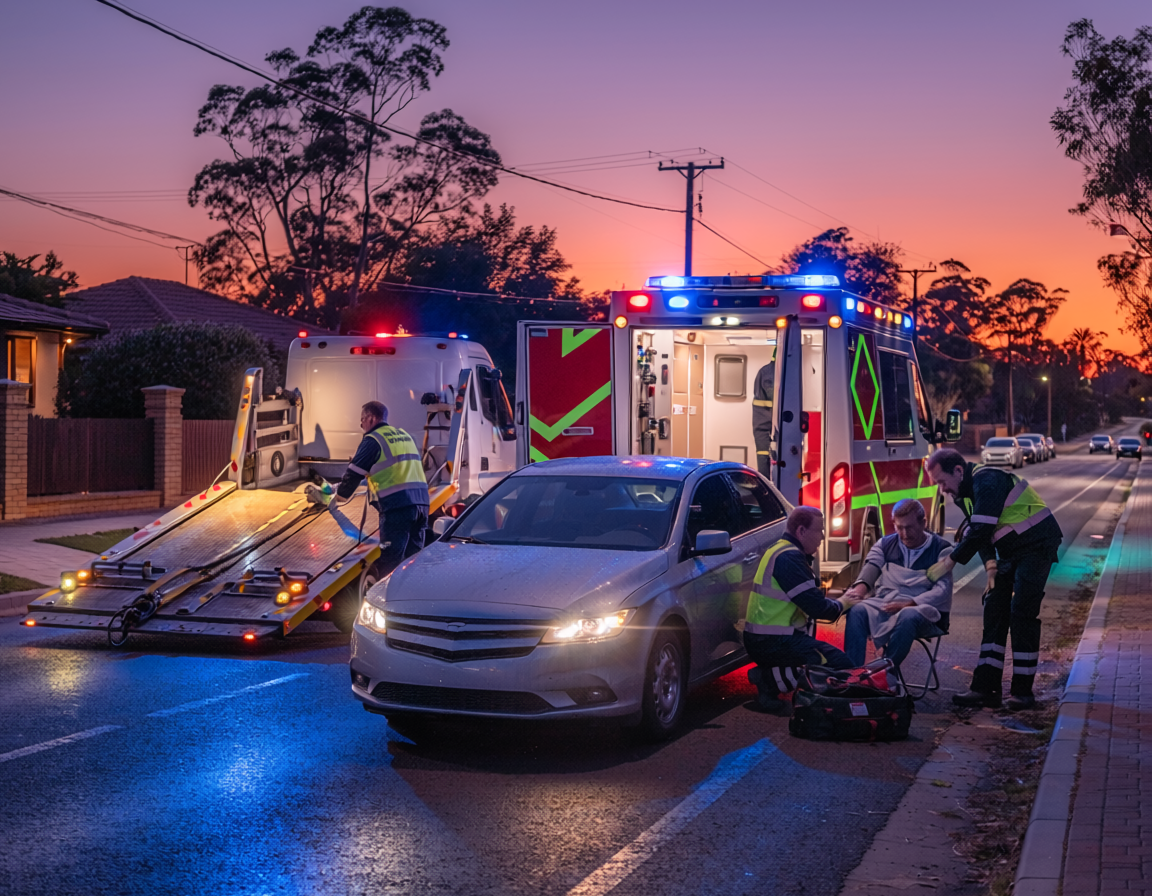
When a medical emergency strikes on Perth’s roads, two urgent needs collide simultaneously. Getting critical medical help to the person in crisis is the immediate priority. Managing the vehicle safely – so it doesn’t create a secondary hazard – is the equally urgent responsibility that falls to experienced towing operators.
A vehicle stopped in a live traffic lane after a driver collapses from a cardiac event creates real danger for paramedics, police, and other road users. Every minute it remains in position increases secondary collision risk. Medical emergency towing isn’t just about moving metal from one point to another – it’s about operating within an active emergency scene where evidence preservation, first responder safety, and legal compliance all matter.
Hospital breakdown assistance that goes far beyond routine vehicle recovery is what these situations demand. Standard roadside operators lack the emergency service dispatch relationships, the evidence-handling training, and the specialist equipment required at active medical scenes. The coordination between WA Police, paramedics, and towing operators exists for good reason – and it requires all three to function as a practised team.
All Out Towing has worked alongside paramedics, police, and emergency responders across Perth for over 15 years. Our operators are trained for these high-pressure scenarios and maintain direct dispatch relationships with WA Police for immediate critical incident vehicle removal when it’s needed most.
What Defines a Medical Emergency Towing Situation
Medical emergency towing occurs when a driver or passenger experiences a sudden health crisis – cardiac arrest, stroke, diabetic emergency, seizure, or severe trauma – that renders them unable to control or move their vehicle. The car might be stopped in a live lane, crashed into a barrier, or abandoned mid-intersection after the driver collapsed.
The Priority Hierarchy on a Medical Scene
These situations differ fundamentally from standard accident or breakdown recovery. The vehicle owner can’t give consent or provide directions. Medical personnel need immediate, unobstructed access. The priority hierarchy shifts completely – the person’s life takes absolute precedence, but the vehicle creates a secondary hazard that must be managed simultaneously.
Hospital breakdown assistance in a medical emergency context means understanding this hierarchy and operating within it. We don’t arrive and start hooking up equipment if paramedics are actively treating someone nearby. We coordinate with the officer managing the scene, confirm the removal plan, and execute it precisely.
When the Vehicle Becomes a Secondary Hazard
A vehicle in a live traffic lane after a medical event doesn’t stay safe for long. Other drivers encounter it with limited warning. Traffic management resources are stretched. Paramedics working the scene face increasing exposure to moving vehicles. Medical emergency towing that arrives promptly protects first responders as much as it clears the road.
AWD and Specialist Equipment Requirements
Medical emergency scenes often involve vehicles in unusual positions – against barriers, at odd angles, or partially on medians after uncontrolled driving. Many modern family vehicles are AWD-configured. Our damage-free tilt tray transport protects AWD and 4WD drivetrains by keeping all wheels completely off the ground during transit – the only safe method for these drivetrains, regardless of the pressure or urgency of the scene.
How Emergency Services Coordinate Vehicle Recovery
When paramedics arrive at a medical emergency involving a vehicle, their entire focus is patient stabilisation and transport. Vehicle recovery responsibility falls to police, who manage the broader scene safety and traffic control. Medical emergency towing receives callouts through WA Police direct dispatch – not through standard call centre queues.
WA Police Dispatch and Police Dispatch Towing in Perth
We receive medical incident callouts through established police dispatch towing protocols in Perth. The information provided is specific: exact location, vehicle type, hazard level, whether it’s a crash scene or medical-only event, and any special handling requirements. Police dispatch towing in Perth for medical scenes is coordinated by the officer managing traffic control – not by bystanders, not by the patient’s family.
Our role is surgical. We get in, secure the vehicle, and remove it safely without disrupting medical care or compromising the scene. We communicate with the officer in charge, not with paramedics who have a single critical focus.
The Critical First 10 Minutes on Scene
On arrival at a medical emergency scene, our operators assess four things immediately:
- Where are medical personnel working, and what space do they need to operate safely?
- What traffic control is in place, and how does vehicle removal fit within it?
- Is the vehicle part of a collision requiring evidence preservation for Major Crash investigators?
- What’s the fastest, safest removal method given the vehicle’s position and condition?
If paramedics are actively treating the patient inside or adjacent to the vehicle, we don’t proceed until they complete their work or explicitly clear us. Critical incident vehicle removal always follows this protocol.
Scene Safety as Non-Negotiable
Our fast emergency recovery team positions the tow truck to create a physical barrier between the recovery operation and live traffic. Warning lights and safety equipment supplement police traffic control. We maintain constant communication with the officer in charge throughout – because uncoordinated movement in an active emergency scene creates additional risk for everyone present.
Evidence Preservation and Legal Requirements
When a medical emergency causes or contributes to a collision, the vehicle becomes evidence. WA Police Major Crash investigators need to examine mechanical condition, impact points, and damage patterns to determine the sequence of events. Medical emergency towing that disregards this can compromise investigations and expose operators to legal liability.
Evidence-Aware Recovery Procedures
Emergency scene vehicle recovery in a medical context means photographing the vehicle’s position before touching it, documenting any fluids or debris, avoiding disturbing the interior, and using recovery methods that don’t create additional damage confusable with collision damage. WA Police accident towing coordination protocols require this documentation as standard.
Our operators are trained in evidence-aware procedures meeting WA towing industry standards. We record the vehicle’s exact position, condition, and any visible contents. We note pre-existing damage. We secure the vehicle to prevent tampering during transport and storage.
Chain-of-Custody Documentation
WA Police accident towing coordination requires a clear chain of custody from scene through to secure storage. Our documentation records every step: who authorised removal, what condition the vehicle was in, how it was transported, and where it was stored. This documentation is available to investigators, insurers, and families on request.
Protecting Rights When the Owner Can’t
The vehicle owner’s medical crisis doesn’t eliminate their legal rights. Even if they’re unconscious or unable to communicate, their property must be handled with the same care and accountability as any routine towing situation. WA Police provide the authority to remove the vehicle, but we remain responsible for its security, condition, and documentation throughout.
Handling Different Medical Emergency Scenarios
Not all medical emergencies present the same recovery challenges. The circumstances of each event determine how emergency scene vehicle recovery is approached.
Cardiac and Stroke Events
Cardiac and stroke events often leave vehicles in relatively controlled positions. The driver may have had seconds to pull over or slow down before losing consciousness. These recoveries are typically straightforward – the vehicle is intact and can be loaded using standard tilt tray procedures once medical personnel clear the immediate area.
Seizures and Diabetic Emergencies
Seizures and diabetic emergencies can cause erratic driving before the vehicle comes to rest. We’ve recovered cars from garden beds, median strips, and partially through fences after these events. The vehicle may have sustained damage from the uncontrolled path – requiring careful tilt tray loading to avoid causing further damage that could be misinterpreted in any subsequent investigation.
Trauma and Complex Scenes
Trauma incidents involving vehicles create the most complex critical incident vehicle removal scenarios. The vehicle may be both a crime scene and a traffic hazard. We work under direct police instruction – often waiting for forensic examination before removal – then using specialised techniques to preserve evidence integrity throughout the recovery and transport process.
Hospital Breakdown Assistance for Families
After the patient is transported to hospital, someone still needs to deal with the vehicle. Family members arriving at the emergency department often have no idea where the car is, whether it’s secure, or how to retrieve it. Hospital breakdown assistance in this context means being the calm, reliable point of contact when families are dealing with crisis.
How Families Can Locate and Collect Vehicles
We provide vehicle location and condition information to WA Police, who pass it to families at the hospital. When a family member contacts us directly, we explain clearly:
- Where the vehicle is stored and what condition it’s in
- What documentation is needed for collection – police incident number, proof of ownership or relationship
- What costs are involved for towing and storage
- Whether the vehicle is subject to a police evidence hold that prevents immediate collection
Hospital breakdown assistance means answering these questions with patience. Families dealing with medical trauma shouldn’t face bureaucratic obstacles or impersonal responses at this time.
Compassionate Storage Timelines
If a medical emergency was fatal, hospital breakdown assistance becomes a deeply sensitive matter. We work with next of kin and estate representatives, understanding that collecting a deceased loved one’s vehicle is emotionally devastating. We allow families time and space to process what’s happened. Storage fees are regulated and transparent – we don’t compound grief with unreasonable charges.
Why Standard Services Can’t Handle Medical Emergencies
Medical emergency towing cannot be handled by standard breakdown operators. The operational requirements are different, and the consequences of getting it wrong are severe.
Emergency Service Integration
Standard breakdown services aren’t integrated with WA Police dispatch systems. They have no direct relationship with emergency service protocols. They’re not trained in evidence preservation, scene safety within active medical responses, or the legal requirements that apply when a vehicle is involved in a medical incident.
Critical incident vehicle removal at an active emergency scene demands operators who’ve worked alongside paramedics and police many times before. That experience can’t be improvised.
Specialist Equipment for Compromised Positions
Medical emergencies leave vehicles in positions that standard tow trucks can’t safely handle. A car nose-down in a drain, sideways against a barrier, or partially in a garden bed requires tilt tray equipment that can load from multiple angles. Our post-accident vehicle recovery service uses specialist equipment meeting WA towing industry standards for exactly these scenarios – with certified operators who handle compromised vehicles without causing further damage.
PPE and Biohazard Protocols
Our operators carry personal protective equipment for biohazard situations involving blood and bodily fluids. They understand contamination protocols and know how to secure a scene safely if they arrive before other emergency services. This level of preparedness is not standard breakdown operator training – it’s specialist emergency response capability built over years of working medical incident scenes across Perth.
What Happens to Vehicles After Medical Emergency Recovery
Once a vehicle is removed from a medical emergency scene, its journey depends on the circumstances of the incident and the owner’s condition.
When the Owner is Hospitalised
If the owner is hospitalised but stable, our safe vehicle towing in Perth service secures the vehicle in our facility and waits for them or their family to arrange collection. We inventory visible valuables, lock the vehicle, and document its condition with photographs. Collection can be arranged at the family’s convenience.
Evidence Holds and Police Release
If the vehicle was involved in a collision requiring Major Crash investigation, it may be held as evidence until investigators complete their examination. We provide secure, monitored storage and access for investigators during this period. The vehicle is released only when WA Police authorise it – and we communicate this process clearly to families waiting for resolution.
Estate Processes and Compassionate Disposal
When a vehicle’s owner has passed away, it becomes part of their estate. We work with solicitors, executors, and next of kin on timelines that accommodate grief. Some families need the vehicle held for months during estate settlement. Others want compassionate disposal arranged because the memories are too painful. Hospital breakdown assistance that serves families well extends long after the initial incident is resolved.
Ready When the Situation Is Most Difficult
Medical emergency towing requires technical skill, regulatory compliance, and the emotional intelligence to support families through their worst moments. Hospital breakdown assistance in this context isn’t just a logistics service – it’s a responsibility that experienced operators take seriously.
When WA Police dispatch a medical emergency towing request, or when a family calls us seeking information about a loved one’s vehicle, our team responds with both competence and care. Emergency scene vehicle recovery handled correctly protects first responders, preserves evidence integrity, and gives families one less thing to worry about during a crisis.
Professional operators understand the stress these situations place on everyone involved. Reach All Out Towing at 0418 959 216 for 24/7 medical emergency towing across Perth – available every day of the year when you need calm, professional assistance most.