Getting a vehicle stuck in soft sand isn’t just frustrating – it’s a physics problem that standard towing methods can’t solve. What works perfectly on asphalt or gravel becomes actively dangerous when the ground beneath your tyres shifts and compresses under load. Understanding why standard towing fails in sand also explains why professional sand recovery physics knowledge is essential before you attempt any extraction.
We’ve pulled hundreds of vehicles from Perth’s coastal dunes, Lancelin’s sand tracks, and remote beach access points. The difference between a safe recovery and a damaged vehicle often comes down to understanding how sand behaves under tension and weight. Every vehicle extraction tip we apply in the field is grounded in physics – not improvisation.
Standard towing relies on a simple principle: apply pulling force in a straight line until the vehicle moves. That approach assumes solid ground beneath both the stuck vehicle and the recovery vehicle. Sand breaks both those assumptions simultaneously – and the consequences of ignoring that are damage, secondary boggings, and in worst cases, serious injury from failed recovery gear.
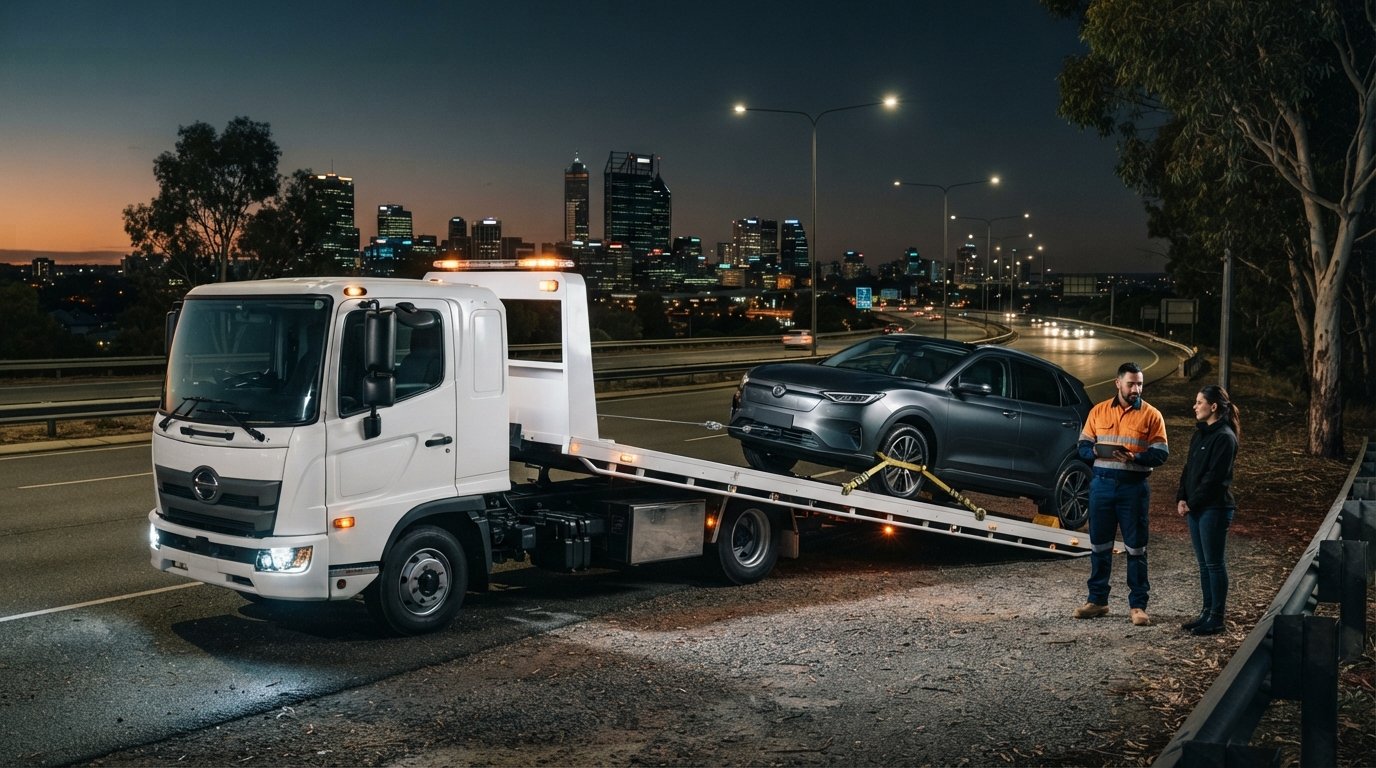
All Out Towing, operating across Perth’s metro area, operates purpose-built sand recovery vehicles specifically because standard equipment fails in this environment. Here’s the physics behind why.
The Ground Doesn’t Push Back
Tarmac and compacted gravel provide what engineers call “bearing capacity” – the ability to resist vertical loads without deforming. When a tow truck positions on solid ground, the surface pushes back against the truck’s weight with equal force. That’s basic Newtonian physics.
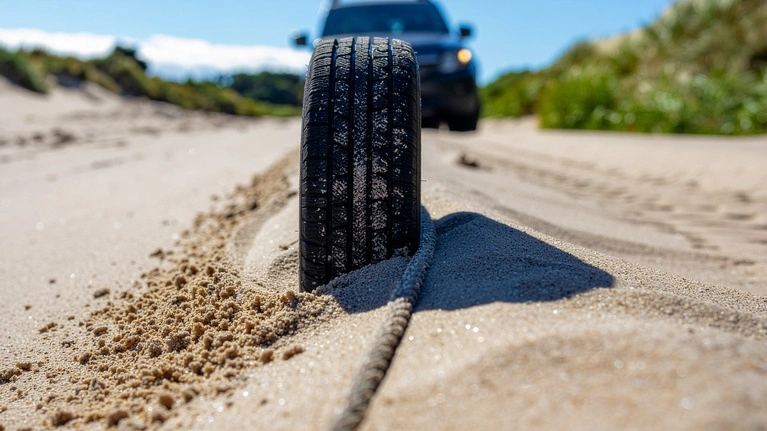
Sand doesn’t work that way. Apply vertical load and the grains compress and shift sideways. The deeper the sand, the more pronounced this effect becomes.
Why Standard Tow Trucks Sink
A standard tow truck weighs between 5,000-7,000kg empty. Add the hydraulic boom load and you’re easily over 8 tonnes pressing down on the surface. On a road, that’s fine. On soft sand, each tyre sinks until it finds enough compressed sand underneath to distribute the load.
Once the truck sinks even 15-20 centimetres, it’s no longer recovering another vehicle – it’s becoming stuck itself. We’ve seen recovery operators position a standard tow truck on what looked like firm beach sand, only to watch it sink to the axles the moment they applied tension to the winch line. Now you’ve got two stuck vehicles and a significantly more expensive recovery operation.
This is the first and most fundamental vehicle extraction tip: the recovery vehicle must be able to support its own weight on the surface before it can support anything else’s weight.
Pulling Force Creates Downward Force
Think of a tow strap or winch line as a straight line between two points: the stuck vehicle and the recovery vehicle. When you apply tension, you’re not just pulling horizontally – you’re pulling at an angle determined by the height difference between the two attachment points.
The Geometry of Sand Recovery Physics
If the tow point on the stuck vehicle sits 60cm off the ground and the winch on the recovery truck sits 1.2 metres high, that angle creates a downward vector on the stuck vehicle’s front end. Instead of lifting the vehicle out of the sand, you’re pushing it deeper.
The softer the sand, the more pronounced this effect becomes. We’ve measured bogged vehicles sink an additional 10-15cm during a poorly executed recovery attempt, compacting sand beneath the chassis and making the extraction significantly harder. This is sand recovery physics working directly against you.
Standard tow trucks don’t have low-mounted recovery points because they’re designed for hard surfaces where the angle doesn’t matter. In sand, attachment point height is the difference between a 20-minute vehicle extraction and a three-hour ordeal.
Our specialised recovery equipment includes multiple winch points at varying heights, allowing us to select the angle that lifts rather than pushes. That vehicle extraction tip alone prevents a significant portion of the secondary damage we see from failed DIY recovery attempts.
Traction Requires Resistance
A tow truck generates pulling force by using its own weight and tyre grip to resist the load. On asphalt, rubber grips the textured surface. On gravel, tyres bite into the aggregate. Both surfaces provide shear resistance – the ability to resist horizontal sliding forces.
Sand provides almost none of this, especially when it’s dry and loose.
When a standard tow truck applies power to pull a bogged vehicle, its tyres try to grip the sand. Instead of the truck moving forward and pulling the vehicle, the tyres spin and dig. Sand grains can’t interlock with tyre tread because they’re essentially round and smooth at a microscopic level – like ball bearings beneath the rubber.
Even trucks with dual rear axles struggle in sand. More tyres don’t help if none of them can find purchase. In fact, heavier trucks often perform worse because their weight causes them to sink faster, reducing the already minimal contact patch between tyre and sand.
Weight Distribution Works Against You
Standard tow trucks are built with a heavy rear end to balance the weight of a lifted vehicle. The hydraulic boom, winch assembly, and reinforced chassis all sit behind the rear axle. This keeps the truck stable when lifting a car on hard ground.
In sand, that same weight distribution becomes a critical liability. The rear axle carries 60-70% of the truck’s total weight, which means the rear tyres sink deepest and fastest. Once the rear tyres are buried, the truck can’t reverse out and can’t winch forward without digging deeper.
Our sand recovery vehicles carry weight evenly across all axles – a fundamental design difference that reduces ground pressure and minimises sinking. Understanding this distinction is core sand recovery physics knowledge for anyone evaluating towing options in soft ground.
Sand Compaction Changes During Recovery
Here’s something most people don’t realise: sand doesn’t behave the same way throughout a recovery. It changes as the extraction proceeds.
When a vehicle first gets stuck, the sand underneath is relatively loose. As attempts are made to move the vehicle, several things happen:
- The vehicle’s weight shifts, compressing sand under different axle positions
- Spinning rear tyres create bowls of loose, churned sand
- The chassis may contact the ground, spreading load across a wider area
- Moisture in the sand gets squeezed out, reducing cohesion further
Each of these changes the recovery dynamics. Standard towing equipment can’t adapt to this constant change because it’s designed for static, predictable surfaces. Professional sand recovery physics knowledge allows our operators to reassess and adapt the approach as conditions evolve during the extraction.
The Role of Tyre Pressure
We run our sand recovery vehicles at dramatically reduced tyre pressures – often as low as 15-18 PSI compared to the standard 35-40 PSI for road use. This increases the tyre’s contact patch with the sand, spreading the vehicle’s weight over a larger area.
Think of it like snowshoes. A person wearing boots sinks into snow because all their weight presses down through a small area. Snowshoes spread that same weight across a much larger surface, so they float rather than sink. Lowering tyre pressure does the same thing in sand – the tyre flattens out, creating a longer, wider contact patch that reduces ground pressure.
Standard tow trucks can’t safely run at these pressures. Their tyres are load-rated for specific pressures, and dropping below that rating risks tyre damage, bead separation, or loss of control. This is a non-negotiable vehicle extraction tip for anyone assessing whether a conventional tow truck is appropriate for a sand recovery job.
Recovery Angles and Load Paths
Professional sand recovery requires thinking about load paths – the direction forces travel through the stuck vehicle and into the ground.
Pulling straight back from the front tow point concentrates all the load on the front axle and whatever’s underneath it. In soft sand, that means pulling against maximum resistance. A better approach – one that experienced operators apply as a core vehicle extraction technique – uses a recovery angle of 30-45 degrees off the centreline. This shifts the load path diagonally across the vehicle, engaging both axles and distributing force more evenly.
This approach also creates slight lateral movement, which helps break the sand’s grip on the tyres. Standard towing equipment doesn’t allow for this positioning – a tow truck’s winch is fixed in direction relative to the truck’s chassis. Our portable winch systems can be anchored and repositioned to create optimal recovery angles for each specific situation.
The Danger of Shock Loading
When a winch line or tow strap is under tension and the stuck vehicle suddenly breaks free, all that stored energy releases instantly. This is called shock loading, and it can snap cables, shear bolts, and damage recovery points in milliseconds.
In sand, shock loading is almost inevitable with standard towing methods. The vehicle doesn’t slide smoothly – it breaks free in sudden jerks as the sand’s grip releases unevenly. One moment there’s maximum resistance, the next there’s almost none.
We’ve seen tow hooks ripped clean off vehicle chassis because the shock load exceeded the mounting point’s design strength. We’ve seen winch cables snap and recoil with enough force to shatter windscreens. These aren’t rare events – they’re predictable outcomes of applying standard towing methods to sand recovery situations where the sand recovery physics demands a different approach.
Professional sand recovery uses dynamic recovery straps with built-in elasticity. These straps stretch under load, absorbing shock and releasing it gradually. Standard tow truck winch cables are steel wire rope with almost no stretch. They’re perfect for controlled lifts on solid ground, but dangerous in dynamic sand recoveries.
Why We Use Dedicated Recovery Vehicles
Our towing services in Perth for sand recovery use purpose-built vehicles that address every physics problem outlined above. These aren’t modified tow trucks – they’re engineered specifically for soft-surface work.
Key Design Differences
- Weight distribution – Recovery vehicles carry weight evenly across all axles, minimising ground pressure and reducing sinking
- Tyre selection – We run aggressive off-road tyres designed for sand, not highway radials. The tread pattern and sidewall construction are completely different
- Winch positioning – Multiple winch points at varying heights allow adjustment of pull angle for each specific recovery
- Ground clearance – Higher clearance prevents the chassis from contacting the sand during approach and positioning
- Traction aids – Differential locks, traction control systems, and low-range gearing provide controlled power delivery without wheel spin
These vehicles cost significantly more than standard tow trucks and require specialised operator training. But they’re the only way to perform sand recoveries safely and reliably – because the physics demands it.
When to Call for Professional Recovery
If you’re stuck in sand and considering your options, here’s the honest assessment rooted in sand recovery physics: if a standard tow truck could reach you and pull you out safely, you probably wouldn’t be stuck in the first place.
Sand that’s firm enough to support a standard tow truck is usually firm enough that you could’ve driven out under your own power, or with a simple snatch strap recovery from another 4WD. If you’re genuinely bogged – axles sunk, chassis grounded, or in a remote location – you need specialist recovery capability.
We respond to beach and dune recoveries across Perth’s coastal areas, from Yanchep to Mandurah. Our specialist towing solutions team assesses the situation remotely – we’ll ask for photos and location details – to ensure we bring the right equipment on the first trip. Attempting a DIY recovery or calling a standard towing service just delays the proper solution and often makes the situation significantly worse.
For vehicles that sustain damage during a bog or failed recovery attempt, our professional accident towing service provides safe transport to your preferred workshop without adding further stress to already-compromised components.
Conclusion
Sand recovery isn’t just towing with extra difficulty – it’s a fundamentally different operation that requires different equipment, different techniques, and a solid understanding of how forces behave in unstable ground. Standard towing fails in sand because it’s built for environments where the ground provides resistance, weight doesn’t cause sinking, and pulling forces follow predictable paths. Sand violates all three assumptions simultaneously.
The sand recovery physics are unforgiving. You can’t overcome them with more power, heavier equipment, or determination. You need purpose-built recovery vehicles, properly trained operators, and an approach that works with sand’s properties rather than against them.
Every vehicle extraction tip we apply in the field is grounded in this physics – not guesswork. That’s the difference between getting you out safely and turning a manageable situation into a write-off.
Call 0418 959 216 for a fast response from our experienced operators. All Out Towing operates across Perth’s metro area with purpose-built sand recovery vehicles – available 24/7 with the equipment and expertise to get you out without guesswork, without secondary damage, and without adding another bogged vehicle to the problem.