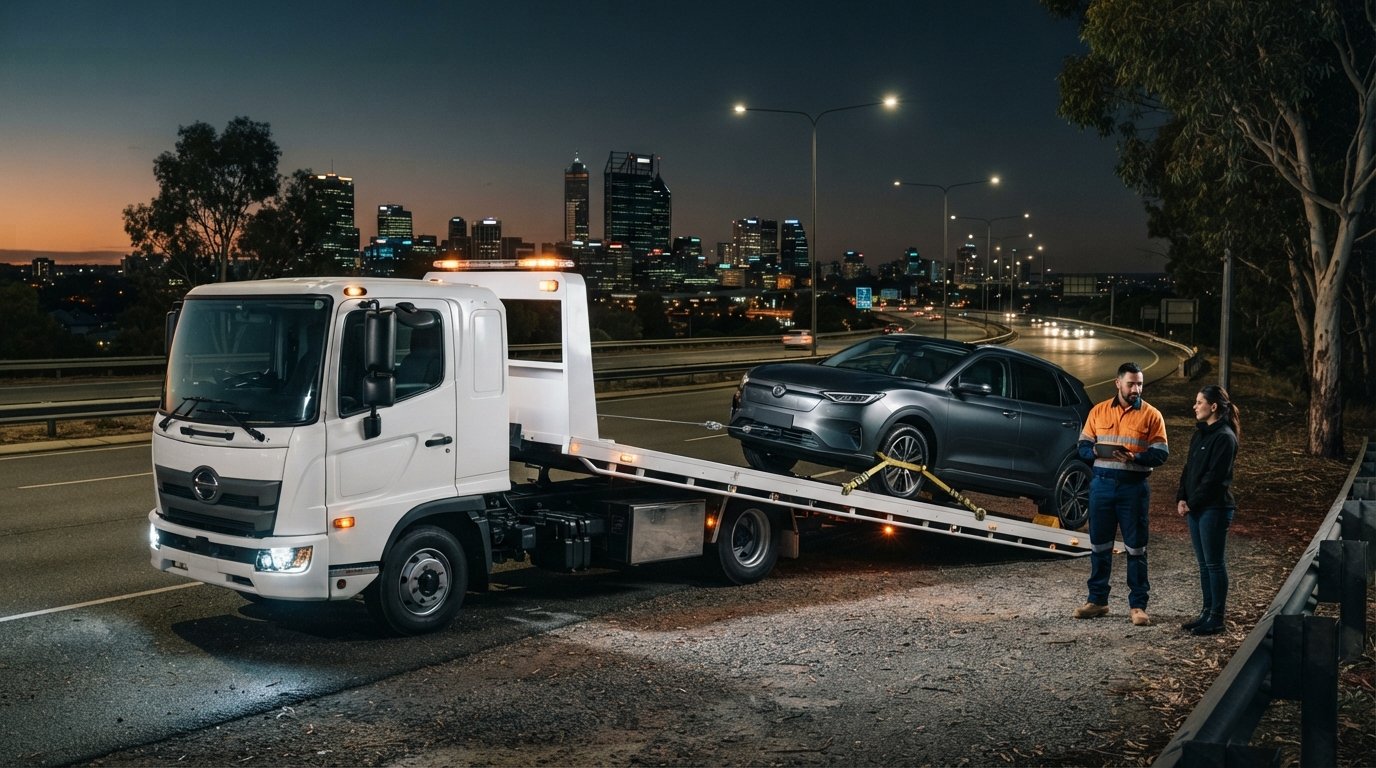
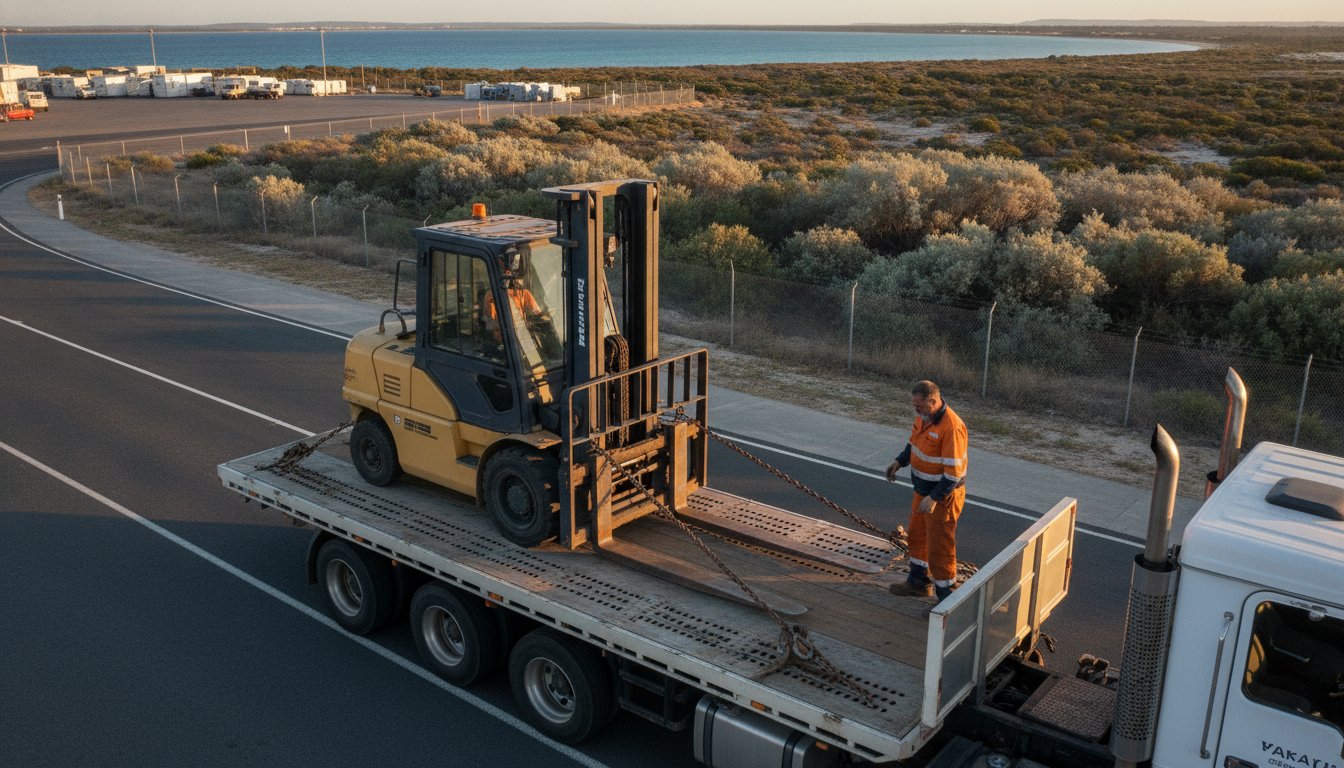
The cheapest option you find on a freight broker board might end up being the most expensive mistake your job site makes all week. When comparing bobcat transport quotes WA contractors and tradies often discover that vague estimates lead to surprise standby fees, late arrivals, and damaged attachments caused by improper load restraint. You need heavy machinery relocation that protects your equipment and keeps your crew on schedule, without unexpected depot charges on the final bill.
You shouldn’t have to wonder whether a carrier holds proper transit insurance or if they fully understand Western Australia’s Chain of Responsibility requirements under local road laws. This guide explains how to secure clear, fixed pricing without the hidden delays that blow out operational budgets. We walk through the exact machine dimensions and attachment details you need to provide upfront, how booking directly with a dedicated tilt tray fleet prevents costly site downtime, and the essential safety checks that ensure your machinery arrives ready to work.
Key Takeaways
- Providing exact machine dimensions, operating weight, and auxiliary attachments upfront is the fastest way to get accurate bobcat transport quotes WA without hidden fees.
- Booking directly with an established fleet operator eliminates broker middleman markups and secures reliable arrival windows to prevent costly site downtime.
- Western Australia’s Chain of Responsibility regulations make consignors legally accountable for transit safety, requiring certified drivers who follow official load restraint standards.
- Matching your skid steer to the correct deck capacity, such as a 7-metre or 10-metre tilt slide tray, protects your equipment and guarantees compliant transport across the state.
What Influences Bobcat Transport Quotes in Western Australia?
Securing an accurate price for machinery transport is never as simple as calculating distance between two postcodes. Online freight boards often post broad bidding estimates, but these figures routinely change once actual plant parameters emerge. When evaluating realistic bobcat transport quotes WA plant managers must factor in machine mass, ancillary tools, route clearance, and site conditions. Missing a single detail can turn an attractive initial estimate into unexpected depot surcharges or site delays.
Every transport move requires careful planning. A professional operator balances several core elements to calculate a fair, transparent figure:
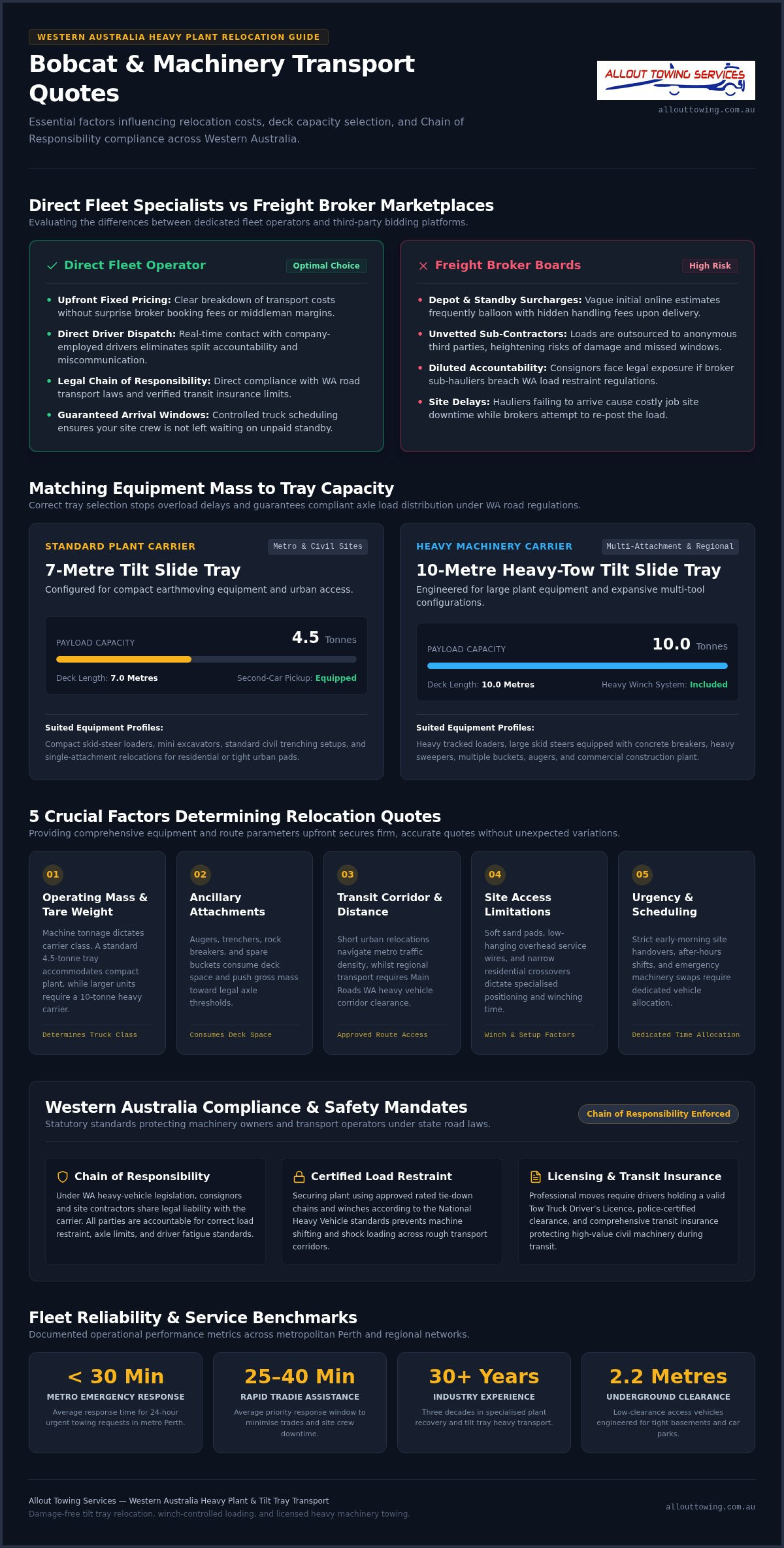
- Deck capacity and operating mass: Machine tonnage dictates whether a standard tilt tray or a heavy-tow carrier is required.
- Ancillary attachments: Additional augers, trenchers, rock breakers, and spare buckets consume valuable deck real estate and add substantial weight.
- Corridor travel versus metro routes: Short urban relocations involve navigating traffic density, whereas regional transport demands route compliance along designated heavy vehicle networks.
- Access limitations: Soft sand pads, overhead wires, and narrow residential crossovers restrict truck positioning and add recovery winching time.
- Urgency windows: Tight project handovers, after-hours relocations, or emergency equipment replacement require dedicated vehicle allocations.
Equipment Dimensions and Tare Weight
Weight remains the primary driver of transport pricing. A compact skid-steer loader designed for backyard civil work has completely different transport demands than a heavy tracked loader approaching four tonnes. While a smaller machine fits securely on a seven-metre tilt slide truck with a 4.5-tonne capacity, pairing that same skid steer with a concrete breaker, heavy sweepers, and multiple buckets can quickly push total mass past legal axle thresholds. Providing exact specifications upfront stops overload delays at collection, ensuring your transport provider dispatches the right truck first time.
Transit Distance and Route Planning
Relocating gear between local civil depots in Perth is fundamentally different from hauling heavy plant equipment across regional Western Australian highways. Regional travel requires route verification along approved corridors regulated by Main Roads WA, where road train interactions and isolated stretches demand rigorous equipment reliability. Professional heavy machinery towing includes full transit insurance coverage throughout these regional routes, protecting your capital investment from mechanical transit incidents across vast distances.
Direct Fleet Providers vs Freight Broker Marketplaces in WA
When searching for bobcat transport quotes WA civil contractors usually face a choice between hiring a direct fleet specialist or posting the load to an online freight broker board. While digital bidding platforms promise widespread carrier access, they act purely as middlemen. They farm your job out to unvetted third parties, which creates communication barriers, unpredictable arrival windows, and split accountability on active construction sites.
Working directly with an established local carrier changes the dynamic. A dedicated operator controls its own trucks, maintains direct communication with drivers, and takes immediate legal responsibility for moving your equipment safely under the state’s Heavy Vehicle Load Restraint Rules. This distinction directly influences both job safety and your final invoice.
Pricing Transparency and Hidden Surcharges
Freight aggregators rely on platform margins added to sub-contractor rates. Their initial quote rarely accounts for standby time, depot handling fees, or narrow residential site conditions, which often leads to surprise surcharges once the delivery docket lands. Partnering directly with a local carrier gives you upfront, fixed rates without hidden booking penalties. If you need reliable plant relocation without billing games, explore professional machinery transport Perth services that clearly outline every cost before the truck departs.
Accountability and Scheduling Reliability
Nothing stalls a project faster than an empty pad while your crew waits for plant that was scheduled for first light. When an anonymous marketplace haulier fails to show up, the broker simply re-lists the job. That leaves you paying idle operator wages while trying to coordinate with a remote call centre.
A family-owned specialist with over 30 years of towing industry experience delivers true accountability. Owning and operating our own fleet means we pair your exact loader with the right vehicle every time, whether that requires our seven-metre tilt slide trucks with a 4.5-tonne capacity or our heavy 10-metre tilt slide truck with a 10-tonne capacity. Your site team speaks straight to local dispatchers who understand Perth access gates and Western Australian road logistics. If you need dependable timing from a team that respects your work schedule, you can book an allocated truck directly through Allout Towing Services.
Essential Details to Provide for an Accurate Machinery Quote
Securing a firm price without post-booking adjustments depends entirely on the accuracy of the technical information you share. Vague machinery listings force transport operators to hedge against worst-case recovery scenarios or risk sending an undersized truck. Preparing a complete machinery profile ensures competitive bobcat transport quotes WA plant hire companies and civil contractors can rely on from the outset.
When you contact a dispatch team, step through these five core elements to lock in a fixed rate:
- Step 1: Machine specifications: Provide the exact make, model, total operating weight, overall height, and track or tyre width.
- Step 2: Attachment inventory: List every auxiliary piece joining the machine, including pallet forks, sweepers, trenchers, augers, or additional buckets.
- Step 3: Machine mobility: Confirm whether the plant powers on and drives freely or if it remains immobilised due to mechanical failure.
- Step 4: Location access profiles: Detail physical constraints at both collection and set-down points, such as tight crossovers, overhead lines, or unsealed tracks.
- Step 5: Delivery schedule: Set firm collection windows and site cut-offs to avoid overtime charges or after-hours logistics delays.
Operational Status and Winching Requirements
A dead skid steer transforms a straightforward drive-on relocation into a specialised technical recovery. Immobilised machinery demands slow, winch-controlled loading onto the slide tray deck to manage the machine’s deadweight safely. Informing dispatch early protects the tow line against extreme shock loading, which occurs if mechanical steering locks or seized final drives bind during winching. For jobs involving non-operational plant, reviewing professional construction equipment transport Perth solutions guarantees the truck arrives equipped with heavy-duty winches, rated snatch blocks, and proper recovery rigging.
Site Accessibility Checklist
Physical bottlenecks at collection or delivery can halt an otherwise smooth move. Drivers must know if an active suburban building pad features low-hanging service lines, steep driveway gradients, or soft sand that risks high-centring a loaded carrier. Verifying whether the truck must reverse against live traffic or unload across busy metropolitan street frontages allows operators to plan safe perimeter positioning, spotters, and compliance with local municipal safety buffers before wheels roll.
Safety, Load Restraint, and Compliance Standards in Western Australia
Transporting heavy plant across Western Australian roads is governed by strict statutory safety requirements. While shopping around for bobcat transport quotes WA project managers often overlook regulatory compliance, focusing solely on the bottom line. However, taking shortcuts on restraint methods or carrier credentials introduces severe financial and legal liabilities that far outweigh any minor savings on freight.
Every transport movement must meet the National Transport Commission’s performance standards. These standards dictate that tie-down systems must withstand forces equal to 80% of the machine’s mass forward, 50% sideways and rearward, and 20% vertically. Meeting these safety benchmarks demands rated lashing equipment, correct tie-down angles, and certified operators who understand transport physics.
Proper Heavy Plant Equipment Restraint
Securing skid steers requires a four-point direct tie-down system using transport-grade chains and load-rated turnbuckles. Each lash connects directly to designated chassis recovery lugs, rather than looping loosely around axles. Operators must lower the front bucket or attachment flat against the steel tray to drop the centre of gravity, relieve hydraulic circuit line pressure, and prevent mechanical movement during emergency braking. You should never trust an unlicensed chaser truck using worn, frayed fabric straps to hold high-mass steel machinery, as strap friction against sharp chassis rails leads to transit failures.
Chain of Responsibility Obligations for Contractors
Under Western Australia’s Road Traffic (Vehicles) Act 2012, Chain of Responsibility laws hold everyone in the transport sequence legally accountable. If you hire a haulier who overloads their truck or neglects correct restraint practices, regulators can prosecute your business alongside the driver. Senders, schedulers, and site managers share non-delegable legal duties to verify that transport contractors operate fully certified equipment with valid public liability and commercial transit policies.
When plant sizes exceed standard legal dimensions or require heavier payload envelopes, contractors should look into super tilt heavy transport WA options to remain completely compliant. If you need peace of mind that your next machinery move satisfies all state transport regulations, contact our licensed operations team today to book fully insured transit with police-certified drivers.
How Allout Towing Delivers Fast, Accurate Machinery Relocation Quotes
Waiting hours for anonymous online bids is rarely an option when civil schedules press and earthmoving crews stand waiting. Tradies and site supervisors need straightforward pricing without lengthy back-and-forth messages. When seeking firm bobcat transport quotes WA businesses turn to our dedicated dispatch team for rapid, all-inclusive numbers based on actual equipment specifications and real-world site access.
Our approach removes guesswork through direct fleet matching. With over 30 years of towing industry experience across Western Australia, we know how local arterial roads flow and how fast Perth suburban access gates close. Every relocation is carried out by licensed, police-certified operators using dedicated company assets, giving your plant complete protection under our full commercial transit insurance policies.
Matching the Fleet to Your Equipment
Precision loading starts with deploying the correct vehicle for your specific load profile. For standard civil moves, we dispatch our two tilt slide trucks featuring seven-metre trays and a 4.5-tonne capacity, making short work of standard wheeled skid steers and compact tracked machines. When your job demands carrying multiple heavy attachments alongside the base unit, our 10-metre heavy tilt slide truck provides a 10-tonne payload capacity to transport everything on a single deck.
Both vehicle setups utilise damage-free tilt-tray geometry. Shallow loading angles allow track-mounted equipment and low-clearance cutting edges to walk smoothly up the bed without undercarriage scraping, belly-pan impact, or unnecessary track wear.
Booking Your Transport and What Happens Next
Securing transport takes just a few minutes over the phone or via our online booking form. Once you supply the machine profile, access parameters, and target timeline, our dispatch team confirms your booking with a clear delivery window and fixed rates. On the day of transport, your site manager receives direct contact with the driver, ensuring smooth coordination as the truck approaches the gate.
Protect your project timeline by avoiding freight exchange uncertainty. Contact Allout Towing today to discuss your machine move and receive a dependable, transparent transport quote from our local specialists.
Secure Safe, Reliable Machinery Relocation Across WA
Securing the best bobcat transport quotes WA civil contractors can find isn’t just about chasing the lowest dollar figure on a bidding board. Providing precise tare weights, listing auxiliary tools upfront, and confirming site access requirements eliminates the surprise depot charges that blow out project budgets. Choosing direct fleet transport over an unvetted broker network also protects your company under Western Australia’s strict Chain of Responsibility road regulations, ensuring you avoid costly compliance penalties.
With over 30 years of towing experience across Western Australian roads, our family-owned team handles your machinery with dedicated care. Our fleet includes 4.5-tonne and 10-tonne tilt slide trucks operated by police-certified drivers with full transit insurance protection. Get an accurate bobcat transport quote from Allout Towing today and keep your next civil project running smoothly on schedule.
Frequently Asked Questions
How much notice do I need to give for bobcat transport in Perth?
While booking ahead secures your preferred delivery window, we regularly handle urgent relocations across the Perth metro area. Our average response time for metro dispatch sits comfortably under 30 minutes during standard conditions. Giving 24 to 48 hours notice for scheduled civil moves helps us allocate the ideal tray size and coordinate fixed bobcat transport quotes WA contractors can budget on with total certainty.
Can your tilt slide trucks carry my bobcat together with all attachments?
Yes, our fleet easily accommodates your skid steer alongside auxiliary tools like trenchers, sweepers, and augers. For standard machinery, our twin seven-metre tilt slide trucks deliver a 4.5-tonne payload capacity. When moving multiple heavy work attachments or larger tracked loaders, our 10-metre heavy tilt slide truck provides a 10-tonne capacity, allowing your crew to shift the entire setup on a single deck.
Are my earthmoving machines insured while being transported across WA?
Yes, every piece of machinery relocated by Allout Towing is protected by full commercial transit insurance and public liability coverage. Backed by more than 30 years of towing industry experience across Western Australia, we ensure your capital equipment remains protected against transit damage from pickup to delivery. Our police-certified operators inspect every tie-down and safety chain before departing your job site.
What happens if my skid steer has broken down and cannot drive onto the truck?
We routinely manage immobilised plant using specialised winch-controlled loading onto our tilt slide decks. If your machine has suffered an engine failure, electrical fault, or hydraulic leak, mention the breakdown when booking. Our operators connect heavy-duty hydraulic winches and rated recovery rigging to guide non-running plant onto the tray smoothly, eliminating shock loading risks and avoiding steering component damage.
Do you service regional Western Australia or only the Perth metropolitan area?
We service both the wider Perth metropolitan region and country Western Australia. While we frequently move machinery between suburban depots and civil building pads, our fleet also handles long-haul relocations across regional highway networks. When requesting bobcat transport quotes WA operators moving gear to regional projects simply need to provide drop-off coordinates, ground conditions, and site delivery deadlines.
What is Chain of Responsibility, and why does it matter for plant transport?
Chain of Responsibility is a legal framework under Western Australian road law that holds everyone who organises transport accountable for transit safety. Site supervisors and business owners face direct prosecution if their hired haulier overloads axles or breaches restraint regulations. Booking a licensed operator who adheres strictly to official load restraint standards ensures your project complies with state transport laws.
Why should I book a dedicated tilt tray instead of using an equipment trailer?
Dedicated tilt slide trucks eliminate the safety and compliance hazards of pulling heavy plant behind a site utility. Exceeding gross combination mass limits, risking dangerous trailer sway on highways, and balancing on steep plant ramps create substantial site hazards. A dedicated tilt tray offers a shallow ground-level approach, high-capacity winching, and a licensed commercial driver who guarantees secure load restraint.