When your car breaks down or you’re involved in an accident, the last thing you need is a shock towing bill. Yet it happens more often than you’d think – drivers in Western Australia have been charged anywhere from $300 to over $1,000 for a basic tow, often without understanding their rights or what they should actually be paying.
The good news? WA has clear regulations that cap what towing operators can charge for certain services. These aren’t suggestions – they’re legally enforceable limits designed to protect you when you’re at your most vulnerable. Understanding these caps means you won’t be taken advantage of when you’re stranded on Tonkin Highway at 2am or dealing with the aftermath of a collision.
The Regulatory Framework
Western Australia’s towing industry operates under the Tow Truck Act 1974 and its associated regulations. These laws establish maximum fees for specific types of towing services, particularly for accident towing and police-authorised tows.
The current maximum fee caps apply to accident towing (when police or emergency services arrange the tow), police-requested towing (vehicles causing obstruction or hazards), and insurance company-authorised towing (in some circumstances).
Here’s what matters: if your vehicle is towed under these circumstances, the operator cannot charge you more than the legislated maximum. The cap covers the towing service itself, not additional services like storage or after-hours callouts, which we’ll explain shortly.
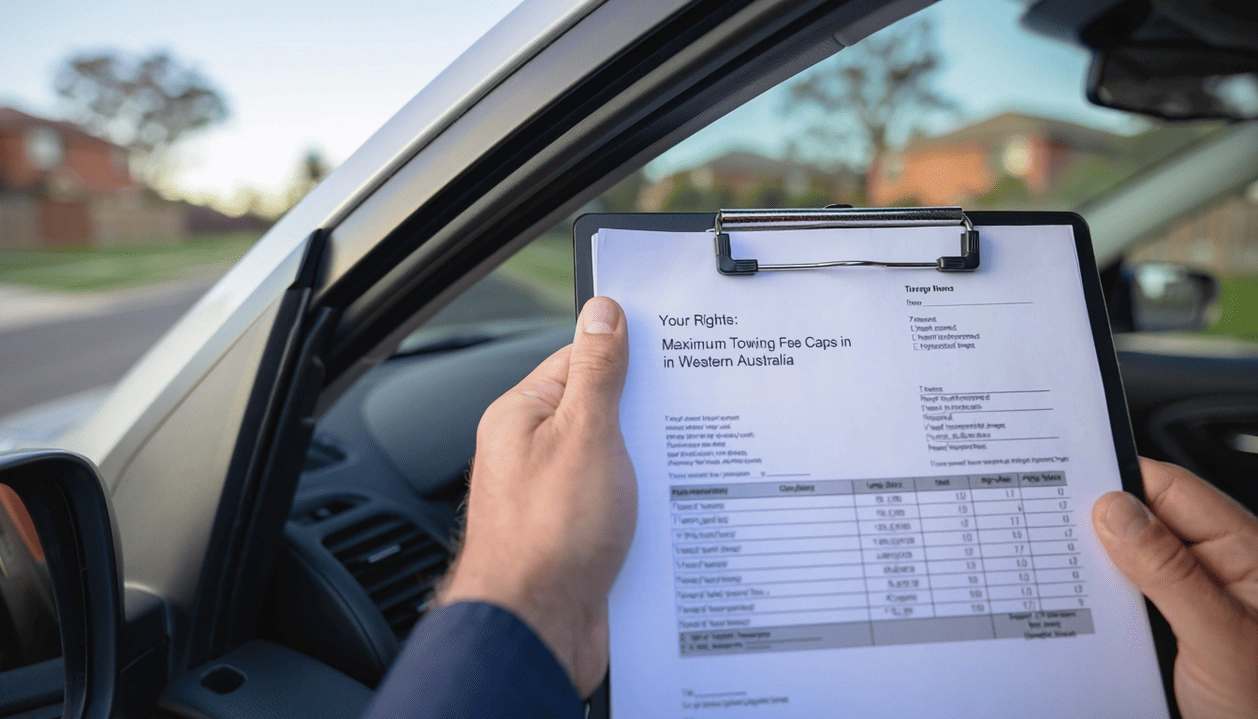
As of 2024, the maximum towing fee for a standard vehicle (under 4.5 tonnes GVM) within the Perth metropolitan area is $258.50 for the first 10 kilometres, then $5.50 per kilometre after that. These figures are set by the Department of Transport and reviewed periodically.
When Fee Caps Apply (and When They Don’t)
This is where it gets crucial. The fee caps don’t apply to every towing situation – only specific scenarios trigger the protection.
Fee Caps DO Apply When
Police direct a tow truck to remove your vehicle from an accident scene. Your vehicle is causing a traffic hazard and authorities arrange removal. You’re involved in an accident and the attending tow truck is on the official police rotation list. Your insurance company has a contract with a towing provider that references regulated rates.
Fee Caps DON’T Apply When
You call a towing company yourself for a breakdown (this is a private arrangement). You request roadside assistance for a non-accident issue. You need specialised towing for machinery, boats, or containers. You arrange prestige car towing or heavy machinery towing privately.
Think of it this way: if you’re making the choice and calling the company yourself, you’re entering a commercial agreement. The fee caps protect you when you don’t have a choice – when authorities make the decision for you.
Breaking Down the Actual Costs
Let’s make this concrete. Say you’re in an accident on Great Eastern Highway, about 15 kilometres from the tow yard. Police attend and call a truck from the rotation list.
Your maximum charge would be:
- Base fee (first 10km): $258.50
- Additional 5km at $5.50/km: $27.50
- Total maximum: $286.00
That’s it. The operator cannot charge you more than $286 for that tow, regardless of the time of day or day of the week. If they try to add “after-hours fees” or “weekend surcharges” on top of the regulated towing fee, they’re breaking the law.
But here’s the catch – and it’s a big one.
What’s NOT Included in the Fee Cap
The maximum towing fee covers getting your vehicle from Point A to Point B. It doesn’t cover everything else that might happen after that.
Additional charges that ARE permitted include:
- Storage fees: Typically $15-25 per day once your vehicle is in the yard
- After-hours release fees: If you want your car back at midnight, expect $50-100
- Administration fees: Some operators charge $30-50 for paperwork
- Salvage or recovery work: If your vehicle is down an embankment or needs winching, that’s extra
- Specialist equipment: Heavy machinery or difficult access scenarios
These additional charges aren’t capped by the same regulations. This is where bills can balloon quickly if you’re not careful. A $286 tow can become a $500+ total if your car sits in storage for a week and you need after-hours access.
Our advice? Get your vehicle out of storage as quickly as possible. Every day it sits there costs you money.
Your Rights When Dealing with Tow Truck Operators
You have specific legal protections when your vehicle is towed under the regulated system. These aren’t courtesies – they’re requirements.
Tow Truck Operators MUST
Display their licence number clearly on the vehicle. Provide you with a written receipt showing the pickup location, destination, distance, and fee charged. Release your personal belongings from the vehicle at no charge (medications, baby seats, wallets, etc.). Allow you to inspect the vehicle before signing any release forms. Not hold your vehicle hostage for payment disputes (though they can retain it for unpaid storage).
You Have the Right to
Request proof of their authority to tow (police job number, insurance authorisation). Refuse additional services you didn’t request (like windscreen covers or cleaning). Challenge fees you believe exceed the legal maximum. Report operators who violate regulations to the Department of Transport.
If an operator refuses to provide a written receipt or won’t show you their licence, that’s a red flag. Legitimate operators expect these questions and answer them without hesitation.
What to Do If You’re Overcharged
You’ve checked your receipt and the maths doesn’t add up. The operator charged $450 for a 12-kilometre tow when the cap says it should be around $270. What now?
Step 1: Document Everything Immediately
Take photos of the receipt. Note the exact pickup and drop-off locations. Record the date, time, and any conversations with the operator. Keep copies of all paperwork.
Step 2: Raise It With the Operator First
Sometimes it’s a genuine mistake. Call the company’s office (not the driver) and explain the discrepancy. Reference the specific regulation and the maximum fee. Many operators will correct legitimate errors without fuss.
Step 3: Lodge a Formal Complaint
If the operator won’t budge, contact the Department of Transport’s Tow Truck Directorate. They investigate breaches of the Tow Truck Act and can issue fines or suspend licences.
Step 4: Consider Your Legal Options
For significant overcharges (hundreds of dollars), you can pursue the matter through the Magistrates Court small claims division. You’ll need your documentation and evidence of the regulated maximum fee.
We’ve seen operators refund overcharges once a formal complaint is lodged. The penalties for breaching fee caps are steep enough that most companies won’t risk their licence over a disputed $200.
How Private Towing Works Differently
When you call All Out Towing directly for a breakdown, you’re entering a private commercial arrangement. The regulated towing fee caps don’t apply – instead, you’re quoted a price based on distance, vehicle type, and service complexity.
This isn’t a loophole or a way to overcharge. It’s how the industry works for non-emergency, customer-initiated services. Here’s why the pricing differs:
Private towing considers factors like:
- Vehicle type and weight: A truck towing job requires different equipment than a sedan
- Method required: Tilt tray services cost more than wheel-lift towing because of specialised equipment
- Urgency and timing: 24-hour emergency towing in Perth at 3am costs more than a scheduled midday tow
- Distance and destination: Moving a vehicle 60 kilometres to a specific mechanic costs more than 10km to the nearest yard
Reputable operators provide upfront quotes before dispatching. You know the price before the truck arrives. If you don’t like the quote, you can call another company.
The difference? Choice. When police arrange the tow, you have no choice – hence the fee protection. When you make the call, you’re free to shop around and compare prices.
Insurance, RACWA, and How They Affect Your Costs
Most comprehensive car insurance policies include towing coverage, typically up to $100-200. If your policy covers towing and you’re in an accident, your insurer will often arrange the tow directly.
Insurance Arrangements
When insurers arrange towing, they usually have contracts with specific operators. These contracts may reference the regulated towing fee caps or negotiate their own rates. Either way, you’re unlikely to pay out of pocket beyond your excess.
RACWA Membership
RACWA membership is different. If you’re a member and call for roadside assistance or towing, RACWA covers the cost up to certain limits (typically 100km within the metro area). You pay nothing beyond your annual membership fee.
The Critical Point
Here’s the key: if you have insurance or RACWA coverage, use it. Don’t agree to pay a tow truck operator directly if your policy covers the service. Once you’ve paid cash, recovering that money from your insurer becomes complicated.
If you’re in an accident and unsure whether your insurance covers towing, call your insurer before signing anything with the tow truck operator. Five minutes on the phone can save you hundreds of dollars.
Why Transparent Pricing Matters to Us
We operate in an industry that’s earned some scepticism over the years. Stories of $800 tows for 15-kilometre trips or operators who “happen to arrive” at accident scenes without being called have damaged trust.
That’s not how we work. When you call our 24-hour emergency towing line, you get a clear quote before we dispatch. If it’s a regulated tow (police-directed accident towing), we charge the legal maximum and not a cent more. If it’s a private arrangement, we explain exactly what you’re paying for and why.
Our car towing services are priced based on real costs – fuel, equipment, labour, and expertise. We don’t inflate prices because you’re stranded or stressed. We don’t add mysterious “administration fees” or charge $100 to release your vehicle on a Sunday.
Transparency isn’t just good ethics – it’s good business. Drivers remember who treated them fairly when they were vulnerable. They remember who explained their rights instead of exploiting their lack of knowledge.
What This Means for You Right Now
If you’re reading this before you need a tow, you’re ahead of the game. Save this information. Screenshot the fee caps. Know that if police arrange your tow, there’s a legal maximum.
If you’re reading this because you’ve already been towed and the bill seems wrong, you have options. Check the receipt against the regulated fees. If it doesn’t match, don’t pay until you’ve asked questions.
And if you need a tow right now – whether it’s accident towing in Perth after a collision or moving a piece of equipment with our heavy machinery towing service – you deserve to know exactly what you’re paying and why.
Understanding Your Protections Makes All the Difference
The towing industry in Western Australia is regulated for a reason. When you’re stranded on the side of the road or dealing with the aftermath of an accident, you’re not in a position to negotiate or shop around. The fee caps exist to protect you in those moments.
But those protections only work if you know they exist. Too many drivers pay whatever they’re told because they assume the operator knows best or because they’re too stressed to question it. That’s understandable – but it’s also why some operators get away with overcharging.
You don’t need to become an expert in towing regulations. You just need to know the basics: regulated tows have maximum fees, you’re entitled to a written receipt, and you can challenge charges that don’t add up.
Whether you’re dealing with a police-directed tow or you’ve called All Out Towing directly for help, you deserve fair pricing and honest communication. That’s not just your right – it’s the standard every operator should meet.
If you’re ever unsure about a towing charge or need clarification on what you should be paying, contact us and we’ll walk you through it. We’d rather answer your questions and lose a job than charge you something you shouldn’t be paying. That’s not just good customer service – it’s how the industry should work.
Call 0418 959 216 for a transparent quote that respects your budget and protects your vehicle.