Does your load exceed WA’s standard access limits? Oversized-load authorisation may be required when a vehicle or combination exceeds standard access limits. The required permit or order sets out where and under what conditions the vehicle can travel.
It’s understandable to feel unsure when the load, route and delivery schedule all need to line up. In Western Australia, Main Roads WA manages Restricted Access Vehicle permits, while some movements also require separate access authorisations or assessments. The requirements depend on the load’s dimensions and mass, the vehicle combination and the route.
This guide explains when authorisation is needed, who issues it and how single-trip permits, route assessments and access conditions fit together. You’ll also see where professional heavy transport can help make a complex move safer and more organised.
Key Takeaways
- A vehicle or combination exceeding 2.5 m wide, 4.3 m high, 19 m long or 42.5 t gross mass generally falls under WA’s Restricted Access Vehicle rules.
- Traffic Escort Wardens are required when the vehicle and load exceed 5.5 m in width or 40 m in length.
- Main Roads WA manages WA Restricted Access Vehicle permits; some routes and loads also need separate network authorisations.
- A single-trip permit covers one movement, while the load’s dimensions, mass and route determine the permit type and operating conditions.
- Route assessments can affect the journey plan, including where powerline clearances or restricted bridges need consideration.
When is a Traffic Escort Warden required in WA?
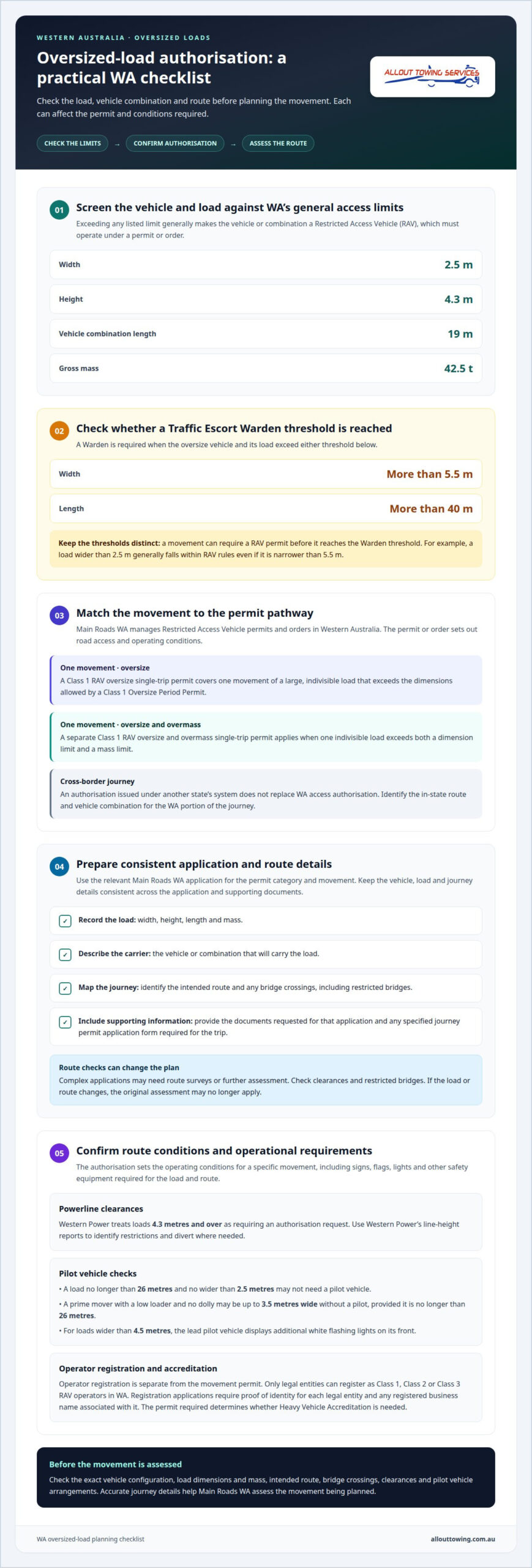
Western Australia’s general access limits are 2.5 m wide, 4.3 m high, 19 m long for a vehicle combination, and 42.5 t gross mass. Exceeding any listed limit generally makes a vehicle or combination a Restricted Access Vehicle (RAV), which must operate under a permit or order.
A Traffic Escort Warden is required when the oversize vehicle and its load exceed 5.5 m in width or 40 m in length. These thresholds are different from the general RAV limits: a combination can need a permit well before it reaches the Warden threshold. For example, a load wider than 2.5 m generally falls within RAV rules, even if it is narrower than 5.5 m.
Main Roads WA manages Restricted Access Vehicle permits and orders. The permit category depends on the movement and the load. A Class 1 RAV oversize single-trip permit covers one movement of a large, indivisible load that exceeds the dimensions allowed by a Class 1 Oversize Period Permit. A separate Class 1 RAV oversize and overmass single-trip permit applies when one indivisible load exceeds both a dimension and a mass limit.
Start by identifying the vehicle, load and intended journey. Use the relevant Main Roads WA application for the permit category and movement, including the specified journey permit application form if the trip requires one. Keep the route and load details consistent across the application and supporting documents. A mismatch, such as describing a different vehicle combination, can make the proposed movement harder to assess.
- Set out the load’s width, height, length and mass.
- Describe the vehicle or combination that will carry it.
- Identify the intended route and any bridge crossings.
- Include supporting information requested for that application.
Operator registration is a separate consideration from the movement permit. Only legal entities can register as Class 1, Class 2 or Class 3 RAV operators in WA. Registration applications require proof of identity for each legal entity and any registered business name associated with it. The permit required determines whether Heavy Vehicle Accreditation is needed.
Complex applications may involve route surveys or further assessment, particularly if the route raises clearance or access concerns. Check whether it includes a restricted bridge, and describe the intended movement clearly. If the load or route changes, the original assessment may no longer apply. Provide Main Roads WA with accurate journey details so its permit decision addresses the movement you are planning.
Who issues oversize permits in Western Australia?
The National Heavy Vehicle Regulator (NHVR) regulates heavy vehicles over 4.5 tonnes GVM in most Australian states and territories, but Western Australia and the Northern Territory sit outside that system. In WA, Main Roads Western Australia (Main Roads WA) manages Restricted Access Vehicle permits and orders. The permit or order sets out the road access and operating conditions that apply to the vehicle’s movement.
WA’s system matters when planning heavy haulage across state borders. A permit issued under another state’s system does not replace WA access authorisation. For a journey entering WA, identify the in-state route and vehicle combination before organising the movement. Main Roads WA requirements apply to the WA portion, while other jurisdictions have their own systems.
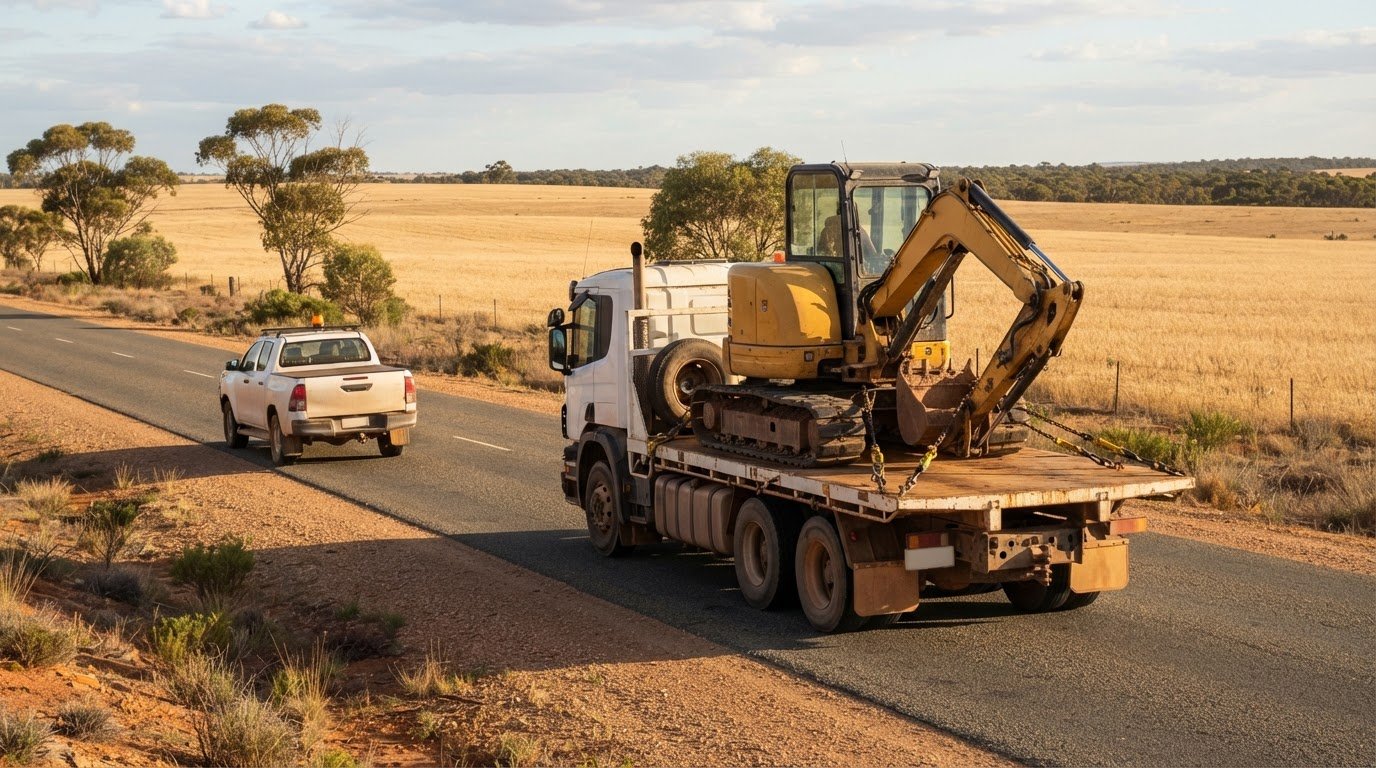
Permit requirements depend on the vehicle and load, not just the cargo description. For example, a prime mover and low loader carrying construction equipment must be assessed as a combination. Its dimensions and weight affect whether restricted access approval is required, and the route can affect where it may travel. The permit type also determines whether Heavy Vehicle Accreditation is needed.
Pilot vehicle requirements are a separate operational consideration. A load no longer than 26 metres and no wider than 2.5 metres may not need a pilot vehicle. In WA, a prime mover with a low loader and no dolly may be up to 3.5 metres wide without a pilot, provided it is no longer than 26 metres. For loads wider than 4.5 metres, the lead pilot vehicle displays additional white flashing lights on its front. These rules show why the exact combination and load dimensions matter.
Consider Special Purpose Vehicles (SPVs) in the same practical way: the vehicle’s name alone does not establish which roads it can use. Record its type, configuration, dimensions and mass, then match those details to the required permit or order. An SPV used for construction work may have different access requirements from a prime mover carrying a machine on a low loader.
- Identify the vehicle or combination that will travel.
- Record the load dimensions and the vehicle’s mass details.
- Map the WA route, including any restricted access roads.
- Determine the required permit or order through Main Roads WA.
- Include any pilot vehicle arrangements required for that movement.
For heavy haulage, align the permit decision with the transport plan. The vehicle configuration, load details and intended route all shape the movement, so accurate information helps clarify which access arrangements apply. For those preparing to operate heavy vehicle combinations, taking truck driving lessons perth helps build the practical driving and road compliance skills needed across Western Australia.
Authorisation assessment and special conditions
The authorisation sets the operating conditions for a specific movement. It also identifies the signs, flags, lights and other safety equipment required for that load and route.
Assessment and Permit Conditions
Assess the load’s height and dimensions against the proposed route before locking in travel arrangements. Western Power treats loads 4.3 metres and over as requiring an authorisation request. Operators must use Western Power’s line-height reports to identify restrictions and divert where needed. A detour can change the route assessment, so record the intended journey accurately.
For movements between Western Power and Horizon Power networks, one inter-district application can be lodged with the network at the origin. Horizon Power applicants must arrange any permissions or escorts required for third-party electricity networks. These are separate from any Main Roads WA permit or order needed for the vehicle’s road access.
Horizon Power’s standard high-load assessment usually takes three business days. Applications involving possible surveys or escorts may take up to 15 business days under its terms. If the load is too high for the intended route, Horizon Power may propose an alternative or survey the requested route. This can affect the planned journey and its operating conditions.
Keep the approved route and load details consistent across network applications. A change in height, route or escort requirements can alter the assessment. For example, a revised detour may involve different line clearances or require further assessment. The permit conditions and network authorisation govern the movement, including the required safety equipment and arrangements.
Authorisation Validity Periods
A Western Power open permit for SWIS or inter-district travel is valid for 6 months. Horizon Power authorisations have shorter validity limits. A high-load authorisation without an escort cannot remain valid for more than six weeks from its authorisation date; an escorted high-load authorisation cannot remain valid for more than one week.
Use the dates and conditions on the issued authorisation to schedule the movement. If the travel date falls outside its validity period, it will not cover the planned trip. Allow time for Horizon Power’s assessment, especially if an escort or route survey may be needed.
For a planned journey, keep the authorisation, approved route and network conditions together with the movement details. This makes it easier to use the correct version if the route or schedule changes. A permit’s validity does not remove the need to follow its operating conditions throughout the authorised movement.
Single-trip oversize and overweight permits
A Class 1 RAV single-trip permit covers one movement, rather than repeated travel under a period permit. In Western Australia, the permit type depends on whether the large indivisible load exceeds a dimension limit, a mass limit, or both. This distinction helps match the application to the load and the movement being planned.
A Class 1 RAV oversize single-trip permit is for one movement of a large indivisible load exceeding the dimensions covered by the Class 1 Oversize Period Permit. It applies where the load is oversize, but the permit category is not the combined oversize and overmass type. Treat that as the permit fee, not the transport charge.
Use a Class 1 RAV overmass single-trip permit when a large indivisible load exceeds a mass limit and needs one movement. The distance travelled and the tonnes above the applicable limit therefore affect the permit fee. This category concerns excess mass, rather than a dimension overrun alone.
If the load exceeds both a dimension and a mass limit, the Class 1 RAV oversize and overmass single-trip permit covers one movement. It generally applies outside the parameters of oversize and overmass period permits. The dimension exceedance identifies the oversize element; the excess tonnes and distance determine the stated mass-based fee.
Before applying, distinguish the load’s measured dimensions from the vehicle’s mass details. Describe the indivisible load, the vehicle or combination carrying it, and the intended route. This information helps establish whether the movement is oversize, overmass or both. Changes to the load or vehicle can affect which permit category applies.
- Choose the oversize single-trip category for a dimensional exceedance only.
- Choose the overmass single-trip category when the load exceeds a mass limit.
- Use the combined category when one indivisible load exceeds both limits.
For an overmass calculation, the charge is based on kilometres travelled and tonnes above statutory mass limits. The excess is not the full load mass: the fee applies to the amount over those limits.
Plan the application around the actual movement, including its origin, destination and route. Infrastructure and network access can affect where a vehicle may travel, while the permit category addresses the load’s dimensions and mass. A single-trip permit authorises one movement only and does not replace any separate route or network authorisation required for that journey.
Western Australia permit and access rules
In Western Australia, a Restricted Access Vehicle (RAV) must operate under the required permit or order. Travelling without that authority does not meet WA access requirements. The risk is proceeding without approved access for the route, including any restricted bridge or power-network conditions.
Axle loads can trigger access requirements even when the overall vehicle configuration seems straightforward. A rigid vehicle longer than 12.5 m generally needs a permit or order. The listed single-axle thresholds are 9 t for an axle and 6 t for a single steer axle. For a twin steer axle group, the threshold is 10 t without load-sharing suspension or 11 t with load-sharing suspension.
Other axle groups have their own limits: 16.5 t for a tandem axle group and 20 t for a tri or quad axle group. Consider the suspension type and each axle group’s load when assessing the vehicle. An overall mass figure alone does not show whether a particular axle or group exceeds its applicable threshold.
Operator registration is a separate requirement. Only legal entities can register as Class 1, Class 2 or Class 3 RAV operators in WA. Applicants must provide proof of identity for each legal entity and any registered business name associated with it. The permit required determines whether Heavy Vehicle Accreditation is needed.
Route-specific approvals may also apply. Western Power treats loads 4.3 m and over as oversize loads requiring an authorisation request. Horizon Power applicants must obtain other approvals needed for the movement, including a Main Roads WA RAV permit or order. Main Roads WA manages high wide load corridors, which require separate authorisation.
Consider restricted bridges separately when planning the route. If one movement needs to cross a bridge specified as restricted, you can apply for a single-trip bridge crossing permit. The issued permit sets the operating conditions for that crossing.
- Assess axle and axle-group loads, including suspension type.
- Establish the operator’s RAV registration and required permit or order.
- Identify network, corridor and restricted-bridge approvals for the route.
Keep each approval matched to the movement it covers. A bridge crossing permit or power-network authorisation does not replace a separate Main Roads WA permit or order when required. For help arranging the transport side of a heavy-load movement, discuss your transport requirements.
Travelling without the required permit or order does not meet WA access requirements and risks proceeding without approved access for the route, including restricted bridges or power-network conditions.
Allout Towing
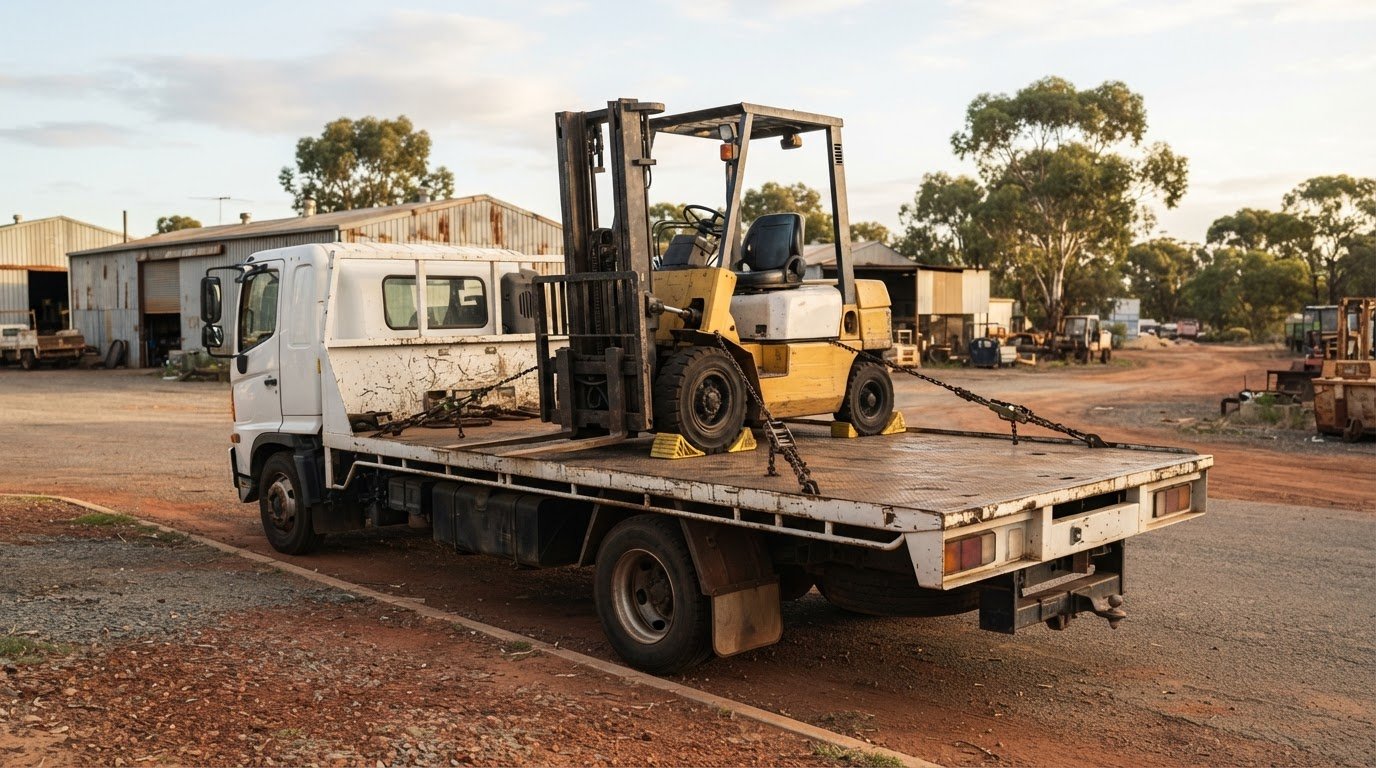
Once the required permits and route authorisations are in place, Allout Towing can transport heavy loads. For large machinery or freight, its Super tilt heavy transport and Container Transport services can handle the transport task alongside the planning covered in this guide.
Before arranging a move, have the load details, origin, destination and approved route ready. These details define the transport job and help keep it aligned with the movement authorised for WA roads. Permit approval is separate from the physical transport, so plan both parts of the job.
If you’re organising a heavy-load movement in Western Australia, contact Allout Towing to discuss your transport requirements.
Plan the next move with confidence
Getting oversized load permits in WA right is one part of planning a heavy movement. Next, align the transport plan with the approved route, any utility conditions and the load details submitted for assessment. Keeping these details consistent helps prevent planning around a route or configuration the authorisation does not cover.
Permit decisions sit with the relevant authority or network. Allout Towing can help with the transport side through its Tilt Tray Perth Services and Super tilt heavy transport. If your vehicle also needs towing, Allout Towing offers 24 Hour Car Towing. Share the load type, origin, destination and approved movement details when discussing your transport needs.
For help arranging transport around your planned movement, contact Allout Towing about your load. A clear plan is a practical place to start, and you can take the next step when you’re ready.
Frequently Asked Questions
Do you require a permit?
Usually, yes, if the vehicle or combination exceeds WA’s general access limits or another Restricted Access Vehicle threshold. These limits cover width, height, combination length and gross mass, as well as rigid vehicle length and axle-group loads. A permit or order sets the access conditions for the movement. Check the loaded vehicle combination and its axle weights, not just the cargo dimensions, when determining which approval applies.
What Does an Oversize Transport Job Involve?
An oversize transport job coordinates the load, vehicle, route and approvals for a planned movement. Moving a machine, for example, may involve matching it to a suitable trailer, recording its dimensions, planning around clearance or bridge restrictions, and arranging any required pilot or utility authorisations. Physical transport and the permit application are separate parts of the job, so both must match the same load and journey details.
What Qualifies as an Oversized Load in Australia?
Across Australia, a load wider than 2.5 m is typically considered overwidth, while 4.3 m is the stated general maximum vehicle height. A standard semi-trailer may be up to 19 m long, and 42.5 t is the general-access carrying limit for a typical rigid vehicle. These are general thresholds, not a substitute for state-specific rules. Western Australia applies its own Restricted Access Vehicle permit system and access conditions.
When is a pilot vehicle required in WA?
A load no longer than 26 m and no wider than 2.5 m may not need a pilot vehicle. A prime mover with a low loader and no dolly may be up to 3.5 m wide without a pilot, provided it stays within the stated length limit. A Traffic Escort Warden is a separate requirement: one is needed when the vehicle and load exceed 5.5 m wide or 40 m long.
What counts as an oversized or over-dimension load in Western Australia?
In WA, the loaded vehicle or combination is assessed against dimension limits, including width, height and length. Exceeding a limit can make it a Restricted Access Vehicle that must operate under a permit or order. Over-dimension refers to exceeding a dimensional limit; overmass means exceeding statutory mass limits. A load can exceed dimensions, mass or both, and the permit category depends on which limits the movement exceeds.
When is an oversize vehicle or load permit required in WA?
A permit or order is generally required when a vehicle or combination exceeds a listed WA access limit. Other triggers include a rigid vehicle longer than 12.5 m, or an axle or axle group carrying more than its applicable mass threshold. Operator registration is also required for Restricted Access Vehicle operations. The required permit determines whether Heavy Vehicle Accreditation is needed, so consider vehicle configuration and operator status alongside load dimensions.
How do I apply for an oversize or overmass vehicle permit in Western Australia?
For oversized load permits in WA, identify the correct Restricted Access Vehicle category and movement type, then complete the corresponding Main Roads WA application. Specify the vehicle combination, load dimensions and mass, origin, destination and intended route. Include the supporting details required for the application, such as operator registration information where relevant. If the journey crosses a power network or restricted bridge, account for those separate authorisations in the movement plan.
What are the WA permit fees, processing times and validity periods?
Horizon Power’s standard assessment usually takes three business days, or up to 15 when escorts or surveys may be needed. Western Power open permits last 6 months; Horizon authorisations have shorter limits.