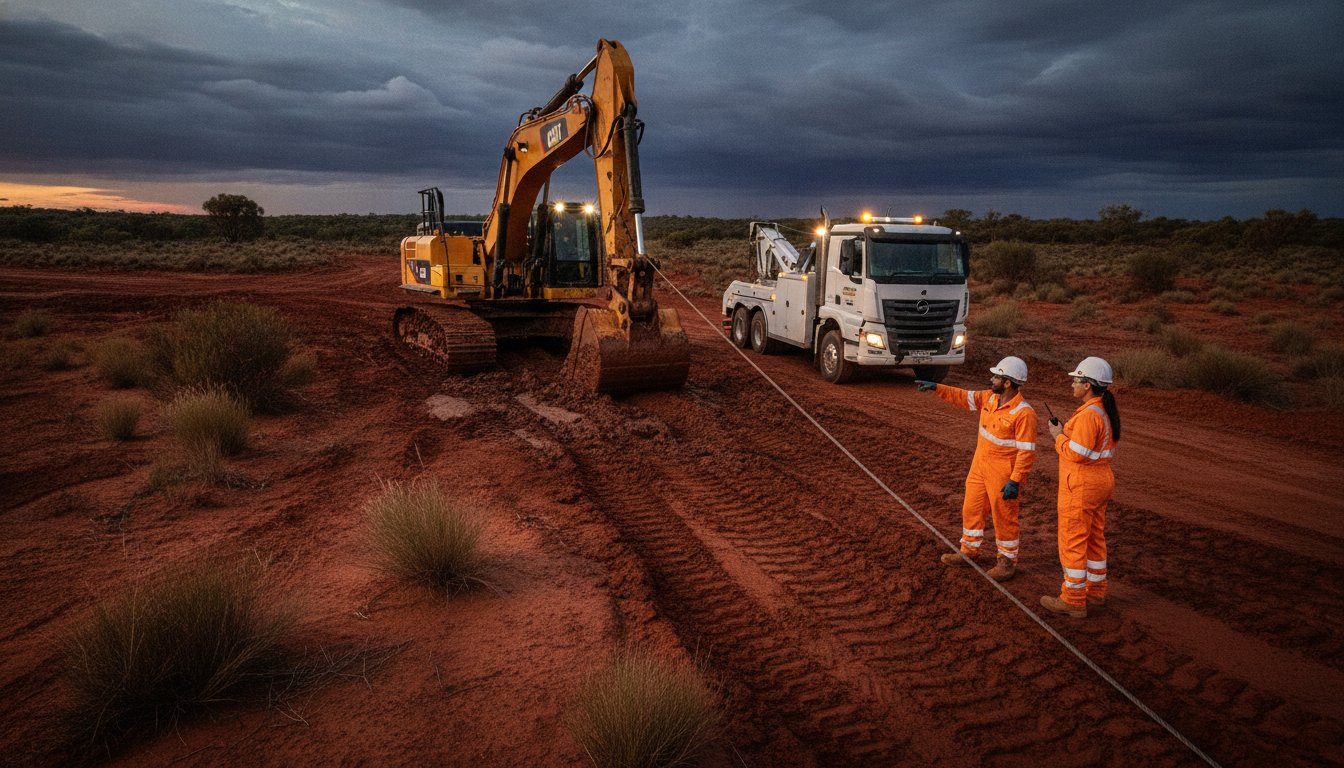
Imagine it’s 4:00 AM on a remote Pilbara site and your multi-million dollar excavator is bogged to the axles with a storm front rolling in. You know that every hour that machine sits idle, the project costs spiral and the risk of structural damage from a botched retrieval grows. It’s a high-pressure situation where a single wrong move with a winch cable can turn a temporary setback into a total write-off. Dealing with machinery recovery WA requires more than just brute force; it demands a calm, technical approach to ensure the safety of your crew and your equipment.
We understand the stress of equipment downtime and the pressure to meet strict Western Australian environmental and safety protocols. This guide will help you master the logistics of heavy equipment retrieval with our professional approach to machinery recovery across the state. We’ll preview the essential technical assessments, the specific advantages of using a specialised super tilt fleet, and how to navigate the 2026 regulatory landscape. By following these industry-standard steps, you can ensure a damage-free retrieval and a quick return to operational status without the guesswork.
Key Takeaways
- Learn how Western Australia’s unique soil conditions, from soft coastal sands to heavy regional clays, impact the safety and success of your equipment retrieval.
- Discover the critical technical differences between recovering bogged assets and managing machinery with compromised steering or braking systems.
- Understand why a specialised Super Tilt fleet and heavy-duty winching are essential for protecting high-value industrial equipment during complex transport.
- Master the immediate steps to secure your worksite and document the situation to streamline the machinery recovery WA process and satisfy insurance requirements.
- Gain peace of mind by knowing how to choose a seasoned, family-owned provider that understands the urgency of both Perth metro and regional country towing.
Understanding Machinery Recovery in Western Australia
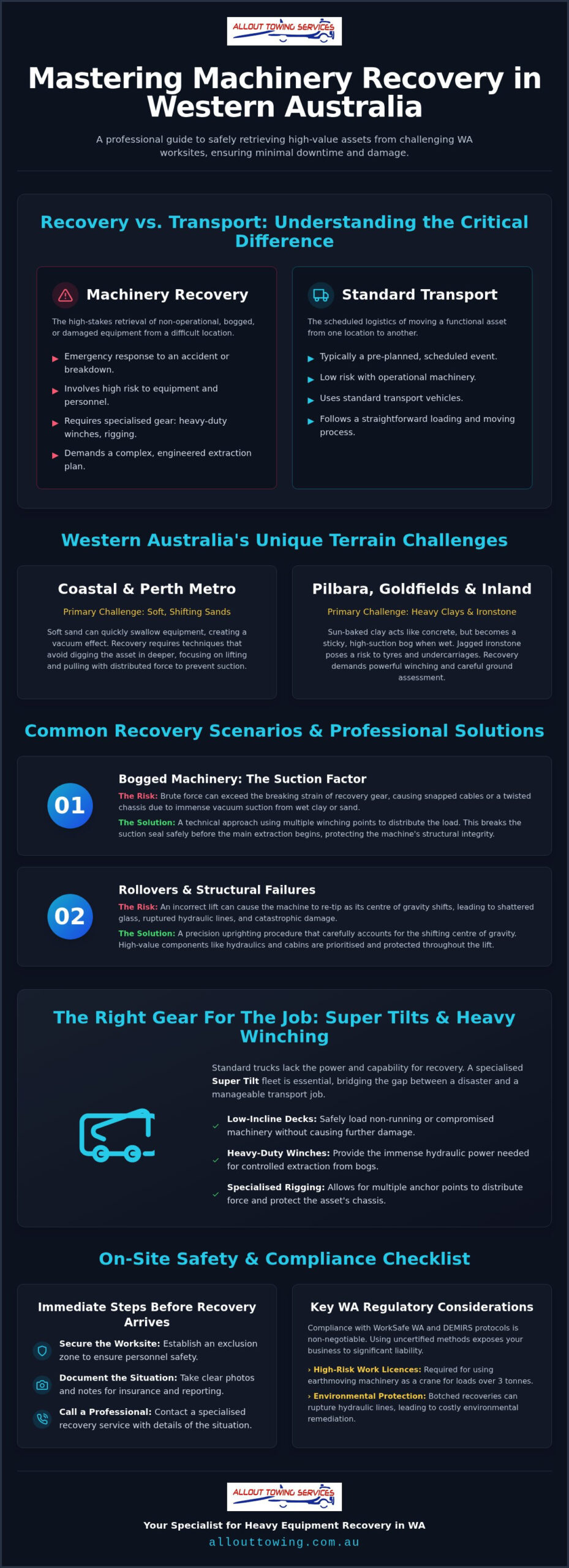
Machinery recovery WA is a specialised field that goes far beyond simple logistics. While transport involves moving a functional asset from point A to point B, recovery is the retrieval of equipment that has become non-operational or stuck in a difficult location. It’s a high-stakes engineering puzzle where the goal is to extract the machinery without causing secondary damage to the chassis, hydraulics, or the surrounding environment. We view every job as a unique challenge that requires a tailored plan before a single cable is tensioned.
The vast geography of Western Australia presents specific challenges that generic providers often overlook. In the Perth metro area and along the coast, we often deal with soft, shifting sands that can swallow a forklift or a small crane in minutes. Move further inland to the Pilbara or Goldfields, and you’re facing heavy, sun-baked clays or jagged ironstone that require entirely different vehicle recovery techniques. Local expertise is vital because a recovery plan that works on a stable construction site in Osborne Park will likely fail on a remote, rain-soaked mine site in the Kimberley. You need a team that understands regional site access and the specific grit of WA soil.
Recovery vs. Transport: Knowing the Difference
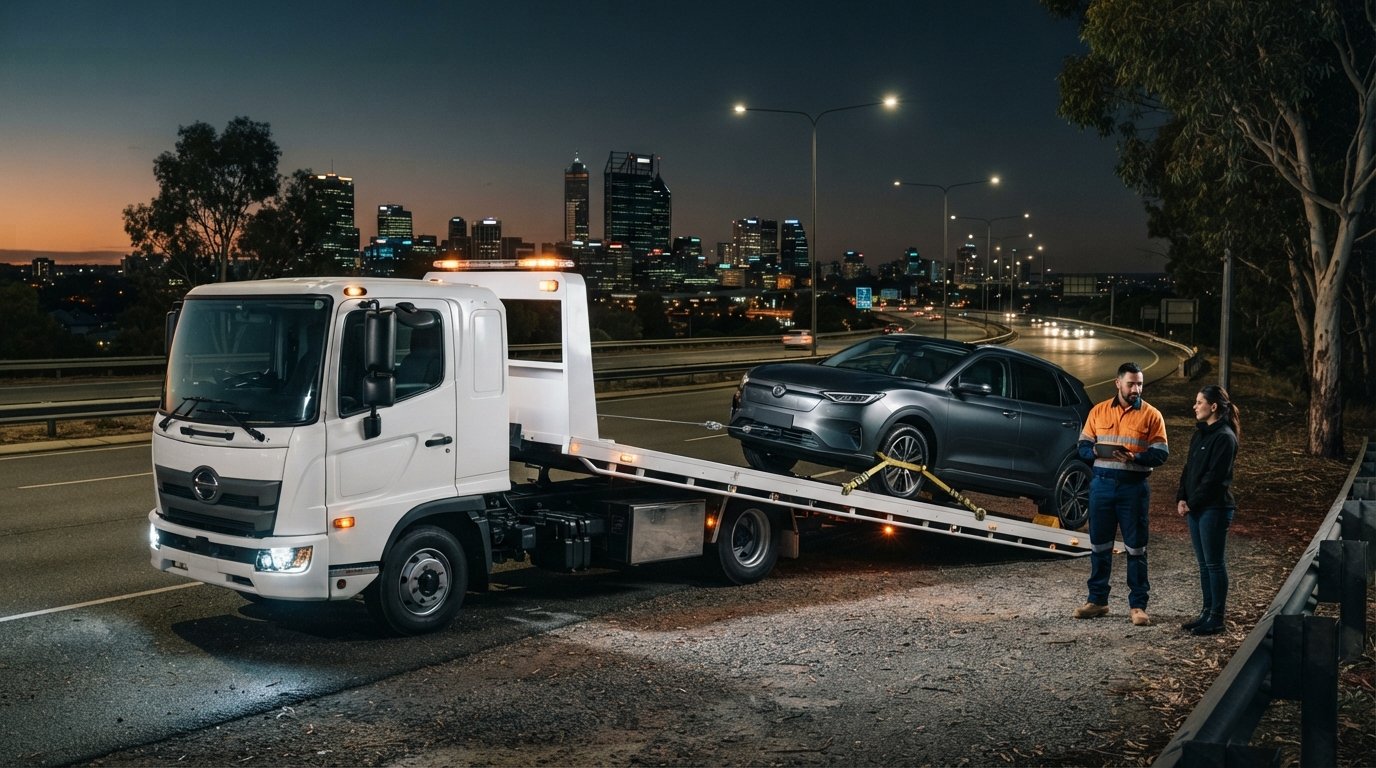
The main difference lies in the level of risk and the equipment required. Transport is usually a scheduled event, whereas recovery is often an emergency response to a breakdown or an accident. Standard transport trucks lack the heavy-duty winches and specialised rigging gear needed to pull a 20-tonne machine out of a bog. Professional super tilt heavy transport WA services bridge this gap. These vehicles provide the hydraulic power and low-incline decks necessary to load non-running equipment safely, turning a potential disaster into a manageable transport job.
The Legal and Safety Landscape in WA
Assessing the Damage: Common Recovery Scenarios for WA Worksites
Every WA worksite presents a different set of recovery hurdles. From the silt of the Swan River to the red dust of the North West, equipment failure is rarely straightforward. Understanding the specific scenario is the first step in a successful machinery recovery WA operation. Whether your gear is stuck in the mud or has suffered a catastrophic mechanical failure, a technical assessment is required before any recovery gear is attached.
Bogged Machinery: The Suction Factor
The physics of a bogged 30-tonne excavator are brutal. When a machine sinks into wet clay or water-saturated sand, a vacuum effect creates immense suction around the tracks or tyres. If an amateur tries to yank the machine out with brute force, the resistance can easily exceed the breaking strain of the recovery gear. We often see snapped cables or twisted chassis rails from poorly executed attempts. A professional recovery uses multiple winching points to distribute the load and break the suction seal before the main pull begins. This controlled approach protects the machine’s structural integrity.
Rollovers and Structural Failures
Uprighting a rolled piece of plant is a precision task. You have to account for the shifting centre of gravity as the machine leaves the ground. One wrong move and the machine flops back down, shattering glass and rupturing hydraulic lines. Our team prioritises protecting these high-value components throughout the lift. While Western Australia operates under its own specific state rules, many transport standards align with the broader Heavy Vehicle National Law followed elsewhere in Australia; this ensures safety remains the absolute priority. Once the machine is upright, you will likely need construction equipment transport Perth to move the damaged asset to a workshop for assessment.
Mechanical failures create a different set of problems. If the steering is locked or the brakes are seized, you cannot simply tow the unit. It requires a Super Tilt that can winch the dead weight directly onto the deck without dragging it across the ground. In Perth’s increasingly dense urban construction sites, space is a luxury. Confined space retrieval requires compact yet powerful recovery vehicles that can manoeuvre between buildings and shoring without causing site damage. If you are facing a complex site extraction, our accident and recovery team can provide a technical assessment to prevent further asset damage.
The Right Gear for the Job: Super Tilts and Heavy Winching
Successful machinery recovery WA relies on more than just a big truck; it requires a specialised fleet designed for the extreme weights of industrial plant. Standard tilt trays are excellent for cars or light commercials, but they lack the structural reinforcement and hydraulic power needed for heavy assets. When you’re dealing with a bogged roller or a dead excavator, the machinery’s weight and the suction of the ground often exceed the safe working limits of basic towing equipment. Using the wrong gear doesn’t just risk the machine; it creates a significant safety hazard for everyone on site. The same principle applies when arranging tilt tray container transport Perth wide, where matching the right equipment to the load is essential for a safe and damage-free delivery.
Why Super Tilts are Essential for WA Recovery
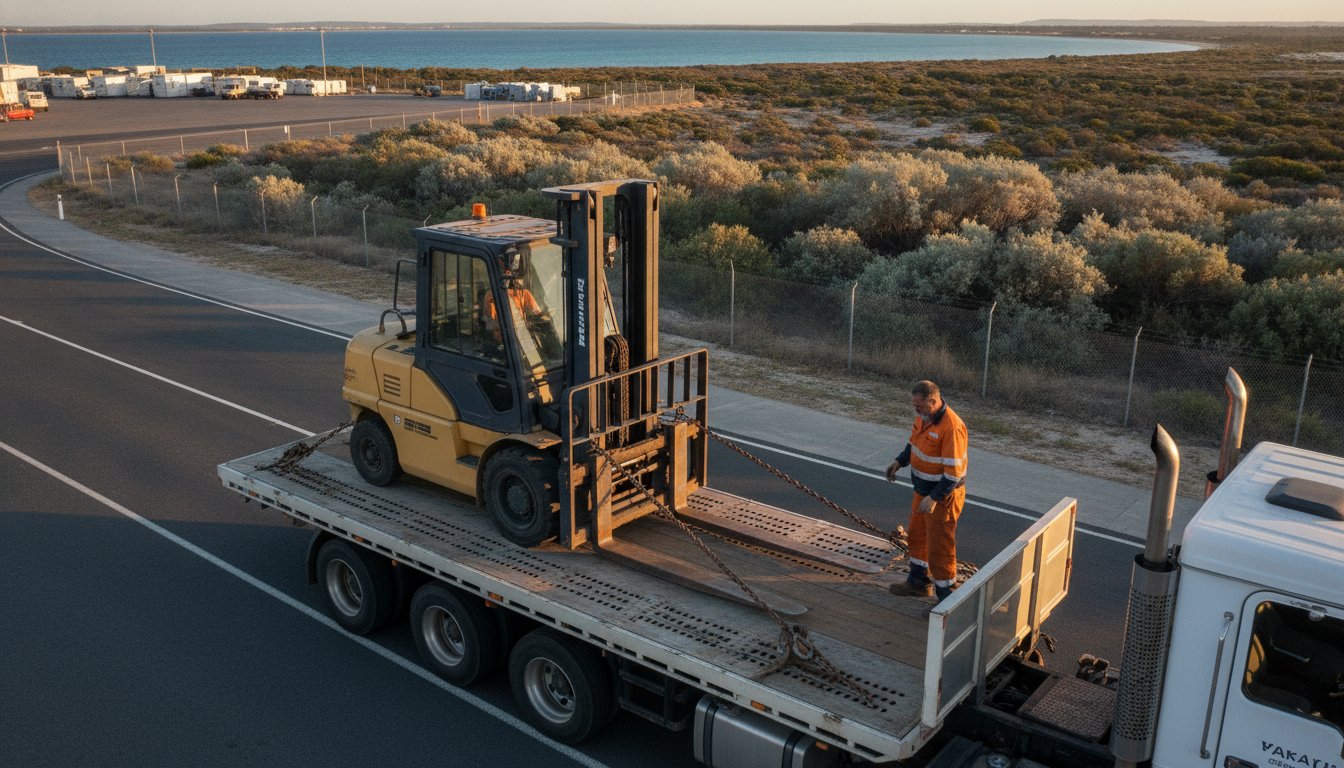
A Super Tilt is the workhorse of the recovery industry. These units feature extended deck lengths and a carrying capacity that typically reaches up to 18-20 tonnes, making them the only choice for oversized loads. The real advantage is in the hydraulic flexibility. Unlike a standard tray, a Super Tilt can adjust its angle to create a much shallower loading ramp. This low-angle approach is critical for equipment with limited ground clearance, such as paving machines or low-slung plant. It prevents the underside of the machinery from scraping or catching during the winching process. For smaller but dense assets that still require heavy-duty handling, our Perth forklift transport guide explains how to manage these compact weights safely.
Winching and Rigging Equipment
Power is nothing without control. A professional recovery unit is equipped with heavy-duty winches often rated at 20,000lb or higher. In a recovery scenario, we rarely rely on a simple direct pull. We use snatch blocks to double or triple the pulling power while reducing the strain on the winch motor. This mechanical advantage is vital when extracting a machine from deep mud or clay. We’ve moved away from heavy steel chains in many cases, opting for high-tensile cables and “soft shackles.” These synthetic shackles are just as strong as steel but significantly safer if a component fails under tension.
The operator’s experience is the most important tool in the kit. Knowing exactly where to place anchor points on a machine’s chassis ensures the force is applied to the strongest structural members. This prevents frame distortion and protects sensitive hydraulic components. For oversized or wide-load machinery common in WA’s mining and construction sectors, we also deploy specialised trailers. These provide the stability required for long-distance transport once the initial recovery is complete, ensuring your asset arrives at the workshop in the same condition it left the site. For operations that regularly move heavy plant between Perth and remote mine sites, understanding the latest mining equipment transport Perth regulations and haulage trends is essential for keeping your project on schedule.
Your Machinery Recovery Template: Steps to Take Before the Tow Arrives
Step 1: Secure the Site. Your first priority is preventing further movement. If a machine is bogged on a slope, use blocks or secondary anchors to stop it from sliding further. Clear all non-essential personnel from the area. Step 2: Document the Situation. Use your phone to take high-resolution photos from at least four different angles. We need to see the depth of the bog, the angle of a rollover, and any visible damage. This documentation is vital for both our technical planning and your future insurance claims.
Step 3: Identify the Asset. Note the exact make and model. We need to know the estimated weight and whether the engine is still operational. A “dead” machine requires a different winching strategy than one that can assist with its own tracks. Step 4: Check Access Routes. Look up for overhead powerlines and down for soft entry points. If our heavy recovery truck cannot get within winching distance because of a narrow gate or a sandy track, we need to know before we dispatch. Step 5: Provide Clear Location Data. In remote WA, “near the back shed” isn’t enough. Use GPS coordinates or a What3Words address to ensure we find you without delay. To maintain reliable communication in these blackspots, you can check out Telco Antennas for specialised mobile signal boosters.
When you call, be ready to describe the ground conditions in detail. Tell us if it’s limestone, swampy mud, or coastal sand. We also need to know if the machinery can be put into “neutral” or “tow mode.” If there are environmental hazards like leaking hydraulic fluid or split fuel tanks, tell us immediately so we can bring the appropriate spill kits. Having this info ready allows us to provide a more accurate response time and the right equipment for the job.
Safety Checklist for Site Personnel
Establish a strict “no-go zone” around the asset. Recovery cables sit under immense tension. A snap can be fatal. Ensure you have a site induction ready for our driver so they can get to work safely and legally. If the recovery is happening near a public road in Perth, you may need to coordinate with local traffic management to ensure our trucks have the space to operate. For reliable support during these high-stress moments, you can trust our super tilt heavy transport team to handle the logistics from start to finish.
Why Allout Towing is WA’s Specialist for Heavy Equipment Recovery
Choosing a partner for machinery recovery WA comes down to trust and proven performance. At Allout Towing, we’ve spent more than 30 years building a reputation as Western Australia’s dependable protector of heavy industrial assets. As a family-owned and operated business, we don’t treat your emergency as just another transaction. We bring a sense of calm authority to every site, balancing the urgency of the situation with the methodical precision required to extract multi-million dollar equipment safely. We’ve spent decades in the trenches, literally and figuratively, ensuring that local businesses can get back to work without the fear of additional asset damage.
State-Wide Coverage: From Perth to the Pilbara
Our operations aren’t confined to the metropolitan area. We specialise in “country towing” and long-distance recovery, mobilising our fleet to support the mining, construction, and agricultural sectors across the entire state. Whether you have a header stuck in a regional paddock or a dump truck compromised on a remote mine site, we have the situational experience to manage the complex logistics of regional WA. For mining operations that need to move heavy plant between Perth and the Pilbara or Goldfields, our team works closely with clients on mining equipment transport Perth planning to ensure compliance with the latest 2026 heavy haulage regulations. While our super tilts handle the heavy lifting, we also provide 24 hour towing Perth for smaller support vehicles and light plant, ensuring every part of your fleet is covered around the clock, no matter where the breakdown occurs.
The Allout Towing Professional Edge
The difference between a successful retrieval and a costly mistake lies in the operator’s training. Our team consists of seasoned experts who understand the technical nuances of heavy machinery, from hydraulic sensitivities to structural anchor points. We focus on a “damage-free” recovery model, which means we spend the extra time on proper rigging and planning to ensure your asset isn’t stressed during the pull. You won’t deal with offshore call centres or automated queues when you contact us. You speak directly with local WA experts who can dispatch the right gear immediately, providing the reassurance you need during high-stress moments.
Our fleet versatility is a core part of our service. By maintaining everything from standard tilt trays to specialised Super Tilts, we can match the exact weight and dimension requirements of your machinery. This eliminates the risk of using underpowered gear that could compromise site safety. We’ve seen every possible scenario on WA worksites over the last three decades, and we use that history to solve your immediate problem with speed and professional rigour. When the stakes are high and the ground is soft, we provide the safe pair of hands you need to return your equipment to operational status.
Protecting Your Assets with Professional Recovery
Recovering heavy plant in Western Australia isn’t just about pulling harder; it’s a technical operation that requires the right engineering and equipment. By using a specialised Super Tilt fleet and following a clear site assessment template, you can avoid the secondary damage that often occurs during amateur retrieval attempts. Having a reliable partner for machinery recovery WA ensures that even the most difficult site extractions are handled with technical precision and care.
Allout Towing brings over 30 years of WA experience and a calm authority to every high-pressure situation. We offer 24/7 emergency dispatch across the state, providing a reliable safety net for your most valuable assets. If you’re facing a complex equipment failure, don’t risk further damage with uncertified methods. Get a Machinery Recovery Quote from Allout Towing today and let our local experts handle the heavy lifting. Your equipment is in safe hands with our seasoned team.
Frequently Asked Questions
How much does machinery recovery cost in Western Australia?
Can you recover a machine that is completely submerged in mud or water?
Yes, we can recover machinery submerged in deep mud or water using specialised winching and rigging techniques. This process requires breaking the suction seal created by wet ground, which is common in WA’s coastal sands or swampy regional areas. We use heavy-duty winches and snatch blocks to extract the asset slowly and safely. It’s vital to notify us of any environmental risks, such as leaking hydraulic fluids, so we can manage the extraction responsibly.
What information do I need to provide for a machinery recovery quote?
To provide an accurate quote, we need the make, model, and estimated weight of the machine. You should also describe the current status, such as whether the engine runs or if the steering is locked. Ground conditions are critical; tell us if the site is sand, clay, or bitumen. Finally, provide clear location data using GPS coordinates or What3Words, especially for remote regional sites where landmarks are scarce and access is difficult.
Do you provide machinery recovery services in regional WA and the Pilbara?
We provide comprehensive machinery recovery and country towing services across all of regional Western Australia, including the Pilbara and the Goldfields. Our fleet is equipped for long-haul transport and remote site access. We understand the logistics of mobilising heavy gear to distant locations and have 30 years of experience navigating WA’s regional road networks. Whether you’re on a remote mine site or a broadacre farm, we can reach your location 24/7.
Is my equipment insured while it is being recovered and transported?
Yes, your industrial assets are fully insured while they are being recovered and transported by our team. We prioritise the safety of your luxury and heavy equipment, providing a “safe pair of hands” throughout the entire process. Our insurance coverage is designed to give you peace of mind during high-stress moments. We recommend documenting the machinery with photos before we arrive to assist with your own internal records and insurance compliance needs.
How quickly can a recovery truck reach my site in Perth?
We offer 24/7 emergency response and aim to reach Perth metro sites as quickly as possible. Actual arrival times depend on current traffic conditions and the specific location of your worksite. Because we operate a local fleet, we can often dispatch a recovery unit immediately after your call. Our team maintains constant communication during the dispatch process so you know exactly when to expect our arrival and can prepare the site induction accordingly.
Can you upright a rolled excavator or telehandler?
We can upright rolled excavators, telehandlers, and other heavy plant using technical lifting and winching methods. This is a precision task that involves assessing the centre of gravity to prevent the machine from flopping or sustaining further structural damage. Our operators use specialised rigging to protect hydraulic lines and cabs during the uprighting process. Once the machine is stable, we can then arrange machinery recovery WA transport to a workshop for a full damage assessment.
What is the maximum weight capacity for your machinery recovery fleet?
Our machinery recovery fleet includes specialised super tilts with a carrying capacity of up to 18-20 tonnes. For recoveries involving larger or oversized loads, we utilise heavy-duty winching gear and specialised trailers to manage the weight safely. This versatility allows us to handle a wide range of industrial equipment, from compact forklifts to large construction plant. We always match the specific recovery vehicle to the weight of your asset to ensure maximum safety and compliance.