You’ve spent years building it. Countless hours fabricating custom parts, dialling in the suspension geometry, perfecting the paint. Your show car isn’t just transport, it’s a rolling piece of art that represents your vision, your skill, and probably a significant chunk of your budget.
Then comes the moment you need to move it. Maybe it’s heading to a show across town, maybe you’re relocating interstate, or perhaps it’s going to a new owner who appreciates what you’ve built. The thought of loading it onto a truck and watching the front splitter dig into a ramp makes your stomach drop.
We’ve moved hundreds of modified vehicles in Perth, from slammed Skylines that sit millimetres off the ground to custom hot rods with handmade chassis components worth more than some houses. The difference between a safe transport and a damaged show car comes down to equipment, technique, and understanding exactly what you’re dealing with.
Why Standard Towing Methods Don’t Work for Modified Vehicles
The Clearance Problem
Most tow trucks are built for stock vehicles with factory ground clearance. They’re designed around the assumption that a car can handle a 10–15 degree loading angle without the front bumper kissing the ramp.
Your show car doesn’t live in that world.
When you’ve dropped the suspension 100mm, fitted a front splitter that extends 150mm forward, and set the ride height so low you need wooden blocks to get a jack under it, traditional loading methods create immediate problems. It’s like trying to walk up stairs when your legs only bend halfway, the geometry simply doesn’t work.
Why Hook and Chain Towing Fails
Hook and chain towing is obviously out of the question. Beyond the clearance issues, you’re not letting anyone attach chains to your custom fabricated subframe or wrap them around your one-off bumper bar. That method belongs to a different era and a different type of vehicle.
Standard tilt tray loading is better, but still problematic. Most tilt trays lower to about 10–12 degrees when tilted. For a stock Commodore, that’s fine. For a car sitting 60mm off the ground with a rigid front splitter, that angle means the splitter contacts the deck before the tyres even start rolling.
The Math is Unforgiving
The maths are simple but unforgiving. If your splitter extends 150mm forward of your front wheels and your car approaches a 12-degree ramp, you need roughly 715mm of ground clearance to avoid contact. Most show cars don’t have 100mm, let alone 715mm.
Standard loading methods create inevitable damage: cracked splitters, scraped chassis rails, bent exhaust components, damaged paint.
How We Transport Low and Modified Vehicles Safely
Specialised Ultra-Low Equipment
We use specialised equipment and techniques developed specifically for vehicles that can’t handle conventional loading angles. It’s not about working harder, it’s about working smarter with the right tools.
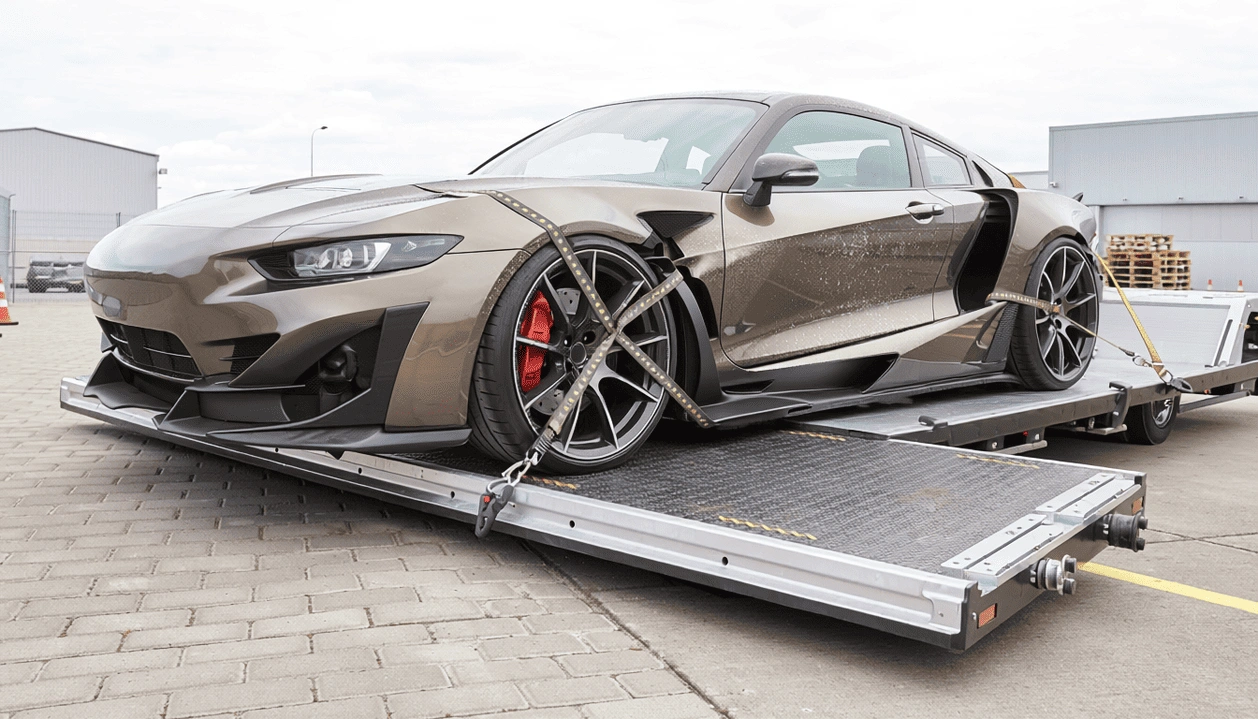
Our approach centres on hydraulic tilt tray services in Perth with ultra-low deck angles. These aren’t your standard flatbeds. The deck can lower to as little as 3–4 degrees, and in some cases, we can achieve nearly flat loading positions.
Think of it like a wheelchair ramp versus a staircase. Both get you to the same level, but one is designed for situations where conventional approaches don’t work. That’s what our low-angle decks do for your show car.
Why Ultra-Low Angles Matter
- Standard tilt tray: 10–12 degree loading angle (unsuitable for extreme lows)
- Our ultra-low equipment: 3–4 degree loading angle (safe for modified vehicles)
- Custom ramp systems: Extended transition zones reduce effective loading angle further
- Wheel dollies: Additional height management for extreme cases
- Hand-guided loading: Operator experience prevents contact
Each tool in our arsenal serves a specific purpose: eliminating the risk of contact at any point during loading.
The Loading Process for Extreme Low Vehicles
Pre-Arrival Assessment
Before we even arrive, we discuss your specific vehicle. We need to know:
- Exact ride height at the lowest point (usually measured at the front splitter or lowest chassis component)
- Splitter or airdam dimensions (how far it extends beyond the wheels)
- Suspension type (static drop, air suspension, hydraulic)
- Any fragile or protruding components (custom exhaust tips, rear diffusers, side skirts)
- Whether the car can be raised (if it’s on air or hydraulics)
This information determines which truck we send and what additional equipment we’ll need.
On-Site Loading Assessment
When we arrive, we assess the actual approach angle. Sometimes the photos don’t tell the whole story, a driveway slope, gutter height, or road camber can add complications that weren’t obvious in your garage.
For cars on air suspension or hydraulics, the process is straightforward. You raise the car to maximum height, we load it onto our low-angle deck, and once it’s secured, you can lower it back down. The straps hold it in place regardless of ride height changes.
Static Drop Loading Techniques
For static-dropped cars (coilovers, fixed suspension), we use a combination of techniques:
- Approach ramps and transition plates: We carry custom ramps that create a gradual transition from ground level to deck level. These extend the effective ramp length, reducing the angle even further.
- Wheel dollies and skates: For extremely low vehicles, we sometimes place the front wheels on low-profile dollies, effectively raising the front end by 20–30mm while we navigate the transition onto the deck.
- Winching with controlled angles: We don’t just drag your car up the deck. We use a slow, controlled winch with tension monitoring, often guiding the car by hand to ensure no component makes unexpected contact.
Securing Modified Vehicles for Transport
Protection-First Securing Method
Getting it on the deck is only half the job. A show car with thousands invested in custom work needs to be secured differently than a stock vehicle.
We never use tie-down points that could damage custom work. No chains around subframes, no hooks on fabricated suspension components, no straps over painted surfaces without protection.
Our Securing System
Our securing method uses:
- Wheel straps: Secure the tyres directly to the deck (these distribute force across the tyre, not through suspension components)
- Soft straps with protective sleeves: For any chassis contact points
- Adjustable tension: Prevents suspension compression during transport (which could damage static-dropped setups)
- Additional stabilisation: For cars with stiff suspension that might bounce or shift
For vehicles with custom paint or wrap work, we place protective material between any strap and the vehicle surface. You didn’t spend months on a custom paint job to have strap marks rubbed into it during a 30-minute transport.
Common Modifications That Require Specialised Transport
Extreme Suspension Drops
If your car sits lower than 80mm ground clearance at its lowest point, conventional loading becomes risky. Below 60mm, it’s almost impossible without specialised equipment.
We’ve transported cars sitting as low as 35mm. At that height, even driving over a painted line on the road requires careful approach angles.
Extended Splitters and Airdams
Front splitters that extend beyond the front wheels create a leverage point that magnifies any contact. A 2mm scrape at the splitter edge can translate to significant force trying to pry the splitter off the car.
Custom carbon fibre splitters are particularly vulnerable, they’re strong in the direction they’re designed for (downforce) but can crack or delaminate if loaded from the wrong angle.
Custom Exhaust Systems
Show cars often feature custom exhaust work with specific tip positioning, unique routing, or decorative components. A standard tow might clear the mufflers but catch on a custom diffuser or relocated tip.
We map the underside clearances before loading to ensure nothing makes unexpected contact with the deck, ramps, or securing equipment.
Wide-Body and Extreme Fitment
Cars with wide-body kits, stretched tyres, or extreme camber need careful width consideration. It’s not just about fitting on the deck, it’s about ensuring the wheels can roll straight during loading without the stretched tyre edge catching on a wheel well or fender.
Interstate and Long-Distance Show Car Transport
Enclosed Transport Options
Moving a show car across Perth is one thing. Transporting it to Melbourne for a national show or relocating it to Sydney is another level of complexity.
For long-distance transport, we offer specialised towing solutions including enclosed tilt tray services when available. This protects your vehicle from road debris, weather, and curious eyes during the journey.
Long-Distance Securing Considerations
The securing method becomes even more critical over long distances. A strap that’s slightly too tight might not matter over 20 kilometres, but over 3,000 kilometres, it could compress suspension components or create pressure points that damage paint.
We also consider climate control for vehicles with sensitive finishes or interiors. Temperature swings between Perth and eastern states can affect certain paint types, vinyl wraps, or custom interior materials.
Pre-Transport Preparation Checklist
Before a long-distance move, we recommend:
- Document everything: Photograph your car from every angle, including close-ups of any existing imperfections. This creates a clear record of pre-transport condition.
- Secure loose components: Remove or secure any parts that could vibrate loose (custom badges, loose trim pieces, aftermarket mirrors).
- Fuel level: Keep it under half a tank to reduce weight and eliminate fuel slosh during transport.
- Disable alarms: Nothing’s more frustrating than your car alarm going off 800 kilometres away while it’s on a truck.
- Check insurance coverage: Confirm your policy covers transport, or arrange specific transport insurance for high-value builds.
Insurance and Liability for High-Value Show Cars
The Agreed-Value Problem
A stock 2015 Commodore has a defined market value. Your custom-built show car doesn’t.
Insurance companies understand replacement value for factory vehicles, but they struggle with modified cars where you’ve invested $80,000 into a car with a $15,000 book value.
We carry comprehensive transport insurance, but we strongly recommend you maintain your own agreed-value coverage that accounts for your modifications. Our insurance covers transport-related damage, but your policy should cover the true replacement cost of your build.
Pre-Transport Documentation
Before transport, we document:
- Current condition (photos and video)
- Specific high-value components
- Any pre-existing damage or imperfections
- Agreed loading and securing method
This creates a clear record that protects both parties and ensures everyone understands the vehicle’s condition before it leaves the ground.
Why Experience Matters When Moving Show Cars
What Inexperienced Operators Miss
We’ve seen what happens when inexperienced operators attempt to move modified vehicles. Cracked splitters. Scraped chassis rails. Damaged custom paint. Bent exhaust components.
The difference isn’t just equipment, it’s understanding the specific challenges your modifications create and knowing how to work around them.
Our Specialised Track Record
When you call All Out Towing, you’re speaking with operators who’ve moved everything from million-dollar classic restorations to purpose-built drift cars worth more in parts than most people’s daily drivers. We understand that your show car represents years of work and significant investment.
Our prestige car towing service extends to modified and show vehicles because we recognise they require the same careful handling as a Ferrari or Lamborghini. Different reasons, same attention to detail.
The Reality of Show Car Transport Costs
What You’re Actually Paying For
Specialised transport costs more than standard towing. That’s the reality.
But consider what you’re protecting. If you’ve invested $50,000 in custom work, paying an extra $100–200 for specialised transport that eliminates scrape risk isn’t an expense, it’s insurance.
Our Pricing Approach
We price based on:
- Distance (obviously)
- Vehicle specifications (how low, how wide, how delicate)
- Loading complexity (can you raise it on air, or do we need extensive ramp work)
- Timing (urgent transport costs more than scheduled moves)
- Insurance value (higher agreed values affect our insurance costs)
We provide transparent quotes before we arrive. No surprises, no hidden fees, no “oh, we didn’t realise it was that low” price adjustments after we’ve already loaded your car.
If you need a quote for your specific vehicle, contact us with photos and details. We’ll give you an accurate price based on what we’re actually dealing with.
When to Use Specialised Transport vs. Driving Your Show Car
Factors Supporting Transport Services
Some owners prefer to drive their show cars to events. If your car is registered, roadworthy, and you’re comfortable with the clearance challenges, that’s absolutely an option.
But consider these scenarios where transport makes more sense:
- Unregistered builds: Many show cars aren’t road-legal. Full race suspension, non-compliant ride height, or missing safety equipment means they can’t legally drive on public roads.
- Long distances: Driving a stiffly-suspended show car 400 kilometres to an event isn’t just uncomfortable, it puts unnecessary wear on custom components and exposes your paint to stone chips.
- Weather concerns: Perth summers can hit 40+ degrees. If you’ve got custom paint or wrap work, extended sun exposure during a drive can affect the finish.
- Preservation of value: Every kilometre driven is a kilometre added to the odometer. For some show cars, especially those being sold, keeping kilometres off matters.
- Mechanical sympathy: Show cars often run aggressive setups, high-compression engines, stiff clutches, race-spec transmissions. These aren’t designed for hours of highway cruising.
Our Fleet and Equipment for Modified Vehicle Transport
Purpose-Built Equipment
We don’t use one truck for everything. Different vehicles need different tools.
For show car transport, we primarily use:
- Ultra-low tilt tray trucks: Hydraulic decks that achieve 3–4 degree loading angles. These handle the majority of modified vehicles, even those with extreme drops.
- Enclosed transport options: For high-value builds or long-distance moves where weather protection matters.
- Specialised loading equipment: Including custom ramps, transition plates, wheel dollies, and soft securing systems designed for vehicles with delicate components.
All our operators receive specific training in modified vehicle handling. We don’t send a driver who normally moves broken-down Corollas to pick up your $100,000 show car. The operator who arrives understands what they’re dealing with.
Our tilt tray services form the backbone of our show car transport capability. The equipment is designed specifically for vehicles that can’t handle conventional loading methods.
Communication Throughout the Transport Process
Keeping You Informed
When you’re trusting someone with a vehicle you’ve invested years into building, you want to know what’s happening.
We maintain communication throughout:
- Pre-transport consultation: We discuss your vehicle’s specific requirements and any concerns you have
- On-site assessment: Before loading, we walk you through exactly how we’ll secure your car
- Loading confirmation: Once secured, we show you the securing points and method
- Transport updates: For long-distance moves, we provide updates at key points
- Delivery confirmation: We don’t just drop your car and leave, we ensure you’re satisfied with its condition
If you have specific concerns, a particular component you’re worried about, a paint area that’s freshly finished, a modification that’s not immediately obvious, tell us. We’d rather know beforehand than discover it during loading.
Protecting Your Investment
More Than Money
Your show car represents more than money. It’s craftsmanship, vision, and countless hours of work. Moving it safely isn’t about finding the cheapest option, it’s about finding operators who understand what they’re handling and have the equipment to do it right.
We’ve built our reputation on moving vehicles that other operators won’t touch. Too low, too valuable, too modified, these aren’t problems for us. They’re exactly the situations our specialised equipment and experienced team are designed to handle.
Whether you’re heading to a show, moving your build to a new location, or delivering a finished project to its new owner, the transport method you choose determines whether your car arrives in the same condition it left.
If you need your show car moved without scrapes, without stress, and without surprises, our team has the experience and equipment to make it happen. We treat your build with the same care you put into creating it, because we know that anything less isn’t acceptable.
Ready to book show car transport? All Out Towing provides specialised prestige car towing for modified vehicles of all types. Call 0418 959 216 for a transparent quote on your specific vehicle.