Road trauma costs Western Australia more than lives – it reshapes families, communities, and futures. In 2023, 171 people died on WA roads, with metropolitan freeways accounting for a significant share of serious crashes. The Mitchell Freeway North, stretching from Perth’s CBD through to Clarkson, carries over 100,000 vehicles daily during peak periods. When accidents occur on this vital artery, every second counts.
Effective freeway accident recovery requires more than a tow truck and a hook. It demands specialist equipment, trained operators, and precise coordination with Main Roads WA and emergency services. A suburban breakdown is stressful. A freeway collision at 100km/h is traumatic – and the recovery operation that follows is an entirely different challenge.
The unique demands of highway safety response on Perth’s busiest corridor mean that response time, equipment capability, and operator experience directly affect how quickly the road reopens and how safely your vehicle is handled. These aren’t just service metrics – they’re safety outcomes for everyone on the road.
All Out Towing, operating across Perth’s metro area, has responded to hundreds of Mitchell Freeway incidents over 15 years. The difference between a 20-minute response and a 45-minute wait isn’t convenience – it’s the difference between a managed scene and a dangerous one.
Why the Mitchell Freeway North Demands Specialist Recovery
The Mitchell Freeway North isn’t just another road. It’s a high-speed corridor with limited stopping points, narrow emergency lanes in sections, and merge points that create collision hotspots. Competent freeway accident recovery on this route requires knowledge of its specific risks – not just general towing ability.
High Traffic Volumes and Collision Patterns
Between the Hutton Street and Ocean Reef Road exits, the freeway experiences some of Perth’s highest traffic volumes. Morning southbound congestion and afternoon northbound crawls create conditions where rear-end collisions are frequent, particularly during winter when wet weather reduces visibility and traction.
High-speed impacts create different recovery challenges than suburban accidents. Vehicles often sustain severe structural damage, making them unsafe to tow using conventional methods. A car with front-end crush damage can’t be safely lifted by its chassis without risking further collapse or fluid leaks.
Access Restrictions and Live Traffic Exposure
The freeway’s design limits access points significantly. Unlike suburban streets where operators can approach from multiple angles, freeway accident recovery often requires positioning a tilt tray against live traffic. Protection comes only from emergency warning lights and, when available, Main Roads traffic management.
That’s precision work under pressure. Professional accident towing in this environment requires operators trained specifically for high-speed roadway conditions – not general towing experience.
What Happens When You’re Involved in a Freeway Accident
Your heart’s racing. The airbags have deployed. Traffic is moving past at highway speed. Here’s the sequence that actually matters in a professional freeway accident recovery response.
Your Immediate Priorities
First priority is your safety. If your vehicle is drivable and you’re in a live lane, move to the emergency lane if it’s physically possible. If you can’t safely exit the vehicle, stay inside with your seatbelt fastened until emergency services arrive. More people are injured exiting vehicles into traffic than staying inside.
Second, contact emergency services. If there are injuries, call 000 immediately. For property-damage-only accidents, contact police on 131 444. WA Police will determine whether they need to attend based on injury severity, traffic disruption, and whether details can be exchanged safely.
Calling for Recovery
This is where our 24-hour emergency towing team steps in. When you call, we ask specific questions: your exact location, nearest exit, vehicle type, extent of damage, whether lanes are blocked, and whether emergency services are on scene. This information lets us dispatch the correct truck immediately.
Our average response time to Mitchell Freeway incidents is under 20 minutes from initial call – often faster during off-peak hours. That speed matters for your safety and for restoring traffic flow across the network.
The Equipment That Makes Safe Freeway Recovery Possible
Recovering a badly damaged vehicle from a freeway requires specialist equipment. Standard tow trucks aren’t built for this environment. Our fleet for freeway accident recovery includes heavy-duty tilt tray trucks specifically configured for collision scenarios – not the same vehicles used for routine breakdowns.
Key Equipment Capabilities
- Dual-speed hydraulic winches capable of pulling vehicles with locked wheels or collapsed suspension
- Wireless remote controls allowing operators to winch from safe positions away from traffic
- Integrated wheel-lift systems for vehicles too damaged to winch conventionally
- Spill containment equipment for fuel and fluid leaks
- Full LED warning light arrays that meet Main Roads WA requirements for freeway operations
Why the Tilt Tray Is Critical for Accident Scenes
When a vehicle has sustained front or rear-end damage, its wheels often won’t roll freely. Dragging it onto a conventional tow truck risks further damage and creates dangerous friction during loading. Our specialist tilt tray towing allows the entire deck to lower to ground level, creating a smooth transition surface for winching damaged vehicles aboard safely.
Vehicles with wheels at 45-degree angles from impact can be loaded without placing any stress on compromised suspension components. That’s the difference between arriving at the repairer with existing damage and arriving with additional damage caused by incorrect recovery.
How We Execute a Freeway Accident Recovery Safely
Every freeway recovery follows a strict protocol developed over thousands of incidents. There’s no room for improvisation when you’re working beside traffic moving at 100km/h. Consistent highway safety response procedures protect both our operators and everyone else at the scene.
Approach and Shadow Positioning
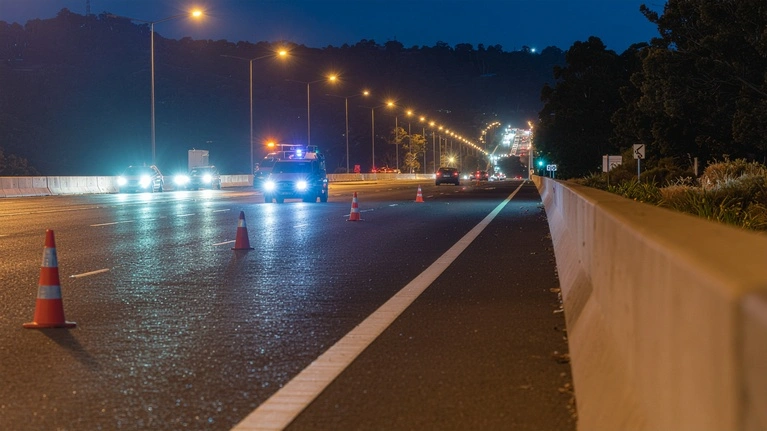
We approach the scene with all warning lights activated, positioning our truck to create a physical barrier between the damaged vehicle and live traffic. This is called a shadow position – our 12-tonne truck becomes a shield. If another vehicle loses control or fails to merge, it contacts our truck, not you or the emergency personnel.
Scene Safety Setup
We deploy additional warning triangles immediately after arrival. For night recoveries, portable LED beacons visible from 500 metres are set up along the approach. If Main Roads Traffic Management is on scene – common for multi-vehicle accidents or lane blockages – we coordinate with their crew to ensure proper traffic control before any recovery begins.
Pre-Recovery Vehicle Assessment
Before touching the vehicle, our operator assesses the following:
- Fluid leaks requiring containment before movement
- Wheel mobility and suspension integrity
- Airbag deployment status – undeployed airbags can activate during recovery
- Load security for commercial vehicles
- Hazardous materials or cargo
Recovery Execution and Scene Clearance
For vehicles with rolling capability, we use the winch to guide them onto the tilt tray under controlled tension. For severely damaged vehicles, wheel dollies or skates move them to the loading position first. The entire process typically takes 8-15 minutes from arrival to having the vehicle secured and ready for transport.
Scene clearance is the final critical step. We inspect the roadway for debris – plastic bumper fragments, glass, metal pieces – that could cause tyre damage or create hazards for motorcycles. We carry heavy-duty brooms and shovels for this purpose. The accident scene isn’t clear until the road surface is safe for all traffic.
Common Mitchell Freeway North Accident Scenarios
Fifteen years of freeway accident recovery on Perth roads means we’ve encountered every accident type this corridor produces. Several patterns emerge consistently.
Peak-Hour Rear-End Collisions
These dominate freeway callouts. Southbound traffic between Hepburn Avenue and Hutton Street during morning peak, and northbound from Cedric Street to Ocean Reef Road in the afternoon, creates stop-start conditions. Drivers expect movement, then suddenly see brake lights. We recover 3-4 vehicles weekly from these incidents alone.
Merge-Point Accidents
These cluster at specific locations – the Hutton Street on-ramp southbound where merging traffic accelerates into 100km/h flow, and the Karrinyup Road exit northbound where drivers cut across lanes at the last second. These collisions often involve side-swipe damage, making vehicles unstable but partially mobile.
Winter Loss of Control
Single-vehicle incidents spike during Perth’s first rains after a dry spell. An oil film develops on the road surface. We’ve recovered vehicles that spun across three lanes after hitting a slick patch during a lane change. These often result in multi-point impacts – barrier, median, sometimes other vehicles.
Mechanical Failure at Speed
Engine fires, tyre blowouts, and transmission failures that lock wheels at 100km/h create unique hazards. A blown tyre at freeway speed can shred completely, leaving the vehicle riding on the rim and scattering rubber debris across multiple lanes. Our specialised freeway accident recovery capabilities handle these scenarios without adding further risk to the scene.
What Happens to Your Vehicle After Freeway Recovery
Your vehicle is loaded and secured. Now comes the destination decision – and it matters more than most drivers realise.
Insured Drivers
We transport your vehicle directly to your insurer’s preferred repairer or assessment centre. Most major insurers have arrangements with specific smash repair facilities. We know which vehicles go where – RAC to their approved repairer network, Allianz to their assessment centres, NRMA to Balcatta. This removes one layer of coordination from an already stressful day.
Uninsured or At-Fault Drivers
We transport to a repairer of your choice, or to our secure storage facility while you arrange next steps. Our yard is fully fenced, monitored, and insured. Your vehicle stays safe until you’re ready to deal with it – no pressure and no surprise storage fees for the first period.
Total Loss Vehicles
We transport directly to a salvage yard or hold in storage for insurance assessment. Total loss assessments sometimes take several days. Your vehicle needs to be somewhere secure during that period – not sitting on a roadside or in an unsecured lot.
Why Response Time Is a Safety Issue, Not Just a Convenience
Every minute a damaged vehicle sits in a freeway lane increases risk exponentially. Fast freeway accident recovery isn’t about service speed – it’s about preventing the next accident.
Secondary Collision Risk
Main Roads WA data shows that accident scenes create 3-4 times higher collision risk than normal freeway driving. Drivers slow to look, merge suddenly, or fail to notice stopped traffic ahead. The faster the scene is cleared, the faster normal traffic flow and normal risk levels return.
Traffic Congestion and Economic Impact
Southbound Mitchell Freeway carries 8,000-plus vehicles per hour during morning peak. Block one lane for 30 minutes and you’ve affected thousands of commuters. That congestion also delays emergency vehicles responding to other incidents across the network. Highway safety response that clears scenes quickly protects far more people than just those directly involved in the crash.
The Human Cost of Waiting
Sitting in a damaged vehicle beside high-speed traffic, waiting for help, is genuinely frightening. Every minute of waiting feels longer under those conditions. Rapid response isn’t just an operational metric – it directly reduces trauma for the people involved.
High-Risk Locations Along the Mitchell Freeway North
Fifteen years of recovery data reveals clear accident hotspots. Understanding these locations explains why we position trucks strategically during high-risk periods and why consistent highway safety response protocols matter most at these points.
Hutton Street to Cedric Street Southbound
This section carries the highest accident frequency on the route. Heavy traffic volume, multiple merge points, and a slight curve that reduces sight lines combine into consistent risk. Winter morning sun glare worsens conditions further.
Karrinyup Road Interchange
Merge conflicts in both directions make this interchange one of the most active spots for our freeway accident recovery callouts. Northbound exits create last-minute lane cuts. Southbound entries force rapid acceleration into dense flow. We respond here 2-3 times weekly on average.
Hester Avenue to Warwick Road Northbound
Afternoon sun glare during winter months blinds northbound drivers at a low angle where the road briefly offers limited natural shade. Rear-end collisions spike during these conditions – particularly in the 3-5pm window when glare is at its worst.
Ocean Reef Road to Hodges Drive
The newest section of the freeway, opened in 2017. Wider lanes and smoother curves encourage higher speeds. Drivers accelerate beyond the posted 100km/h limit in sections where the road feels open. At those speeds, reaction time shrinks significantly and impact severity increases.
Heavy Vehicle Incidents on the Mitchell Freeway North
Not all freeway accidents involve passenger cars. Commercial vehicles and trucks also crash on this corridor – and their recovery requires significantly more capability.
Truck Recovery Requirements
A loaded rigid truck weighs 12 tonnes or more. Our commercial truck towing capabilities include heavy-duty equipment capable of uprighting rolled vehicles and recovering loads safely. This is not a service that a standard light tow operator can provide – the equipment requirements are in a different category entirely.
Coordinating Complex Heavy Recoveries
Heavy vehicle incidents on the freeway often require multi-agency coordination – police for investigation, DFES for hazmat assessment if cargo is involved, Main Roads for infrastructure damage, and specialist recovery operators. We work within that command structure, taking direction from the incident controller and adapting our recovery approach as the scene evolves.
Conclusion
Freeway accident recovery on the Mitchell Freeway North requires specialist capability, rapid response, and precise coordination with emergency services. For the thousands of drivers who use this corridor daily, effective highway safety response means the difference between a scene that clears in 20 minutes and one that disrupts traffic for hours – with all the secondary risks that follow.
Our team provides around-the-clock towing services across Perth’s freeway network, with GPS-tracked trucks averaging 20-minute response times to Mitchell Freeway incidents. For vehicles requiring careful handling after a collision, our damage-free tilt tray transport keeps all wheels off the ground and protects drivetrain and suspension components during transit.
Reach our 24/7 team at0418 959 216 for emergency towing support. All Out Towing provides comprehensive towing solutions in Perth – available every hour of every day, positioned for rapid response when the freeway demands it most.