You’ve invested thousands in your build. Coilovers dial in perfectly. Front lips sit millimetres from ground. Custom exhaust work took months to complete properly. Then your car breaks down on Roe Highway, or you need moving it across Perth for a show. What happens next determines whether your investment stays intact or gets destroyed by improper handling.
Standard towing methods destroy modified cars in minutes. Hook-and-chain towing tears off front bumpers without warning. Dolly towing rips out exhaust systems that took weeks to fabricate and fit. Even some flatbed operators don’t understand clearance issues accompanying properly lowered vehicles, attempting loading procedures that guarantee undercarriage damage.
Professional lowered car towing in Perth eliminates these risks through specialist equipment and trained operators who understand how these vehicles sit, move, and require handling. From slammed VW Golfs with 50mm clearance to track-prepped Supras with rigid suspension setups, each build demands different approaches recognising unique engineering and construction details.
Why Standard Towing Methods Damage Modified Cars
Most tow truck operators work with factory-height vehicles all day, every day. They’re accustomed to clearances of 150-200mm, soft suspension compressing easily during loading, and bumpers sitting well above ground at safe distances. Your modified car doesn’t fit that profile at all.
Hook-and-Chain Towing Destruction
Hook-and-chain towing represents the quickest way to wreck low front ends. Hooks attach to chassis or designated tow points, then lift front wheels off ground at angles between 15-25 degrees. Sounds acceptable for standard vehicles – except lowered cars now sit at angles they were never designed for structurally or aerodynamically.
Front lips drag across pavement. Exhaust systems scrape along ground. Custom diffusers get torn completely off before you’ve even left breakdown spots. One Perth owner watched his $2,500 custom front splitter snap in half during the first 10 metres of hook towing. The operator claimed “the car was too low” and refused responsibility for damage.
Aftermarket body kits feature mounting systems never designed for upward forces from pavement contact. Factory bumpers mount to steel reinforcement bars with multiple attachment points. Aftermarket lips often attach with double-sided tape, plastic clips, or self-tapping screws into fibreglass. These mounting methods work perfectly when components remain clear of ground – they fail catastrophically when components drag along pavement.
Dolly Towing Risks
Dolly towing lifts front wheels onto small wheeled platforms, leaving rear wheels on ground during transport. This approach works adequately for stock-height vehicles with exhaust systems designed maintaining ground clearance during front-end lifting.
Modified cars often feature aftermarket exhaust systems hanging 20-40mm lower than factory equivalents. As fronts lift onto dollies, rears drop proportionally, and exhaust systems become ploughs scraping along ground surfaces. $4,000 stainless steel exhaust setups with hand-fabricated components get destroyed in the first 50 metres, requiring complete replacement that proper towing methods prevent entirely.
Headers, catalytic converters, resonators, and mufflers all sustain damage from ground contact during dolly towing. Thin-walled stainless steel tubes crumple from contact forces. Mounting hangers tear from chassis attachment points. Welded joints crack from stress concentrations. What started as simple transport transforms into exhaust system replacement costing thousands.
Improper Flatbed Loading
If operators lack proper ramps or don’t understand approach angle calculations, vehicles ground out before reaching deck surfaces. Loading ramps creating 15-degree approach angles work fine for factory vehicles with 140-180mm clearance. They guarantee contact for modified cars sitting at 80-100mm or lower.
One Perth owner watched his custom front splitter snap clean off as an inexperienced operator tried winching his car up steep ramps without checking clearance first. The splitter, which cost $1,800 plus $700 in professional painting, destroyed within seconds because the operator didn’t understand modified vehicle requirements.
Even after successful loading, improper securing can damage lowered cars during transport. Strap placement matters enormously with modified suspension. Straps attached to suspension arms or sway bars create stress concentrations never intended by component designs. Professional operators attach straps to chassis or subframe points capable of handling lateral loads safely.
How Ground Clearance Changes Everything
Ground clearance isn’t just numbers on specification sheets – it’s the difference between safe transport and thousands of dollars in avoidable damage. Factory cars typically sit 140-180mm off ground, providing generous clearance for loading ramps and normal road obstacles.
Modified cars live in completely different territory. We regularly transport vehicles with 60-80mm clearance, and we’ve handled extreme builds sitting as low as 40mm in show configuration. These measurements require completely different transport approaches than operators use for factory vehicles.
Approach Angle Challenges
Approach angle represents the angle between ground surface and the point where front bumpers start rising upward. Factory cars feature generous approach angles allowing negotiation of steep driveways and loading ramps without contact between bumpers and surfaces.
Slammed car transport requires completely different thinking because lowered cars with extended front lips have virtually no approach angles remaining. Some show cars feature negative approach angles where front lips actually extend downward below front wheel centres. These vehicles can’t drive up anything – they must roll onto completely flat surfaces.
Professional operators delivering custom-build tilt tray towing measure all angles before attempting loading procedures. If clearances prove inadequate for standard loading, operators deploy specialised ramps spreading approach angles over longer distances or adjust hydraulic deck angles to absolute minimums whilst maintaining stable truck positioning.
Departure Angle Problems
Departure angles prove equally critical but receive less attention from inexperienced operators focused on getting vehicles onto decks without considering how they’ll come off later. If your car features rear diffusers, lowered exhaust tips, or extended rear bumpers, you need loading systems accounting for how rears drop as fronts rise onto platforms.
Cars with long wheelbases face particular challenges. As fronts climb ramps whilst rears remain on ground, vehicle centres drop between front and rear wheels. This “sagging” reduces ground clearance at vehicle centres below static measurements. Factory cars with flexible suspension absorb these geometry changes without contact. Modified cars with rigid coilover setups and minimal ground clearance often contact ramp surfaces during this transition.
Breakover Angle Considerations
Breakover angle describes the maximum angle between front and rear contact points before vehicle centres contact ground surfaces. Factory SUVs and trucks maintain generous breakover angles through combination of short wheelbases and high ground clearance. Low, long vehicles demonstrate poor breakover angles making them vulnerable during loading transitions.
Cars with extended side skirts or undertray components face additional breakover angle issues invisible from outside. As vehicles transition from flat ground onto angled ramps, middles can ground out even if fronts and rears clear surfaces safely. Carbon fibre undertrays costing $3,000-$5,000 crack from these mid-body impacts that careful operators prevent through proper procedures.
Why Tilt Tray Is The Only Safe Option
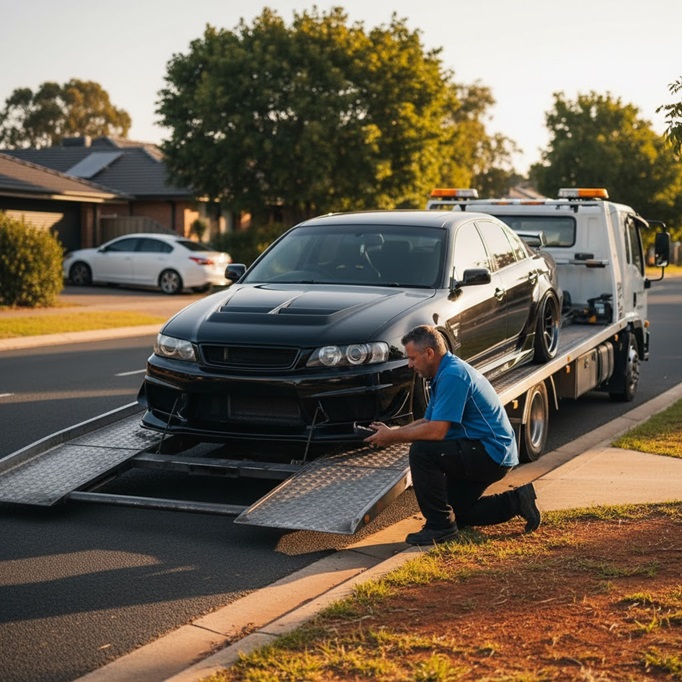
For modified and lowered vehicles, tilt tray services represent industry gold standards. This isn’t marketing language or operator preference – it’s recognition that tilt tray methodology eliminates fundamental damage risks that other methods can’t address adequately.
Ground-Level Deck Operation
Tilt tray trucks lower entire deck assemblies to ground using hydraulic systems. Not to 15-degree angles that operators call “low positions.” Not to heights still 300mm above ground surfaces. All the way down to ground level, creating flat, level surfaces sitting barely higher than roads themselves.
Vehicles don’t climb gradients during loading. They roll horizontally onto decks. No angles means no scraping. No suspension stress. No risk of body kit components contacting loading surfaces. Professional modified vehicle transport in Perth uses this approach exclusively for custom builds because it’s the only methodology guaranteeing damage prevention.
Hydraulic control provides infinite adjustability through deck angle range. Operators achieve exactly the minimum angle required for stable truck positioning whilst ensuring vehicles experience minimal climbing angles. This precision proves impossible with fixed mechanical ramps that work in all-or-nothing fashion.
Specialised Loading Equipment
We use specialised loading ramps for cars with extreme lowness. These aren’t hardware store ramps bought for $50 and used until they break. They’re custom-designed transition plates spreading approach angles over extended distances, sometimes exceeding 3 metres in length.
Cars with 50mm clearance that would ground out catastrophically on standard 1.5-metre ramps roll smoothly onto decks using proper equipment spreading identical height change over twice the distance. This reduces approach angles from impossible 15 degrees to manageable 7-8 degrees where clearance becomes achievable.
Investment in proper equipment costs thousands but prevents damage costing tens of thousands across operator lifetimes. Professional operators understand this mathematics and maintain equipment inventories matching diverse vehicle requirements rather than trying to force all vehicles through identical procedures.
Winch-Controlled Loading
Winches perform actual pulling work whilst vehicles stay level and stable. We attach winch cables to chassis or designated tow points documented in vehicle service information – never to suspension components, body panels, or convenient attachment locations that weren’t engineered for pulling loads.
Winches bring vehicles up whilst operators control every centimetre of movement, watching clearances continuously and stopping immediately if any component approaches contact with surfaces. You’re not driving up ramps risking scrapes from throttle misapplication or clutch engagement mistakes. Winches provide smooth, controlled pulling at exact speeds operators select.
Modern winch systems include load monitoring showing pulling forces in real-time. Excessive loads indicate binding or interference requiring immediate investigation before damage occurs. This feedback helps operators identify problems before vehicles sustain damage rather than discovering issues after destruction occurs.
Common Modified Car Scenarios We Handle
Perth’s modified car scene demonstrates remarkable diversity. We don’t just tow slammed Hondas to meets – we handle full spectrums of builds requiring specialised care, from daily-driven lows to dedicated show cars that never see public roads.
Show Cars With Extreme Lows
These represent our most challenging jobs technically. Cars built purely for appearance, not drivability, often sit at 40-60mm ground clearance with completely rigid suspension and extensive body kits adding vulnerable components at every corner.
They can’t be driven onto anything whatsoever. They need perfectly flat transitions from ground onto deck surfaces with approach angles below 5 degrees – sometimes below 3 degrees for extreme builds. Careful winching with constant clearance monitoring ensures these rolling art pieces reach destinations without damage.
We’ve transported cars to Perth Motorplex, Auto Salon events at Perth Convention Centre, and private collections in northern suburbs without single scrapes or contact marks. This success rate comes from taking time required to execute procedures properly rather than rushing jobs for efficiency.
Show car owners invest $50,000-$100,000 into builds. They expect transport reflecting those investment levels. Professional operators providing museum-quality prestige car towing understand these expectations and deliver services meeting them consistently.
Track Cars With Aero and Splitters
Track-focused builds might feature more ground clearance than show cars – maybe 80-100mm instead of 40-60mm – but they possess aggressive front splitters generating downforce, flat undertrays reducing aerodynamic drag, and rear diffusers managing airflow under vehicles.
One wrong loading angle destroys $2,000-$3,000 worth of carbon fibre aerodynamic components in seconds. Professional custom build towing accounts for every millimetre of overhang, every degree of approach angle, every point where components might contact loading surfaces.
Splitters prove particularly vulnerable because they extend furthest forward whilst sitting lowest to ground. Some racing splitters extend 100-150mm beyond front bumpers at heights barely 80mm above ground surfaces. These geometries create negative approach angles impossible to negotiate without specialized loading procedures.
Bagged Trucks and Utes
Air suspension systems allow vehicles to achieve extreme lows when aired out for shows whilst maintaining driving height when aired up for road use. Bagged trucks sitting at 40mm when fully dropped can raise to 180mm when aired to maximum height.
However, breakdowns often leave air suspension systems non-functional. Trucks sitting on frame rails with suspension completely deflated can’t air up for transport. These situations require loading procedures accounting for absolute minimum ride heights without ability to raise vehicles before loading.
We’ve handled numerous bagged builds experiencing compressor failures, leak issues, or electrical problems leaving suspension systems unable to raise. Proper equipment and experienced operators make these challenging transports successful despite vehicles sitting at minimum possible heights.
Classic Cars With Modified Suspension
1970s Chargers or HQ Holdens sitting on modern coilover systems combine two risk factors – they’re valuable and they’re lowered below factory specifications. Owners invest $30,000-$80,000 restoring these vehicles, then modern suspension creating handling capabilities never imagined by original engineers.
We treat these vehicles with care they absolutely deserve, which is why many classic car owners use our services for their modified builds alongside owners with modern performance vehicles. Age and value don’t matter – proper transport procedures remain identical whether vehicles left factories in 1970 or 2020.
Modified classics often lack documented tow points because engineers never anticipated these vehicles would sit 60mm lower than factory design specifications. Operators must identify proper attachment points through chassis inspection rather than consulting service manuals providing information for factory configurations.
The Real Cost Of Cheap Towing
We’re not the cheapest towing option available in Perth. We’re the safest for modified and lowered vehicles. There’s significant difference between these positions, and it matters tremendously when you’ve invested $20,000-$50,000 into builds representing years of work.
Damage Cost Reality
Cheap tows saving $100 today transform into $4,500 repair bills tomorrow when custom front lips get torn off, exhaust systems get ripped out, or chassis components get scraped and damaged. You’re not saving money through cheap towing – you’re gambling with investments and losing when operators lack proper equipment or experience.
We’ve been called to transport cars after other companies damaged them during attempted towing. One customer had a company destroy his front bumper and undertray, then refuse covering damage because “the car was too low for towing.” Repairs cost $4,500 requiring replacement bumper, new undertray, and professional painting. Our transport fee would have been $280.
Another owner had a budget operator bend his exhaust system during dolly towing, creating clearance problems and exhaust leaks requiring complete system replacement. The exhaust cost $3,800 to replace – the proper transport would have cost $320. These scenarios repeat constantly across Perth’s modified car community because owners choose price over protection.
Professional operators offering build-protecting car towing services understand every vehicle’s unique requirements and use proper equipment matching those requirements exactly. Initial costs prove higher than budget alternatives, but damage prevention creates enormous savings compared to repair expenses.
Why Perth’s Modified Car Community Trusts Us
We’ve built reputations one careful transport at a time over 15 years. Perth’s car scene demonstrates tight-knit characteristics – word spreads quickly when companies damage someone’s build, and it spreads equally quickly when companies consistently execute jobs perfectly.
We’re Car People
This isn’t just towing business operations to us. We understand why you built cars the way you did. We know differences between cheap coilovers and proper BC Racing, KW, or Öhlins setups. We know why front lips sit at specific heights for aesthetic effect, and why exhaust systems hang at particular angles balancing ground clearance with visual impact.
Many operators on our team build or have built their own modified vehicles. They’ve experienced Perth’s car scene firsthand as participants, not just service providers. This creates understanding and respect for builds that goes beyond professional courtesy into genuine appreciation for craftsmanship and dedication these vehicles represent.
Proper Equipment Investment
Our tilt tray trucks maintain specifically for low-clearance work. We carry multiple ramp setups including extended transition plates for extreme lows, soft straps in various lengths for different vehicle sizes, and wheel chocks designed specifically for lowered cars where standard equipment creates interference problems.
This equipment costs significantly more than standard towing gear – sometimes three to four times standard equipment pricing. However, it’s what jobs require for proper execution. We’ve made this investment because we’re committed to modified vehicle transport as specialty service rather than occasional side work.
Equipment maintenance follows strict schedules. Hydraulic systems receive regular inspection and servicing. Winch cables replace at first signs of fraying or damage. Deck surfaces maintain clean, smooth conditions preventing any abrasion to vehicle undersides. This maintenance costs money but ensures equipment reliability when customers need services most.
Protecting Your Modified Investment
All Out Towing provides comprehensive modified vehicle transport solutions throughout Perth’s metro area. For damage-free transport of lowered or modified vehicles anywhere in Perth, our team operates around the clock with specialist tilt tray equipment designed specifically for low-clearance vehicles.
We’ve handled everything from daily-driven lows that see regular street use to trailer-queen show cars that travel exclusively on trucks. Every transport receives identical careful attention to clearance measurements, approach angle calculations, and securing methods protecting investments completely regardless of vehicle values or modification levels.
Modified cars break down at night, on weekends, during shows when enthusiasts gather. We don’t keep business hours – we keep car enthusiast hours matching community needs. If you need us at 2am on Sunday mornings because your car died leaving meet locations, we’ll respond with proper trucks and experienced operators who understand exactly what your build requires.
To arrange safe vehicle transport for your modified or lowered car, contact us at 0418 959 216. Our experienced operators understand modified suspension towing requirements and use proper equipment protecting custom builds throughout entire transport processes from pickup to delivery.