Running a business with vehicles spread across Perth isn’t just a logistics challenge – it’s a timing, safety, and asset protection challenge. When you’re moving multiple vehicles from different locations to different destinations, all in sequence, the complexity compounds with every additional pickup point and delivery window.
Multi-location towing in Perth requires a fundamentally different approach to individual vehicle recovery. A single breakdown handled reactively is straightforward. Seven vehicles, five locations, two project site deadlines, and three different drivetrain types handled sequentially is an operational problem requiring specialist planning.
We’ve coordinated hundreds of multi-location towing jobs across Perth – from dealerships rotating stock between sites to construction companies mobilising entire fleets for new projects. The difference between a smooth sequential operation and a costly, delayed mess consistently comes down to planning quality: route logic, timing windows, vehicle categorisation, and real-time coordination during execution.
What Multi-Location Towing Actually Involves
Sequential Transport Versus Multiple Individual Jobs
Multi-location towing in Perth means coordinating the transport of multiple vehicles from various pickup points to various delivery destinations, often within tight timeframes. It is not simply running the same job several times. It’s orchestrating a sequence where timing, route efficiency, vehicle handling requirements, and site access windows must all align.
Think of sequential vehicle transport like a relay race. Each leg depends on the previous one completing on time. A single delayed pickup creates a cascade that affects every subsequent job in the sequence. Without proactive planning that accounts for those dependencies, the entire schedule unravels.
The specific factors that make multi-vehicle towing in Perth complex include:
- Different vehicle types: A standard sedan tows differently than a 4WD, a lowered sports car, or a light rigid truck. Each requires different equipment and loading times
- Varying locations: Pickup points spanning from Joondalup to Mandurah with drop-offs equally dispersed across the metro area
- Time constraints: Businesses need vehicles delivered within specific windows – not two hours past deadline
- Site access challenges: Industrial estates with weight restrictions, construction sites with access permits, car parks with height limitations
Why Perth’s Geography Makes Coordination Critical
Distances That Cannot Be Ignored
Perth’s sprawling layout creates unique towing route optimisation challenges. The metro area stretches roughly 150 kilometres north to south and 50 kilometres east to west. That’s significant ground to cover, and the route choices made during planning directly affect how much of it gets covered unnecessarily.
Traffic patterns shift dramatically throughout the day. The Kwinana Freeway southbound between 7am and 9am adds significant time to any southern delivery. The Mitchell Freeway northbound after 4pm creates comparable delays. Coordinating multiple pickups and drop-offs without accounting for these patterns doesn’t just slow individual legs – it can collapse the entire vehicle transport sequence schedule.
Our specialist tilt tray towing fleet handles vehicles without adding drivetrain wear – critical when transporting multiple high-value assets in sequence. However, even the best equipment needs intelligent routing. A job that appears to be three hours on paper extends to five when known congestion points aren’t factored into the schedule from the outset.
Every multi-location towing job is mapped against real-time traffic data and historical congestion patterns before the first truck moves.
The Three Phases of Sequential Transport Planning
Phase One: Vehicle Assessment and Categorisation
Before any truck moves, every vehicle in the transport sequence is assessed and categorised. This determines equipment requirements, handling protocols, and realistic timeframes for each individual leg.
Vehicle categories assessed for multi-location towing in Perth include:
- Standard vehicles – sedans, standard SUVs, standard utes – using conventional towing methods with predictable timing
- Specialist vehicles – AWD, 4WD, lowered cars – requiring flatbed transport to protect drivetrains and undercarriages
- Heavy or commercial vehicles – requiring our truck towing services and specific route planning for size and weight restrictions
- High-value assets – requiring prestige protocols with enclosed transport options and comprehensive documentation
A recent example illustrates the complexity. A construction company needed seven vehicles moved from three sites in Balcatta, Bibra Lake, and Wangara to two project sites in Ellenbrook and Rockingham. Two were standard utes, three were 4WDs, one was a lowered supervisor vehicle, and one was a light rigid truck. Seven different handling requirements across five locations. Getting the sequence wrong means backtracking across Perth, adding hours and significant cost to the entire job.
Categorisation before execution prevents exactly that scenario.
Phase Two: Route Optimisation and Timing Windows
This phase is where fleet towing coordination experience separates smooth operations from chaotic ones. Routes are built to minimise backtracking while respecting access windows at each location.
Key factors built into towing route optimisation for multi-location jobs include:
- Pickup and delivery windows: When sites open, when staff are available, when restricted access periods apply
- Traffic pattern mapping: Both real-time data and historical congestion patterns for each route segment
- Distance versus time calculations: The shortest route by kilometre is not always the fastest route by time
- Contingency buffers: Built-in time for unexpected delays without derailing the entire sequential vehicle transport schedule
For that seven-vehicle construction job, the sequence started with Wangara at 5:30am before peak traffic developed, moved to Balcatta by 7am, then south to Bibra Lake by 9am after the morning rush had cleared. Each pickup flowed naturally into the next without wasted kilometres or timing conflicts.
The principle is the same as planning a road trip to collect passengers from different suburbs – you plan a logical loop rather than zigzagging randomly. For multi-location towing in Perth, that planning is done with commercial precision and documented timing targets.
Phase Three: Execution and Real-Time Coordination
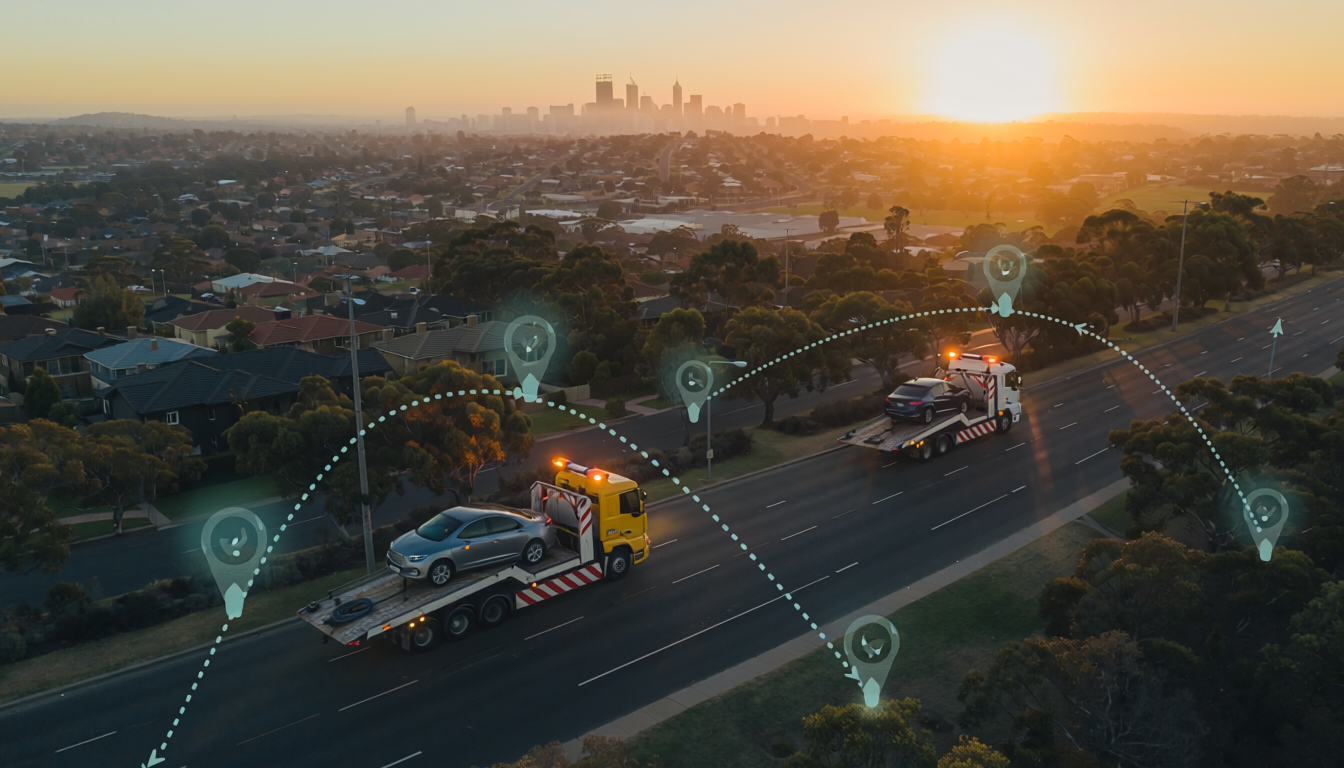
Even precise planning needs adaptable execution. Real-time fleet towing coordination is maintained throughout every multi-location job through GPS tracking on all trucks, dedicated job communication channels, and milestone reporting at each pickup and delivery point.
When a pickup runs longer than anticipated, or traffic creates unexpected delays on a route segment, subsequent timing adjusts immediately – not after it has already caused cascading problems. Drivers report status at each milestone: arrival at pickup, vehicle loaded, departure, arrival at drop-off, vehicle secured and offloaded. That continuous reporting gives the coordination team the information needed to keep the entire sequence on track.
For urgent situations requiring immediate multi-vehicle towing in Perth, our 24-hour emergency towing team applies the same coordination precision to emergency fleet recovery – because commercial emergencies don’t wait for business hours, and neither does our capability.
Common Multi-Location Scenarios We Handle
Dealership Stock Rotation
Car dealerships regularly rotate inventory between locations to match customer demand and optimise display space. A prestige dealership might need five high-value vehicles moved from their main showroom to a satellite location, with three different models returning in exchange.
These jobs demand careful handling throughout. Every vehicle is showroom-perfect and needs to remain that way. We use enclosed transport for weather protection and prestige protocols to prevent cosmetic damage during the sequential vehicle transport process.
Timing matters for dealerships. Vehicles need to move outside business hours to avoid disrupting sales floor operations. We’ve coordinated overnight rotations involving eight vehicles between three locations between 10pm and 6am, with all vehicles positioned and ready for the next business day’s trading.
Fleet Relocation for Project Mobilisation
Construction and mining companies mobilising for new projects often need entire fleets moved to site within tight windows. That might mean relocating vehicles from a central depot to multiple project locations, or consolidating equipment from completed projects to new sites.
A recent mining services client required 12 vehicles and three pieces of heavy machinery moved from two Perth depots to a regional site near Collie. The vehicle transport sequence required coordinating different vehicle types, ensuring assets arrived in the correct order for staged site setup, and timing everything around site access permissions and receiving area preparation.
The transport was staged over two days – light vehicles first to establish site operations, followed by heavy equipment once receiving areas were prepared and cleared. That sequencing matched the operational requirements of the site setup, not simply the most convenient transport order.
Insurance Multi-Vehicle Recovery
After major incidents or when insurance companies need to relocate multiple damaged vehicles from various locations to assessment centres, fleet towing coordination becomes critical. These jobs combine accident towing expertise with multi-location logistics.
Vehicles may be at crash scenes, police holding yards, and temporary storage locations across Perth, all needing delivery to specific assessment facilities within insurer timeframes. Each vehicle carries unique documentation requirements. The safe vehicle recovery services applied to each one must be documented separately and delivered accurately. Mixing documentation between vehicles creates significant problems for the claims processing that follows.
Technology Behind Seamless Coordination
Systems That Support Every Moving Part
Modern multi-location towing in Perth relies on integrated systems that track every vehicle, every movement, and every milestone throughout the transport sequence. The technology components behind fleet towing coordination include:
- GPS tracking on all trucks: Real-time location data for every vehicle in the fleet throughout the job
- Route optimisation software: Calculates the most efficient sequences accounting for traffic, distance, timing windows, and vehicle types
- Digital job management: Every pickup and delivery documented with photos, timestamps, and electronic signatures
- Status reporting at each milestone: Arrival, loaded, departed, delivered – tracked and confirmed for every leg of the sequence
This isn’t technology for its own sake. When you’re coordinating multiple vehicles across Perth simultaneously, everyone needs accurate, current information about where everything is. Guesswork creates delays. Confirmed milestone data creates accountability and allows the coordination team to respond to changes before they become problems.
Cost Factors in Multi-Location Towing
Why Coordination Delivers Savings
Sequential vehicle transport costs depend on several factors beyond simple distance. Total kilometres covered across all pickups and drop-offs, number of locations, vehicle types and their handling requirements, timing demands, and site access complexity all affect the final cost.
The important cost insight for businesses considering multi-vehicle towing in Perth is this: coordinated sequential transport costs significantly less than the equivalent number of individual, separately-booked jobs. Moving seven vehicles in one planned sequence eliminates redundant positioning movements, optimises driver utilisation, and reduces the total kilometres driven compared to seven separate bookings across different days.
Detailed quotes that break down costs by vehicle and location remove any ambiguity about what you’re paying for. Towing route optimisation that eliminates unnecessary backtracking also directly reduces the fuel and time costs passed through to the client.
Safety Protocols for Sequential Transport
Standards That Don’t Compress Under Time Pressure
When moving multiple vehicles across Perth in sequence, safety protocols multiply. Each vehicle requires proper securing, each transport leg requires condition verification, and every handover requires documentation. Time pressure does not reduce these requirements.
Our drivers complete a safety checklist for every vehicle in a multi-location sequence:
- Pre-transport condition inspection with photos from multiple angles
- Correct securing using appropriate tie-down points and rated equipment for each vehicle type
- Weight distribution and load verification before departure
- Post-transport condition inspection and documentation at delivery
For businesses managing fleet assets, this documentation is critical for both insurance and asset management. Proof that each vehicle was transported safely and delivered in the condition it was collected provides protection at both ends of the vehicle transport sequence.
Better to arrive 15 minutes late with every vehicle intact than to arrive on schedule with a damage dispute to resolve.
Planning Your Multi-Location Transport
Information That Enables Accurate Coordination
If you’re facing a multi-location towing requirement, begin planning early. Last-minute coordination limits route options, increases costs, and reduces the ability to accommodate access restrictions at individual sites.
To plan and quote a sequential vehicle transport job accurately, we need:
- Complete vehicle list with make, model, and any special handling requirements for each vehicle
- All pickup addresses with access restrictions, contact details, and available time windows
- All delivery addresses with access windows and site contact details
- Firm timing requirements – when vehicles must be picked up and when they must be delivered
- Any special considerations – high-value vehicles, damaged vehicles, vehicles requiring permits
The more complete the information provided upfront, the more accurate the sequence planning, the more realistic the quote, and the fewer complications during execution. Surprises discovered mid-transport create delays and additional costs that detailed planning prevents.
Conclusion
Multi-location towing in Perth demands specialist planning, appropriate equipment, and proven coordination systems. Perth’s geography, traffic patterns, and the diversity of commercial vehicle types make sequential vehicle transport significantly more complex than simply running the same job multiple times.
Done properly, fleet towing coordination delivers an operation where vehicles arrive on time, in the right order, in the condition they left – without the delays, backtracking, and damage disputes that poorly-planned multi-vehicle jobs generate.
Whether you’re relocating a business fleet, rotating dealership stock, coordinating insurance recoveries, or mobilising construction vehicles for a new project, the planning quality determines the outcome. All Out Towing has coordinated complex multi-location towing across Perth’s metro area including sequential jobs involving up to 15 vehicles and five locations. Contact our team at 0418 959 216 to discuss your specific vehicle transport sequence and receive a detailed quote that accounts for every vehicle and every location in your job.