Perth’s northern suburbs cop humidity like nowhere else in the metro area. When moisture hangs in the air after summer storms or during those sticky February mornings, your car battery is fighting a silent battle you probably don’t even know about.
We’ve towed hundreds of vehicles from Joondalup to Yanchep, and one pattern shows up every humid season: batteries that were fine last week suddenly can’t turn the engine over. It’s not bad luck. It’s physics affecting car battery humidity Perth performance.
Why Humidity Attacks Your Battery
Your car battery doesn’t just store power-it creates it through a chemical reaction between lead plates and sulphuric acid. That reaction depends on precise conditions inside the battery case.
When humidity rises, moisture finds its way into places it shouldn’t be. Battery terminals, cable connections, even microscopic cracks in the casing-all become pathways for water vapour. Once moisture gets in, it starts causing problems.
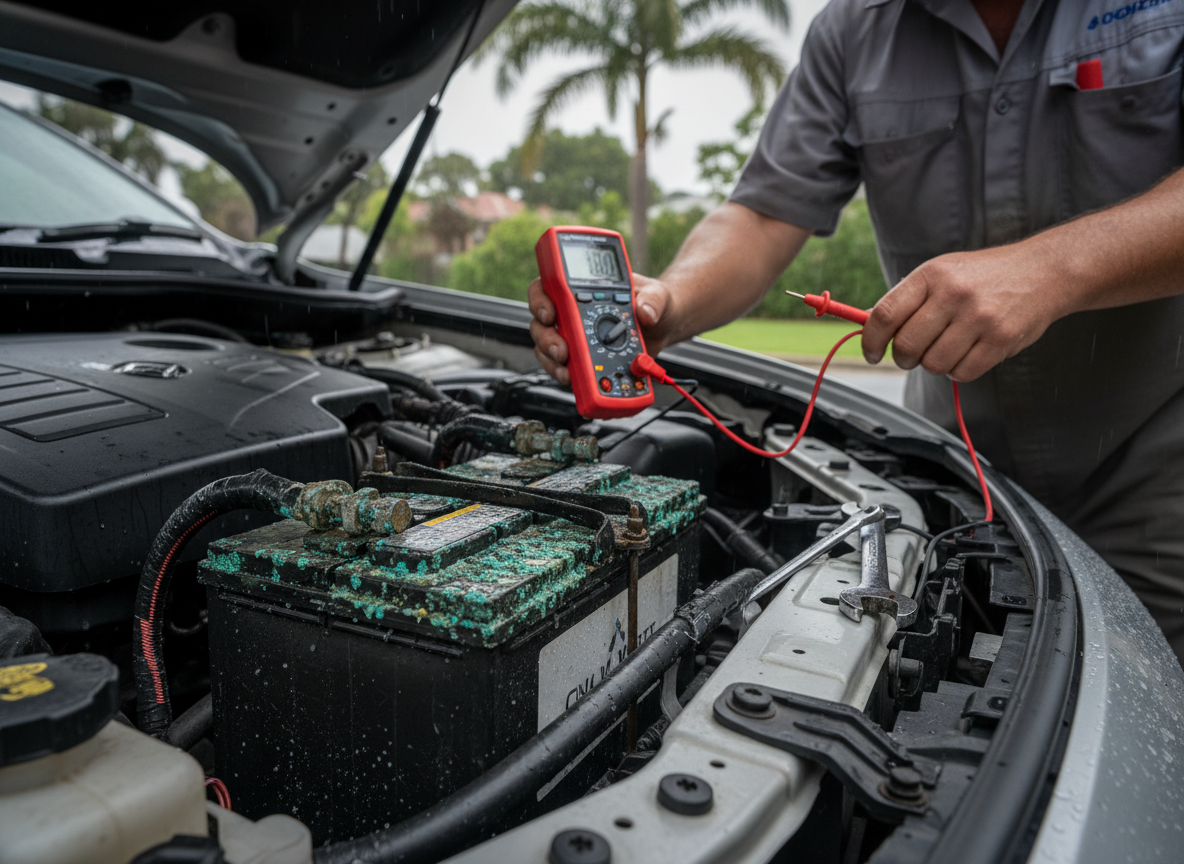
Corrosion is the first casualty. Those white or blue-green crusty deposits you see around battery terminals? That’s corrosion from moisture reacting with the metal connections. It acts like a barrier, blocking the flow of electricity from your battery to your starter motor.
Think of it like trying to drink a thick shake through a straw that’s half-blocked with ice. The shake’s there, but it can’t get through properly. Same deal with your battery-the power’s there, but corroded terminals stop it reaching where it needs to go.
Self-discharge accelerates in humid conditions too. All batteries lose charge naturally over time, but moisture speeds up that process. A battery sitting in Perth’s dry winter air might lose 5% of its charge per month. The same battery in humid summer conditions? It can lose 10-15% monthly.
The northern suburbs-Quinns Rocks, Butler, Alkimos, Two Rocks-sit right on the coast where sea air adds salt to the moisture equation. Salt is corrosive on its own. Combine it with humidity and you’ve got a battery-killing cocktail.
The Temperature-Humidity Double Hit
Here’s where Perth’s climate gets particularly nasty for batteries: we don’t just get humidity. We get humidity and heat at the same time.
A battery’s chemical reactions speed up as temperature rises. That sounds good-more activity means more power, right? Not quite. Faster reactions also mean faster degradation of the internal components.
In summer, when Wanneroo hits 38°C and the humidity sits at 60% after an afternoon storm, your battery is working overtime. The heat accelerates the chemical reactions inside, while the humidity attacks the connections outside. It’s a pincer movement.
We’ve seen batteries that tested perfectly fine in May completely fail by January, not because they were old, but because they couldn’t handle the combined assault of heat and coastal humidity.
How Moisture Gets Inside the Battery Case
Modern batteries are sealed units, but “sealed” doesn’t mean waterproof. Every battery has vents to release hydrogen gas produced during charging. Those vents are designed to let gas out while keeping moisture out, but they’re not perfect.
When humidity is high and temperature swings are dramatic-like a 40-degree day followed by a cool night-condensation forms. Moisture gets drawn into the battery through those vents. Once inside, it dilutes the electrolyte solution (the acid-water mix that makes the battery work).
Diluted electrolyte means weaker chemical reactions. Weaker reactions mean less power output. Less power means your engine struggles to start, especially on cold mornings when the oil is thick and the starter motor needs maximum current.
The Invisible Damage: Sulphation
Here’s the technical bit, explained simply.
When a battery discharges, lead sulphate crystals form on the plates inside. When you recharge the battery (by driving your car), those crystals dissolve back into the electrolyte. It’s a reversible process-normally.
But when a battery sits partially discharged in humid conditions, those lead sulphate crystals harden. They become permanent. This is called sulphation, and it’s the leading cause of northern suburbs battery failure in Perth’s northern suburbs.
Why does humidity make it worse? Because moisture accelerates self-discharge, which means your battery spends more time in a partially discharged state. More time partially discharged equals more opportunity for sulphation to set in.
You can’t see sulphation happening. The battery looks fine from the outside. But internally, the plates are becoming coated with hardened crystals that reduce capacity. Eventually, there’s not enough active plate surface left to generate the current needed to start your engine.
The Warning Signs (Before You Need a Tow)
Most people don’t realise their battery is struggling until they’re stuck in a Currambine shopping centre car park with a dead car. But the signs show up earlier if you know what to look for.
Slow cranking is the classic warning. If your engine takes an extra second or two to turn over, especially first thing in the morning, your battery is telling you something. It’s not generating enough current to spin the starter motor at full speed.
Electrical glitches are another red flag. Flickering dashboard lights, radio cutting out, power windows moving slower than usual-these all point to voltage dropping below optimal levels.
Visible corrosion around terminals means moisture is already attacking the connections. That white crusty build-up doesn’t appear overnight. It’s been developing for weeks, slowly degrading the electrical contact.
Battery age matters too. Most batteries last 3-5 years in Perth’s climate. If yours is pushing four years and you’re seeing any of the above symptoms during humid weather, it’s living on borrowed time.
What You Can Do About It
You can’t control Perth’s weather, but you can control how well your battery handles it.
Keep terminals clean and protected. Check your battery terminals every few months. If you see corrosion, disconnect the cables (negative first, always), clean the terminals with a wire brush and baking soda solution, then reconnect (positive first). Apply a thin layer of petroleum jelly or terminal protector spray to seal out moisture.
Check the battery hold-down. If your battery moves around while you’re driving, vibration will crack the case and internal components. Moisture gets in through those cracks. Make sure the hold-down bracket is tight.
Drive regularly. A battery that sits unused for weeks in humid conditions will self-discharge and sulphate. If you’ve got a second car or work from home, start it every few days and let it run for 15 minutes. Better yet, take it for a 20-minute drive to fully recharge the battery.
Park undercover when possible. Direct sun heats the battery, while overnight dew adds moisture. A carport or garage makes a real difference, especially in coastal suburbs where salt air is constant.
Get your battery tested. Most auto shops and service stations offer free battery testing. A load test shows the true condition of your battery-not just its voltage, but its ability to deliver current under demand. Test it before summer hits, not after it fails.
When the Battery Finally Gives Up
Despite your best efforts, batteries eventually fail. When that happens in Perth’s northern suburbs, you’ve got options.
If you’re at home, a jump start might get you going long enough to drive to a battery supplier. If you’re stuck at work, in a shopping centre, or on the roadside, that’s where All Out Towing comes in.
Our roadside assistance team handles battery failures every day. We carry jump packs powerful enough to start anything from a small hatchback to a heavy 4WD. We’ll get you started and assess whether you can drive to get a replacement, or whether the battery is too far gone.
If it’s completely dead-which often happens with sulphated batteries in humid conditions-we’ll arrange a tow to your preferred mechanic or battery supplier. No drama, no stress.
Why Northern Suburbs Get Hit Harder
Geography matters when it comes to battery life. Perth’s northern suburbs run along the coast from Mindarie to Yanchep and inland to suburbs like Banksia Grove and Carramar.
Coastal areas get constant salt-laden humidity from the Indian Ocean. Sea breezes bring moisture inland every afternoon in summer. That moisture doesn’t just disappear overnight-it settles on everything, including your car’s battery.
Inland northern suburbs like Banksia Grove and Eglinton don’t get the sea breeze, but they get humidity from a different source: the wetlands and bushland surrounding the developments. After rain, evaporation from these areas creates localised humidity that hangs around for days.
Compare that to Perth’s eastern suburbs-Kalamunda, Forrestfield, High Wycombe-which sit higher up and further from the coast. Drier air, less salt, less moisture. Batteries last longer there. It’s not a coincidence.
The Myth of “Maintenance-Free” Batteries
Modern batteries are marketed as “maintenance-free,” which gives people the impression they can ignore them completely. That’s not quite true.
“Maintenance-free” means you don’t need to top up the electrolyte with distilled water like you did with old-style batteries. The chemistry is sealed inside. But you still need to maintain the connections and monitor the battery’s condition.
In Perth’s humid northern suburbs, “maintenance-free” batteries still corrode at the terminals. They still self-discharge faster in moisture. They still fail if you ignore the warning signs.
Think of it like a “sealed-for-life” wheel bearing. It doesn’t need regular greasing, but if you ignore a failing bearing, it’ll still wreck your hub. Same principle applies to batteries.
When to Call for Help Instead of DIY
Jump-starting a car is straightforward if you know what you’re doing, but it’s not risk-free. Connect the leads wrong and you can fry your car’s electrical system. Modern vehicles have sensitive electronics that don’t tolerate voltage spikes.
If you’re not confident, don’t risk it. Our 24-hour emergency towing team is available around the clock, and we respond fast to car battery humidity Perth callouts across the northern suburbs.
We’ve seen too many cases where someone tried to jump-start their car, connected the leads incorrectly, and turned a $200 battery replacement into a $2,000 electrical repair. It’s not worth the risk.
The Real Cost of Battery Failure
A dead battery is more than an inconvenience. If it fails when you’re heading to work, you’re late. If it fails when you’re picking up the kids, they’re waiting. If it fails in a car park on a 38-degree day, you’re stuck in the heat.
But the bigger cost is the cascade effect. A failing battery forces your alternator to work harder to keep the electrical system running. That extra load shortens the alternator’s life. When the alternator fails, you’re looking at a much bigger repair bill.
A $200 battery replacement now can prevent a $1,500 alternator replacement later. It’s the cheapest insurance your car has.
Looking After Your Investment
Your car is likely one of the biggest investments you own after your house. The battery is a small part of that investment, but it’s the part that determines whether your car starts or sits dead in the driveway.
In Perth’s northern suburbs, where humidity and salt air team up to attack batteries, a little bit of preventative care goes a long way. Clean terminals, regular driving, and proactive testing will add years to your battery’s life.
And when the battery finally does give up-because eventually they all do-you’ve got reliable help available. Whether it’s a jump start to get you going or a tow to get you sorted, we’re here to make sure a dead battery doesn’t wreck your day.
If you’re experiencing battery issues or want advice on whether your current battery will survive another Perth summer, contact us any time. We’ve been dealing with humidity-affected batteries in the northern suburbs for over 15 years, and we’ve learned a thing or two about keeping Perth drivers on the road.