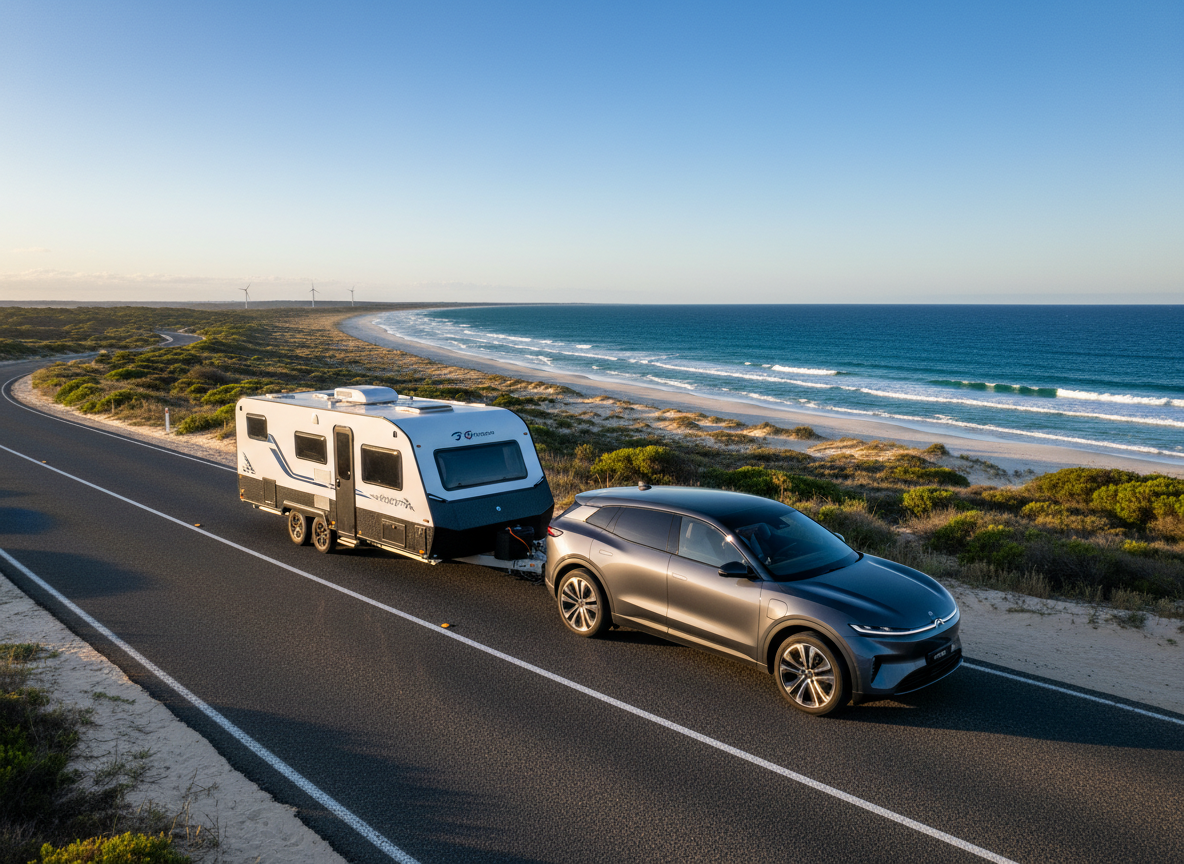
Electric vehicles are rapidly changing the transport landscape across Western Australia, but when it comes to towing, the conversation shifts from environmental benefits to raw physics. If you’re considering an EV for your Perth lifestyle and need to tow a caravan to Coral Bay or haul a boat down to Mandurah, the answer isn’t as simple as checking a brochure’s towing capacity figure.
The reality? Most EVs can tow, but how they tow-and whether they’re practical for Western Australia’s vast distances-requires a deeper look at battery drain, weight distribution, and infrastructure gaps that won’t be solved by 2026.
At All Out Towing, we’ve recovered EVs that’ve run flat mid-journey and transported plenty of electric vehicles that owners assumed could handle a long haul with a trailer. We’ve seen what works and what doesn’t on WA roads. Let’s cut through the marketing and talk about what actually happens when you hook a 2-tonne caravan to a Tesla or Rivian.
What Makes EV Towing Different From Petrol or Diesel
Towing with an internal combustion engine (ICE) vehicle means you’ll burn more fuel-everyone knows that. You might drop from 10L/100km to 15L/100km hauling a caravan, but you can refuel in five minutes at any servo from Perth to Broome.
EV towing Perth is a different beast entirely. It’s not just about “using more battery.” The energy demand skyrockets because electric motors work hardest overcoming aerodynamic drag and moving mass. A caravan acts like a giant parachute behind your vehicle, and battery range can plummet by 40-60% depending on weight, wind, and terrain.
Here’s the kicker: while a diesel ute might see a 30% fuel economy hit, an EV towing the same load could see its effective electric vehicle range towing cut in half. That 500km rated range? It becomes 250km real-world when you’re pulling a 2.5-tonne van into a headwind on the Brand Highway.
Regenerative braking does help-going downhill or slowing down recovers some energy-but it’s not enough to offset the massive drain of highway towing. Think of it like this: regen braking is a small rebate on a huge energy bill. It helps, but it won’t make your battery last twice as long.
Which EVs Can Actually Tow in 2026
Not all electric cars are built for towing. Many popular models-like the Nissan Leaf, Hyundai Ioniq 5, or MG ZS EV-have zero towing capacity. They’re designed for urban commuting, not hauling gear across the Nullarbor.
But a growing number of EVs sold in Australia are rated to tow, and by 2026, that list will expand. Here’s what’s available or coming soon:
Current and Upcoming EV Towing Champions
Tesla Model X: 2,250kg braked towing capacity, 100kWh battery, ~500km range (unladen)
Tesla Model Y: 1,600kg braked capacity, 75kWh battery, ~450km range
Rivian R1T: 5,000kg towing capacity (US spec; Australian variant TBC), dual or quad motor, 135-180kWh battery
Ford F-150 Lightning: 4,500kg towing (if it arrives in Australia), 131kWh battery
Mercedes EQE SUV: 750kg braked, 90kWh battery, ~500km range
BMW iX xDrive50: 2,500kg braked, 111kWh battery, ~600km range
Kia EV9: 2,500kg braked, 99kWh battery, ~500km range (expected late 2024/2025)
BYD Shark PHEV Ute: 2,500kg braked (plug-in hybrid, not pure EV), launching 2024
If you’re serious about towing heavy machinery or a large caravan regularly, the Rivian R1T and Ford F-150 Lightning are the only EVs that compete with traditional diesel utes. But here’s the catch: neither is officially sold in right-hand-drive Australia yet, and even if they arrive, their massive batteries don’t solve the range problem-they just delay it.
What About Plug-In Hybrids?
If you need towing capability and long-range confidence, plug-in hybrids (PHEVs) like the Mitsubishi Outlander PHEV (1,500kg towing) or the upcoming BYD Shark (2,500kg) offer a middle ground. You get electric driving for daily commutes and a petrol engine as backup for long towing trips. It’s not pure EV, but it’s practical for WA’s distances.
The Real-World Range Problem: Perth to Margaret River With a Caravan
Let’s run the numbers on a realistic WA road trip.
Scenario: You own a Tesla Model Y (75kWh battery, 450km unladen range) and want to tow a 1,400kg caravan from Perth to Margaret River-roughly 270km.
What happens:
Towing range drops by 50%-your 450km range becomes ~225km with the van.
You need to charge en route. There’s a fast charger in Bunbury (180km south), so you plan a stop.
Charging takes 30-45 minutes to go from 20% to 80% (fast chargers don’t run full speed at high percentages).
You arrive in Margaret River with ~15% battery left, meaning you’ll need another charge before heading home.
Compare that to a diesel ute: you’d make the trip on one tank, refuel in five minutes, and head home without a second thought.
Now picture towing to Exmouth (1,270km) or Esperance (720km). The fast-charger network along those routes is sparse at best, and non-existent in stretches. You’d be stopping every 150-200km, waiting 30-60 minutes each time, and praying the charger isn’t broken or occupied.
This is why most caravan and boat owners in WA still choose diesel utes. It’s not about range anxiety-it’s about time, convenience, and infrastructure that doesn’t exist yet outside the Perth-to-Albany corridor.
Charging Infrastructure in WA: Where Are We in 2026
Western Australia’s EV charging network is improving, but it’s still patchy beyond the South West. Here’s the reality:
Fast Chargers (50kW+)
Perth Metro: Well covered (RAC, Chargefox, Tesla Superchargers)
South West (Bunbury, Busselton, Margaret River): Adequate
Great Southern (Albany, Katanning): Limited but functional
Wheatbelt, Goldfields, Mid West, North West: Sparse to non-existent
What This Means for Towing
If you’re towing a caravan or boat trailer, you’re already operating at half your normal electric vehicle range towing capacity. That means you must charge every 150-250km, depending on your EV. If a charger is offline, occupied, or simply doesn’t exist, you’re stuck.
And unlike a petrol car that can carry a jerry can, there’s no backup for an EV. If you run flat 80km from the nearest charger, you’re calling for 24-hour emergency towing to get you to a plug. We’ve done those recoveries, and they’re not cheap.
By 2026, expect more chargers along Highway 1 and the South West, but don’t expect full coverage to remote areas. The business case for installing fast chargers in towns with 500 people just isn’t there yet.
Towing Technique: What You Need to Know
If you do decide to tow with an EV, here are the non-negotiables:
Check your towing capacity (braked vs unbraked). Braked capacity is the maximum weight your EV can tow if the trailer has its own brakes (most caravans and boat trailers do). Unbraked capacity is much lower-usually 750kg or less. Never exceed the manufacturer’s towing limit. EVs are heavy (batteries add 400-600kg), and overloading affects handling, braking, and legality.
Distribute weight correctly. Aim for 10% of the trailer’s weight on the towball (e.g., 150kg ball weight for a 1,500kg van). Too little and the trailer sways. Too much and your EV’s rear suspension sags, affecting steering and braking.
Use towing mode (if available). Many EVs (Tesla, Rivian, BMW iX) have a towing mode that adjusts throttle response, regen braking, and stability control. Always activate it before you hitch up.
Plan charging stops in advance. Use apps like PlugShare, Chargefox, or A Better Route Planner (ABRP) to map charging stations. ABRP even accounts for towing and calculates realistic range. Don’t assume a charger will be available-always have a backup plan.
Drive smoothly. Aggressive acceleration and high speeds kill EV range. Keep it under 100km/h when towing, and anticipate braking to maximise regen. Think of it like hypermiling-smooth inputs, steady speed.
What If Your EV Breaks Down While Towing
Here’s where things get tricky. If your EV runs out of charge or suffers a mechanical fault while towing, you can’t just jump-start it or pour in some fuel.
You need a tilt tray. Most EVs can’t be towed on two wheels (even in neutral) because the electric motors can generate voltage and damage the battery system. Tesla, Rivian, and most manufacturers explicitly state: flatbed towing only.
If you’re towing a caravan or boat and your EV dies, that means we need to unhitch your trailer (safely, off the roadway if possible), load your EV onto our tilt tray, and arrange separate transport for your caravan or boat (often requiring a second truck).
It’s more complex and more expensive than recovering a diesel ute. If you’re planning long-distance EV towing, factor this risk into your trip planning-and make sure you’ve got roadside assistance that covers EV recovery.
Should You Wait or Buy Now
If you’re asking whether an EV can tow your caravan or boat in 2026, the honest answer is: yes, but with significant compromises.
You should consider an EV for towing if:
- You’re towing short distances (Perth to Mandurah, Perth to Bunbury)
- You have access to home charging and aren’t in a rush
- You’re towing lightweight trailers (under 1,500kg)
- You’re comfortable with 30-60 minute charging stops every 150-200km
Stick with diesel or PHEV if:
- You’re towing long distances (Perth to Exmouth, Perth to Esperance)
- You tow frequently and can’t afford the time penalty
- You’re towing heavy loads (2,000kg+ caravans, large boats, machinery)
- You travel to remote areas with no charging infrastructure
The technology is improving. Battery energy density is increasing, charging speeds are getting faster, and the network is expanding. But WA’s sheer size and low population density mean we’ll lag behind the eastern states for years.
By 2030, EV towing Perth might be genuinely practical for most WA trips. In 2026? It’s still a niche solution for early adopters willing to plan carefully and accept limitations.
What We’re Seeing on the Road
We transport EVs regularly-whether it’s a prestige car towing job for a Tesla Plaid or recovering a Hyundai Ioniq that misjudged its range. The most common issue? Owners underestimating how much towing drains the battery.
One client tried towing a 1,800kg boat from Perth to Jurien Bay in a Model Y. He made it to Lancelin (127km) before realising he’d burned 60% of his battery. No fast charger in Lancelin. He called us, we brought the car and boat back on two trucks, and he switched to a LandCruiser for the next trip.
That’s not a failure of the EV-it’s a mismatch between the tool and the job. EVs are brilliant for daily driving, even with a small trailer around town. But for serious towing across WA, the infrastructure and range just aren’t there yet.
If you do find yourself stranded or need to move an EV safely, contact us anytime. We’ve got the tilt tray fleet and the experience to handle electric vehicles properly-no guesswork, no damage.
The Bottom Line
Can your electric car tow a caravan or boat in 2026? Technically, yes-if you choose the right EV, plan meticulously, and accept that your trips will take longer and require more patience.
But for most West Australians who tow regularly or travel beyond the South West, diesel and petrol vehicles remain the practical choice. The physics of towing and the realities of WA’s charging network haven’t caught up to the EV revolution yet.
That’ll change. Just not by 2026.
If you’re weighing up an EV purchase and towing is part of your life, run the numbers on your actual trips. Map the chargers. Calculate the time. And be honest about whether you’re willing to trade convenience for lower emissions.
And if your EV or towing setup ever leaves you stranded, you know who to call. We’ll get you sorted, no matter what you’re driving.