Sunday mornings in Perth’s northern suburbs usually mean community footy matches at Joondalup Arena, family coffee runs along Ocean Reef Road, or quiet drives to church services and weekend activities. However, when accidents happen on Sundays, everything changes immediately for those involved. Professional response becomes critical not just for vehicle recovery, but for cutting through confusion, coordinating with emergency services, and removing people from chaotic and potentially dangerous situations quickly and safely.
We’ve been recovering vehicles across Wanneroo, Joondalup, Mindarie, and surrounding northern suburbs for over a decade. Sunday accident response isn’t simply about towing damaged cars from crash sites to repair facilities. It’s about showing up when most businesses don’t answer phones, understanding insurance documentation requirements when claim lines operate with reduced staffing, working directly with WA Police during accident investigations, and providing calm guidance to drivers experiencing one of the most stressful situations they’ll ever face.
Road trauma reshapes families, communities, and individual lives in ways that extend far beyond immediate physical injuries. In 2023 alone, 171 people died on WA roads according to official WA Police statistics, with significant proportions occurring outside standard business hours when professional assistance feels furthest away. Sunday mornings present unique challenges for accident victims and first responders alike, as weekend staffing levels across emergency services, towing operations, and insurance companies create coordination difficulties that weekday accidents don’t typically encounter.
All Out Towing runs 24-hour emergency towing across Perth’s northern suburbs every single day of the year without exception. Sunday morning call outs receive the same immediate response speed, complete equipment access, and experienced operator expertise as Tuesday afternoon jobs. We maintain full operational capacity seven days a week, no skeleton crews, no “we’ll get there when we can” responses, no compromises in service quality because it’s the weekend.
Why Sunday Accidents Require Specialist Response
Sunday mornings see distinctly different traffic patterns compared to weekday peak periods or even Saturday activities. Understanding these patterns helps explain why Sunday accidents create unique recovery challenges requiring specialist knowledge and experience.
Different Traffic Patterns and Accident Dynamics
Sunday mornings between 6am and 11am feature lighter overall traffic volumes but higher average speeds, particularly along major arterial routes like Marmion Avenue, Wanneroo Road, and Mitchell Freeway’s northern extension. Drivers take advantage of clearer roads to travel faster, and this increased speed translates to higher impact severity when accidents occur. What might be a minor fender-bender at 40 km/h during weekday congestion becomes significant structural damage at 80 km/h during Sunday morning’s freer-flowing traffic.
Additionally, Sunday morning drivers often include those less familiar with specific routes, families visiting relatives in different suburbs, tourists exploring Perth’s northern coastal areas, or drivers heading to unfamiliar sporting venues or community events. This unfamiliarity with roads contributes to navigation errors, missed turns, and sudden braking that can trigger accidents. Understanding these patterns helps operators position resources appropriately and anticipate likely accident locations.
Most suburban towing operators don’t staff fully on Sundays, operating instead with skeleton crews or on-call arrangements that significantly extend response times. What should be coordinated Sunday towing in Perth becomes a frustrating waiting game for accident victims who may be injured, in shock, or responsible for damaged vehicles blocking traffic. Our Sunday accident response in northern suburbs ensures the same immediate availability regardless of day, treating weekend emergencies with the same urgency and resource allocation as weekday incidents.
Emergency Service Coordination Challenges
WA Police, ambulance services, and fire rescue all maintain 24/7 operations including Sundays. However, coordination between these services and towing operators can become complicated when commercial operators are operating at reduced capacity or using on-call systems with delayed responses. Professional operators maintaining full Sunday capability integrate seamlessly with emergency services, understanding their protocols, radio systems, and documentation requirements.
Furthermore, accident scenes often require traffic management by Main Roads WA, particularly when accidents block multiple lanes or occur on freeways. Coordinating these traffic management resources during Sundays requires understanding weekend staffing models and communication protocols specific to non-business hours. Operators with experience in this coordination ensure smoother, faster scene clearance that reduces traffic disruption and secondary accident risks.
Insurance Claim Processing During Weekends
Most major insurance companies operate 24/7 claims lines that remain accessible during Sunday mornings. However, weekend staffing typically involves fewer claims handlers covering larger territories, meaning longer hold times and potentially less immediate assessment availability. Professional towing operators understand how to work within these constraints, providing comprehensive documentation that enables smooth claim progression even when immediate insurance assessor availability is limited.
Accident recovery on Sundays requires careful documentation: scene photography before vehicles are moved, damage assessment reports noting pre-existing damage versus accident damage, and secure transport to insurance-approved facilities even when those facilities are closed on weekends. Operators experienced in insurance coordination understand what documentation insurers require and ensure appropriate information is captured before scenes are cleared.
What Happens In The First 30 Minutes After Accidents
The initial half-hour following accidents is critical for safety, legal compliance, and setting appropriate recovery processes in motion. Understanding what should happen during this period helps accident victims know what to expect and what information they need to provide.
Immediate Safety Assessment
First priority is always safety: Are all parties safe from oncoming traffic? Does anyone require medical attention? Are vehicles in stable positions or at risk of rolling, catching fire, or creating additional hazards? Professional operators arriving at accident scenes conduct rapid safety assessments before beginning recovery operations, ensuring all immediate dangers are addressed.
This assessment includes checking for fuel leaks, deployed airbags indicating severe impacts, smoke or unusual smells suggesting fire risks, and structural damage that might cause vehicles to collapse during loading. Operators trained in accident recovery recognise these warning signs and adjust their approach accordingly, potentially requesting fire service support if significant risks are identified.
Emergency Service Notification
If police haven’t already been called, they must be notified for accidents involving injuries, significant property damage, or situations where fault is disputed. WA law requires police notification for accidents meeting specific criteria, and failing to notify when required can complicate insurance claims and potentially result in legal consequences.
Our dispatch team asks specific questions during initial calls to determine whether police notification is required: Are there injuries? What’s the estimated damage value? Are all parties in agreement about fault? This initial assessment ensures appropriate emergency service responses are coordinated from the outset.
Vehicle Position and Traffic Management
Accidents on busy roads create immediate traffic hazards. Vehicles blocking lanes need to be moved to safe positions as quickly as possible, but WA Police often require accident scenes to be preserved until they’ve documented vehicle positions, skid marks, and other evidence. Professional crash site towing with police liaison involves understanding when vehicles can be moved immediately versus when they must remain in position for investigation, balancing traffic flow needs against legal requirements.
Operators carry appropriate warning equipment including high-visibility markers, battery-powered warning lights, and traffic cones that meet Main Roads WA standards. These devices establish safe work zones around accident scenes whilst recovery operations proceed, protecting operators, accident victims, and passing traffic from additional incidents.
Professional Operator Dispatch and Equipment Selection
Not all tow trucks are appropriate for accident recovery. Standard wheel-lift tow trucks can’t safely transport vehicles with front-end damage, deployed airbags, or compromised structural integrity. Our dispatch coordinators ask detailed questions about damage extent, vehicle positioning, and apparent mechanical condition to select appropriate equipment for each specific situation.
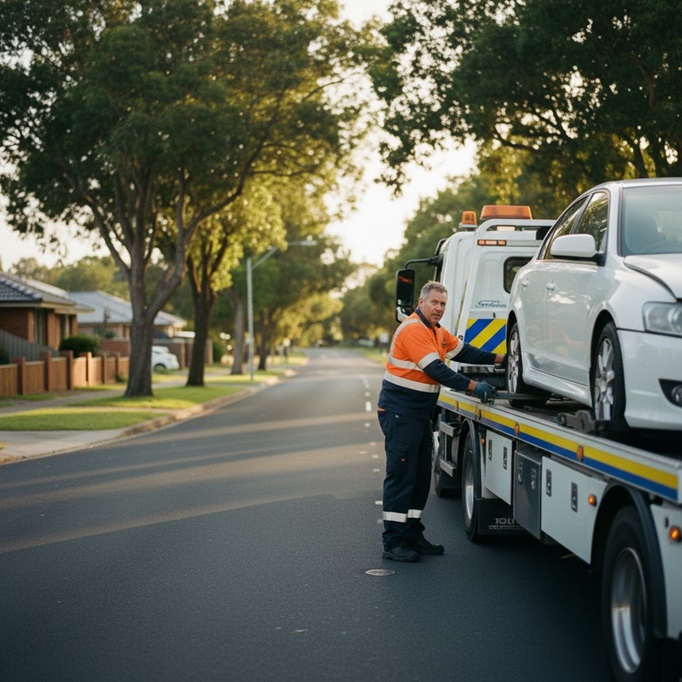
This equipment selection process often involves dispatching tilt tray trucks rather than conventional tow trucks, as accident damage frequently compromises vehicle driveability and structural soundness. Vehicle damage assessment determines whether conventional recovery is safe, or whether complete flatbed transport for damaged vehicles is required to prevent additional damage during recovery and transport.
Making this determination correctly protects both the damaged vehicle and ensures recovery operations proceed safely. Attempting to tow structurally-compromised vehicles conventionally can cause additional damage, create safety hazards during transport, and potentially void insurance coverage if damage worsens due to inappropriate towing methods.
The Northern Suburbs Geography Challenge
Perth’s northern suburbs sprawl across more than 40 kilometres from Balcatta near Perth CBD northward to Yanchep near the metropolitan fringe. This vast geographic area creates specific operational challenges for accident response, particularly during Sunday mornings when traffic patterns and operator availability differ from weekday norms.
Coverage Area Complexity
The northern suburbs encompass diverse environments: dense urban areas around Joondalup CBD, suburban residential zones through Warwick and Woodvale, coastal strips along Marmion Avenue, and semi-rural areas approaching Yanchep. Each zone presents different accident patterns and recovery challenges. Dense urban accidents often involve intersections with multiple traffic signals and restricted access for recovery trucks. Coastal accidents may involve vehicles leaving roads and entering bushland or sand areas requiring winching. Semi-rural accidents along high-speed sections result in greater impact severity and more significant vehicle damage.
We stage trucks strategically in Joondalup, Wanneroo, and Mindarie so Sunday morning response times average 20-25 minutes across the entire northern suburbs coverage area. This positioning requires careful analysis of historical accident patterns, traffic flow models, and probabilistic forecasting of likely incident locations. During Sunday mornings, we position additional resources near high-risk corridors where accident frequency is statistically elevated.
Major Accident Hotspots
Certain intersections and road sections experience disproportionate accident frequencies. Understanding these hotspots allows strategic resource positioning that minimises response times when accidents occur. Major northern suburbs accident hotspots include Mitchell Freeway between Hodges Drive and Hepburn Avenue, Marmion Avenue through Hillarys and Sorrento, Ocean Reef Road particularly near major shopping centres, and Wanneroo Road intersections with cross streets carrying heavy traffic volumes.
We maintain detailed records of accident frequencies by location, time of day, and day of week. This data-driven approach ensures resources are positioned where they’re most likely to be needed, rather than evenly distributed across arbitrary geographic zones. During Sunday mornings, our positioning adjusts to reflect Sunday-specific accident patterns that differ from weekday peak-hour patterns.
Traffic Management Considerations
Accident recovery on busy roads requires coordination with traffic management authorities to ensure safe working conditions whilst minimising traffic disruption. Main Roads WA maintains traffic operations centres monitoring freeway and arterial road traffic flows in real-time. During complex recoveries requiring lane closures or traffic diversions, we coordinate directly with these centres to establish appropriate traffic management.
This coordination becomes particularly important during Sunday mornings when sports events, community activities, and beach traffic create significant volumes despite overall lower traffic densities than weekday peaks. Understanding these Sunday-specific traffic patterns helps operators anticipate congestion points and plan recovery approaches that minimise disruption whilst maintaining safety.
Why Tilt Tray Trucks Are Essential For Accident Recovery
Not all tow trucks can safely recover accident-damaged vehicles. Accident damage compromises structural integrity in ways that make conventional wheel-lift towing dangerous for both the vehicle and other road users. Understanding why tilt tray trucks are essential for most accident recoveries helps explain the equipment investment professional operators maintain.
Structural Integrity Compromises
Modern vehicles are designed with crumple zones that absorb impact energy during accidents by deforming in controlled ways. Whilst this design protects occupants, it also means accident-damaged vehicles have compromised structural strength. Attempting to lift these vehicles using conventional towing methods that place stress on damaged components can cause additional structural failure, potentially dropping vehicles during loading or transport.
Tilt tray trucks eliminate these risks. Entire flatbed trays lower completely flat to ground level. We winch damaged vehicles onto decks without putting any weight on compromised wheels, suspension components, or drivetrains. This approach protects damaged vehicles from further harm whilst ensuring safe transport. The vehicle rests completely on the flatbed with all wheels off the ground, eliminating any mechanical stress during transport.
Deployed Airbag Considerations
Vehicles involved in sufficient-impact accidents to deploy airbags require special handling. Deployed airbags indicate significant deceleration forces that may have caused hidden structural damage beyond visible exterior damage. Additionally, undeployed secondary airbags (side curtains, knee airbags, additional front modules) remain present and could potentially deploy during recovery operations if electrical systems are disrupted.
Professional operators trained in accident recovery understand these risks and use appropriate techniques when handling vehicles with deployed airbag systems. Tilt tray trucks minimise handling that could trigger additional deployments, loading vehicles with minimal disturbance to damaged electrical systems and supplemental restraint components.
Securing Methods for Compromised Vehicles
Standard securing points used for conventional towing may be damaged or compromised in accident vehicles. Frame damage, suspension distortion, or body panel collapse can eliminate normal attachment points used to secure vehicles during transport. Tilt tray operators must identify alternative securing points that provide adequate strength without causing additional damage.
This requires experience and training beyond standard towing operations. Operators must understand vehicle structures well enough to identify appropriate alternative securing points when standard locations are unavailable. Using inappropriate attachment points can cause additional damage or allow vehicles to shift during transport, creating serious safety hazards.
Protection During Transport to Assessment Facilities
Accident-damaged vehicles often have sharp edges, protruding metal, broken glass, and other hazards that require careful management during transport. Tilt tray transport keeps these damaged vehicles isolated on the flatbed, preventing contact with other vehicles or roadway users. Conventional towing with damaged vehicles partially suspended can create hazards for following traffic if debris falls or damaged components separate during transport.
Furthermore, insurance companies require vehicles to arrive at assessment facilities in the same condition as when they left accident scenes. Additional damage occurring during transport complicates insurance claims and can result in disputes about what damage resulted from the accident versus what resulted from recovery operations. Professional tilt tray transport minimises these risks, protecting both customers and operators from insurance complications.
Insurance Coordination And Sunday Claims
Most major insurance companies operate 24/7 claims lines that remain accessible during Sunday mornings, but weekend claim processing operates differently than weekday procedures. Understanding these differences helps accident victims navigate claims processes smoothly even when incidents occur during weekends.
24/7 Claims Line Availability
Major insurers including AAMI, NRMA, Allianz, RAC Insurance, and others maintain dedicated claims reporting lines available 24 hours daily including Sundays and public holidays. However, Sunday staffing typically involves fewer claims handlers covering larger territories than weekday operations. This means longer hold times when calling to report accidents and potentially delayed assessor deployment for physical vehicle inspections.
We bridge this gap with professional accident scene documentation. If drivers are covered for towing through comprehensive insurance policies, we can often bill insurers directly after obtaining claim reference numbers and policy details. We document accident scenes thoroughly before vehicles are moved, capturing photographs that support insurance claims even when assessors can’t attend immediately.
Weekend Documentation Requirements
Insurance companies require specific documentation to process claims efficiently: photographs of all damaged vehicles from multiple angles, documentation of accident scene including positions, traffic controls, and environmental conditions, contact information for all parties involved including witnesses, police report reference numbers if police attended the scene, and initial damage assessments noting extent of structural versus cosmetic damage.
Professional operators experienced in insurance coordination ensure this documentation is captured appropriately before scenes are cleared. We provide digital photo packages to customers at no additional charge, ensuring they have comprehensive evidence supporting their insurance claims. This thorough documentation prevents disputes about damage extent and helps expedite claim processing when insurers return to full staffing on Monday mornings.
Direct Billing Arrangements
Many comprehensive insurance policies include towing coverage that eliminates out-of-pocket costs for customers. We maintain direct billing arrangements with all major insurance companies, allowing us to submit invoices directly rather than requiring customers to pay and seek reimbursement. This arrangement benefits customers by eliminating immediate financial stress during already-difficult situations.
However, direct billing requires proper documentation and authorisation. We obtain necessary policy details, claim reference numbers, and verbal authorisation from insurers before proceeding with recovery operations. This ensures billing proceeds smoothly and customers aren’t surprised by unexpected invoices if insurance authorisation wasn’t properly obtained.
Approved Assessment Facility Coordination
Insurance companies maintain networks of approved assessment facilities and repairers with whom they’ve negotiated pricing agreements. Directing damaged vehicles to these approved facilities often expedites claim processing and ensures repairs meet insurer quality standards. However, these facilities are typically closed on Sunday mornings, creating logistical challenges for accident vehicle storage.
We coordinate transport to approved facilities even when they’re closed, securing vehicles in facility car parks or, when necessary, in our own secure storage yard until facilities reopen. This coordination ensures vehicles are positioned appropriately for Monday morning assessments whilst protecting them from weather, theft, or vandalism during weekend storage periods.
Multi-Vehicle Accident Coordination
Accidents involving multiple vehicles require coordinated recovery operations that address each vehicle appropriately whilst managing overall scene safety and traffic flow. Sunday mornings occasionally see multi-vehicle accidents during sports event traffic or on freeway sections where speed differentials between vehicles create chain-reaction collision risks.
Coordinating Multiple Recovery Trucks
Multi-vehicle accidents often require deploying multiple recovery trucks simultaneously to clear scenes efficiently. We maintain sufficient fleet capacity to handle these situations, deploying 2-3 trucks when necessary to expedite scene clearance. This coordinated approach minimises traffic disruption and reduces secondary accident risks caused by extended lane closures.
Coordinating multiple trucks requires experienced dispatch personnel who understand which equipment is appropriate for each damaged vehicle, prioritise recovery sequence based on traffic management needs, and maintain communication between truck operators to ensure efficient, safe operations. Our dispatch team manages these complex scenarios regularly, ensuring smooth coordination even during high-pressure emergency situations.
WA Police Scene Management
When police attend accidents, they control scenes until investigations are complete and they authorise vehicle removal. Professional operators understand these protocols and work cooperatively with attending officers rather than attempting to expedite operations beyond what police procedures allow. This cooperation builds professional relationships that benefit both emergency services and commercial operators over time.
Police may require detailed scene documentation including measuring distances between vehicles, photographing skid marks or debris patterns, and interviewing witnesses before authorising vehicle recovery. Professional operators anticipate these requirements and position equipment appropriately without interfering with investigative processes. Our operators carry appropriate credentials and understand how to interact professionally with emergency services personnel.
Traffic Flow Restoration
Extended lane closures during accident recovery create traffic backups that can extend for kilometres, particularly on freeways or major arterial roads with limited alternative routes. Professional operators prioritise efficient scene clearance that restores traffic flow quickly whilst maintaining appropriate safety protocols. This requires balancing urgency against thoroughness, working methodically but without unnecessary delays.
Modern recovery equipment enables faster scene clearance than older conventional towing methods. Tilt tray trucks can load damaged vehicles in 10-15 minutes compared to 20-30 minutes for conventional towing involving multiple securing points and balance adjustments. This efficiency benefits everyone: accident victims get moved from stressful roadside situations faster, traffic returns to normal flow sooner, and emergency services can return to availability for other potential incidents.
Conclusion
Sunday morning accidents require immediate professional response that coordinates effectively with emergency services, documents situations appropriately for insurance claims, and recovers vehicles safely using equipment appropriate for damaged vehicles’ compromised structural integrity. Drivers involved in Sunday accidents benefit from operators who work seamlessly with WA Police, maintain direct relationships with insurance companies, and understand the unique challenges of weekend accident recovery when normal business support systems operate at reduced capacity.
Professional accident recovery extends far beyond simply towing damaged vehicles from crash scenes. It involves providing calm guidance during chaotic situations, ensuring appropriate documentation for legal and insurance purposes, protecting vehicles from additional damage during recovery and transport, and coordinating storage when assessment facilities are closed. These comprehensive services distinguish professional operators from simple towing services that lack training, equipment, or experience for proper accident recovery.
For immediate Sunday accident assistance, call 0418 959 216 for professional recovery across Joondalup, Wanneroo, Mindarie, and all northern suburbs. Our team operates at full capacity every Sunday, providing the same rapid response, expert handling, and comprehensive service that weekday accidents receive, including expert car recovery services and rapid breakdown response for both accident and mechanical emergency situations.