You’re having a brilliant day at the beach. The sun’s out, the kids are happy, and you’ve found the perfect spot near the water. Then you try to leave, and your tyres just spin. Sand flies everywhere, your car sinks deeper, and that sinking feeling in your stomach matches what’s happening to your vehicle.
Getting bogged in sand is one of those experiences that makes you feel simultaneously foolish and helpless. You know you shouldn’t have driven quite so close to the soft stuff, but hindsight’s not much help when you’re axle-deep and the tide’s coming in. The good news? This happens to hundreds of Perth drivers every summer, and professional car recovery Perth operators like All Out Towing have seen it all before.
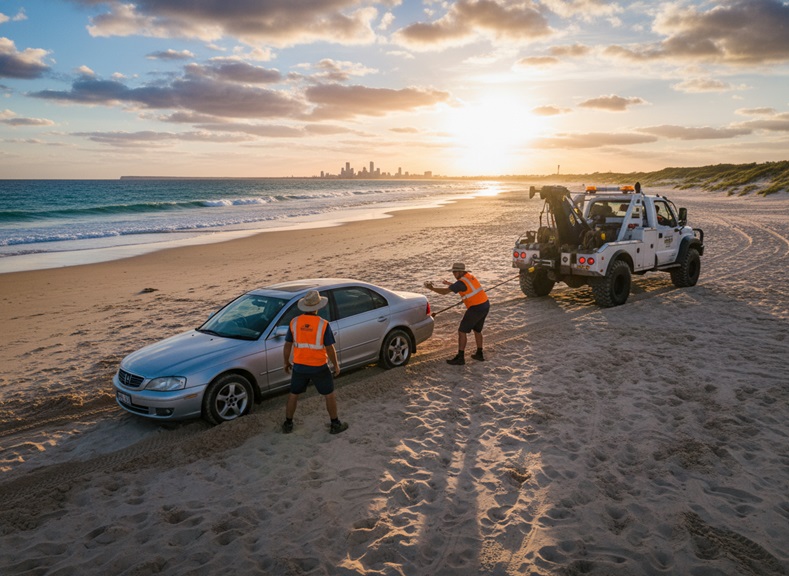
Our team has spent over fifteen years pulling vehicles out of sand along WA’s coastline, from Yanchep down to Mandurah. One scorching January afternoon, we were called to Quinns Beach, where a brand-new Land Cruiser was buried up to its running boards. The owner had all the right gear in the back – recovery tracks, shovel, the works – but sometimes you need more than equipment. You need technique, experience, and occasionally, a proper tow truck with enough grunt to do what a mate’s 4WD can’t.
Why Sand Traps Your Car So Effectively
Sand doesn’t play by the same rules as dirt or gravel. When your tyres can’t get traction, they dig instead of grip. The weight of your vehicle compresses the sand beneath it, creating a bowl that gets deeper with every wheel spin. It’s like trying to climb out of a hole by digging faster – you’re working against yourself.
Beach sand near the water is particularly treacherous because it’s often damp underneath a dry crust. You drive onto what looks solid, and suddenly you’ve broken through to the wet layer below. Your tyres sink, your chassis grounds out, and you’re stuck fast.
The type of vehicle matters less than you’d think. Our beach towing Perth crews have recovered plenty of 4WDs driven by people who assumed their car’s capabilities exceeded the laws of physics. Two-wheel drives get stuck faster, but overconfident 4WD owners often get stuck deeper because they keep trying to power out.
What Makes Professional Beach Towing Perth Services Different
You might wonder why you can’t just get a friend with a truck to yank you out. Sometimes that works. Often it doesn’t – and occasionally it makes things spectacularly worse.
Professional beach towing Perth specialists understand the mechanics of sand recovery. Pulling at the wrong angle can damage your vehicle’s undercarriage or suspension. Our operators use proper recovery points and equipment rated for the heavy forces involved. Your mate’s tow ball and a bit of rope? That’s a bent chassis or snapped cable waiting to happen.
The right recovery vehicle matters enormously. Beach recoveries need either a proper tow truck with enough weight and power to maintain traction or a specially equipped 4WD with diff locks, appropriate tyres, and a driver who knows what they’re doing. At All Out Towing, we’ve got both – along with years of experience reading sand conditions and knowing which approach will work for your specific situation.
If your bogged vehicle requires damage-free extraction, our tilt tray services provide the safest option for prestige or low-clearance cars.
The Damage You Don’t See Coming
Here’s what worries professionals about DIY recoveries – the hidden damage. When you’re stuck in sand, especially wet sand, there’s often water and grit getting into places it shouldn’t. Brake components, wheel bearings, and undercarriage parts are all exposed. A rushed, aggressive recovery can force more contamination into these systems.
We’ve seen people snap axles, tear off bumpers, and bend chassis rails trying to get unstuck. The repair bills dwarf what a professional recovery would’ve cost. One driver at Alkimos Beach tried to winch himself out using a star picket he’d hammered into the sand. The picket came out like a javelin, went straight through his radiator, and turned a $200 recovery into a $3,000 repair job – plus the recovery anyway.
There’s also the timing factor. The longer your car sits bogged, especially near the water, the worse your situation becomes. Sand settles, tides come in, and what started as a simple extraction becomes a race against seawater. Professional car recovery Perth operators know this and work quickly to get you out before conditions deteriorate.
What Happens During a Professional Sand Recovery
When you call for help, the first thing we’ll ask is your exact location and how stuck you are. “Pretty stuck” doesn’t tell us much – we need to know if you’re buried to the sills, whether you’re near the water line, and what type of vehicle you’re driving.
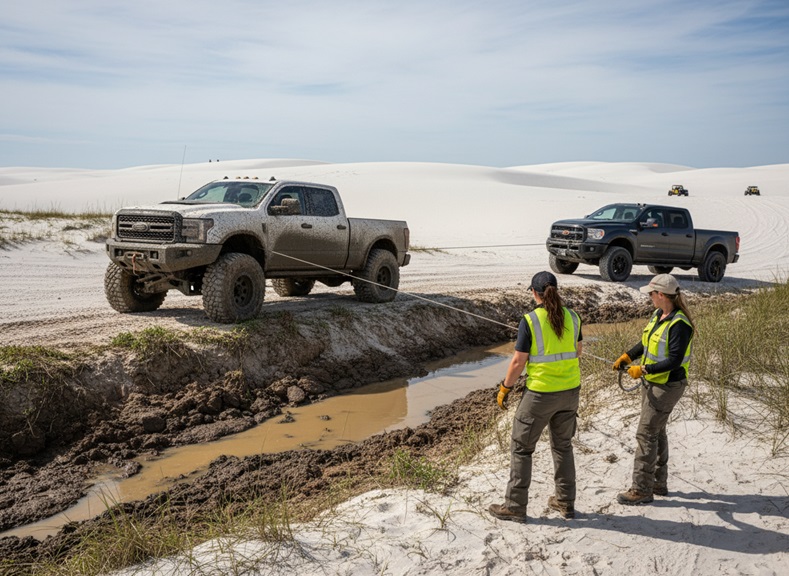
We’ll arrive with the right equipment already loaded, for most beach recoveries, that includes recovery tracks, a shovel, a tyre-deflation kit, and rated snatch straps or winch gear. The first step isn’t pulling – it’s assessment. We check what’s actually touching the ground, where the solid sand is, and what’s preventing your vehicle from moving.
Often, we’ll deflate your tyres first. Lower pressure increases the tyre’s footprint, giving more flotation on soft sand. Then we dig out around the tyres and chassis, removing compacted sand that’s creating resistance. Recovery tracks go under the drive wheels to give them something solid to grip.
The actual extraction is usually less dramatic than people expect. A steady, smooth pull in the right direction at the right angle does the job. No wheel spinning. No jolting. Just physics applied correctly. Your car comes out, we check for any obvious damage, and you’re back on solid ground.
The Mistakes That Make Things Worse
The biggest mistake people make when bogged is panic-accelerating. Your instinct says to give it more power, but all you’re doing is digging deeper and overheating your transmission. Stop as soon as you feel yourself sinking.
The second mistake is accepting help from anyone with a tow rope. Good intentions don’t equal good technique. We’ve responded to countless situations where a “helpful” stranger has either got themselves stuck trying to assist or caused damage by pulling incorrectly. Unless someone demonstrably knows what they’re doing – and has proper gear – wait for professional help.
Trying to drive out by rocking back and forth can work on firm surfaces, but in soft sand it usually creates deeper ruts. You’re also risking transmission damage if you keep shifting between drive and reverse under load.
Some people try to put things under their tyres – bits of wood, floor mats, even clothing. On soft sand, these items just get buried or shredded. Proper recovery tracks are designed to bridge the gap and spread the load. Your car’s floor mats aren’t.
When to Call for Help Immediately
If you’re stuck near the water and the tide’s coming in, don’t muck about. Call for 24-hour emergency towing straight away. Seawater and cars don’t mix, and a vehicle swamped by the tide is often a write-off. Insurance companies take a dim view of preventable flood damage.
Similarly, if you’re blocking access or stuck in a restricted area, get professional help fast. Some beaches have limited entry points, and you don’t want to be the one trapping twenty other cars at the access track.
If you’ve already tried several times and you’re just digging deeper, stop. Every attempt makes the recovery harder and potentially causes damage. It’s frustrating to wait, but it’s cheaper and safer than continuing to make things worse.
For non-towing help – jump starts, tyre changes, or fuel delivery – our roadside assistance team is available around the clock.
How to Avoid Getting Bogged in the First Place
The best recovery is the one you don’t need. When driving on sand, stay on firm, damp areas near the water line – but not so close that waves can reach you. The dry, soft sand further up the beach is where most people get caught out.
Keep your speed steady and steering smooth. Sudden changes in direction or speed break through the surface crust. If you feel your car losing momentum, don’t accelerate – maintain steady throttle until you reach firmer ground.
Lower your tyre pressure before driving onto sand. For most vehicles, 18-20 PSI provides good flotation without risking the tyre coming off the rim. Don’t forget to reinflate before driving on sealed roads again.
According to Main Roads WA, beach driving requires specific precautions and awareness of local conditions. Some beaches have areas that are consistently soft or dangerous, and local knowledge matters.
The Insurance Question Nobody Asks Until It’s Too Late
Most comprehensive car insurance policies cover beach recovery, but there are conditions. If you’ve driven into a restricted area or ignored warning signs, your claim might be denied.
Check your policy before heading out. Some insurers exclude mechanical damage from beach driving or sand recovery. Others cover the recovery but not the aftermath.
If you need recovery, document everything. Take photos of your location, nearby signage, and your vehicle’s condition before and after. Keep all receipts – professional operators like All Out Towing provide detailed invoices accepted by insurers. DIY recoveries that go wrong are much harder to claim because there’s no professional documentation of what occurred.
The Reality of Beach Access in Perth
Perth’s northern beaches – Yanchep, Quinns, Mindarie – are stunning but not all 4WD accessible. Many have soft sand approaches that catch out even experienced drivers. The southern beaches down towards Mandurah often have firmer sand but narrower access tracks, where getting stuck can block others.
Some beaches require permits for vehicle access. Driving without one can result in fines on top of recovery costs. The WA Department of Transport provides up-to-date information about where you can and can’t drive on beaches.
Local councils also have specific rules. The City of Wanneroo, for instance, restricts beach driving in certain areas during nesting seasons to protect wildlife. Getting stuck in a restricted area means paying for recovery, a fine, and possibly further penalties if dunes or vegetation are damaged.
What Professional Recovery Actually Costs
Beach recovery costs vary based on how stuck you are, where you are, and when you need help. A straightforward extraction during business hours typically costs less than a complex recovery at midnight with the tide coming in.
Most car recovery Perth companies charge a call-out fee plus time and any special equipment used. Expect around $200 for a simple pull-out to $800 or more for complex recoveries involving multiple vehicles. It sounds like a lot – until you compare it to repair costs from a botched DIY attempt.
After-hours and weekend callouts cost more because you’re paying for immediate availability. If you’re stuck but safe, waiting until morning can save money. If you’re in danger or blocking access, the premium is worth every cent.
When you get in touch with a professional service, ask for a clear quote before they dispatch. Reputable operators will give you an honest estimate.
Why Experience Matters More Than Equipment
We’ve seen people with thousands of dollars’ worth of recovery gear get stuck worse because they didn’t understand the principles. We’ve also completed simple recoveries with basic equipment because we knew exactly where to pull from and at what angle.
Experience teaches you to read sand conditions – to spot the difference between sand that’ll hold a vehicle and sand that won’t. Professional beach towing Perth operators develop a feel for how much force is needed and when to stop before causing damage.
There’s also the safety factor. Sand recoveries involve heavy equipment and high tension. Snatch straps under load can be dangerous if they fail. Vehicles can roll if pulled from the wrong angle. Professionals understand these risks and have procedures to minimise them.
The Environmental Considerations You Might Not Think About
Beach and dune systems are fragile. Spinning wheels or creating deep ruts can cause erosion that takes years to repair. When you’re being recovered, the method matters.
Professional towing crews know how to extract vehicles with minimal environmental impact. We use existing tracks where possible, avoid sensitive areas, and employ techniques that don’t tear up the landscape unnecessarily. It’s about responsibility – and avoiding fines from rangers who patrol WA’s coast.
The Department of Biodiversity, Conservation and Attractions manages many coastal areas and enforces penalties for environmental damage. That’s why our recovery techniques prioritise safety for both you and the environment.
What to Do While You’re Waiting
Once you’ve called for help, resist the temptation to keep trying. Every attempt risks digging deeper or causing mechanical harm.
If you’re near the water, watch the tide. Move valuables from your car and stay clear of rising waves. No vehicle is worth risking your safety.
Stay with your vehicle unless there’s a clear safety reason to leave – the recovery team needs to find you quickly. If it’s hot, stay hydrated and create shade if possible. Perth summers are brutal, and 24/7 roadside assistance can get busy during peak beach season.
Whether it’s a day out at Lancelin or a family trip to Mindarie, All Out Towing has the experience, equipment, and calm professionalism to get you back on solid ground safely.