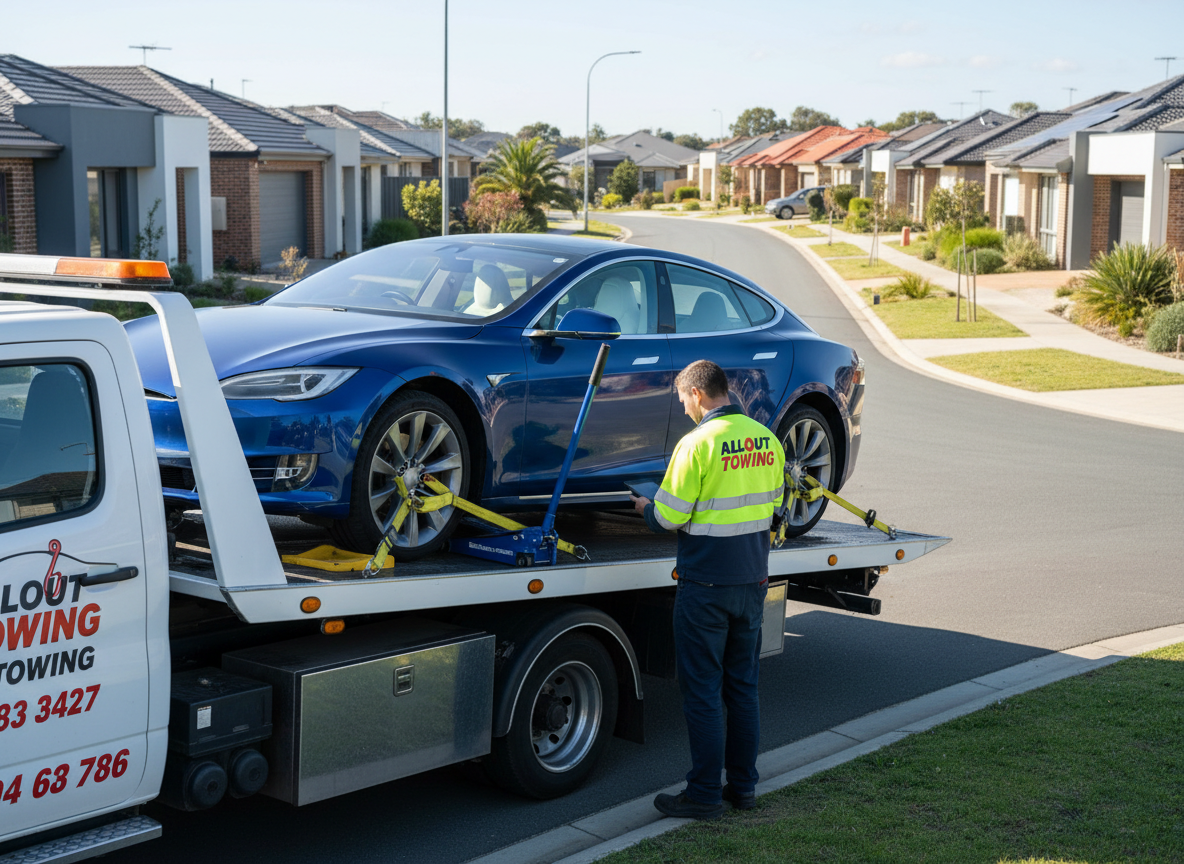
Electric vehicles have become a common sight on Perth’s northern suburbs roads, from Joondalup to Wanneroo and across to Ellenbrook. But when your Tesla, Hyundai Ioniq, or BYD breaks down, the towing process isn’t the same as a petrol car. It’s more complex.
The battery systems, regenerative braking, and drivetrain configurations in EVs require specialised knowledge to move safely. Get it wrong, and you’re looking at thousands in damage to the electric motor or battery pack. That’s why understanding electric vehicle towing Perth protocols matters, whether you’re an EV owner or simply planning to buy one.
We’ve been towing vehicles across Perth for over 15 years, and the shift to electric has changed our entire approach. Here’s what you need to know.
Why Electric Vehicles Can’t Be Towed Like Regular Cars
Most modern EVs use permanent magnet motors connected directly to the wheels. When those wheels turn, the motor spins. Simple enough, right?
Here’s the problem: when you tow an EV with its drive wheels on the ground, the spinning wheels turn the motor, which generates electricity. But unlike when you’re driving and that energy feeds back into the battery (regenerative braking), during a tow there’s no control system managing that power. The uncontrolled voltage can fry the motor’s electronics or damage the battery management system.
It’s like trying to charge your phone by jamming a wire directly into the battery, bypassing all the safety circuits. You wouldn’t do it.
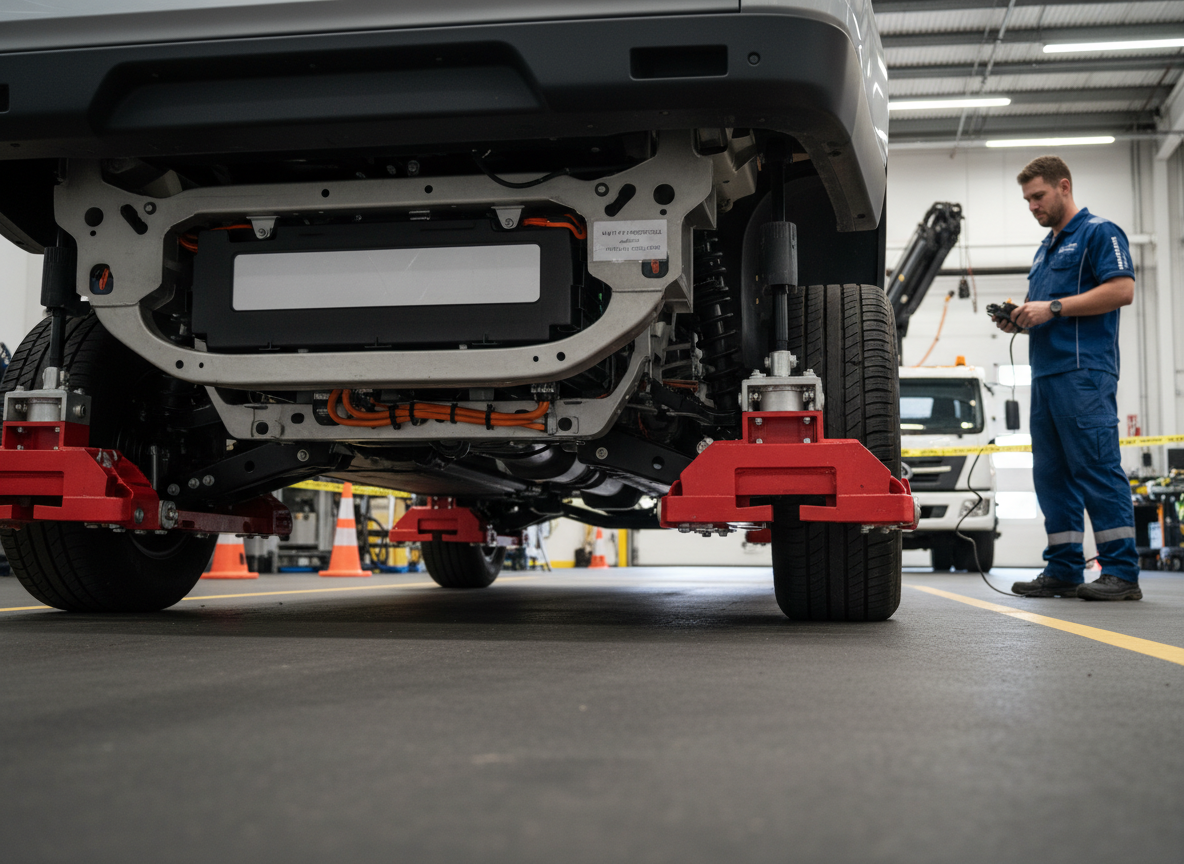
All-wheel-drive EVs face an even trickier situation. With motors on both axles, you can’t simply lift one end. Both sets of wheels need to be off the ground, or you risk damaging the entire drivetrain.
Some manufacturers allow very short-distance towing (we’re talking metres, not kilometres) with specific procedures. But most owner’s manuals are clear: flatbed or tilt tray EV transport only.
The Only Safe Method: Tilt Tray Transport
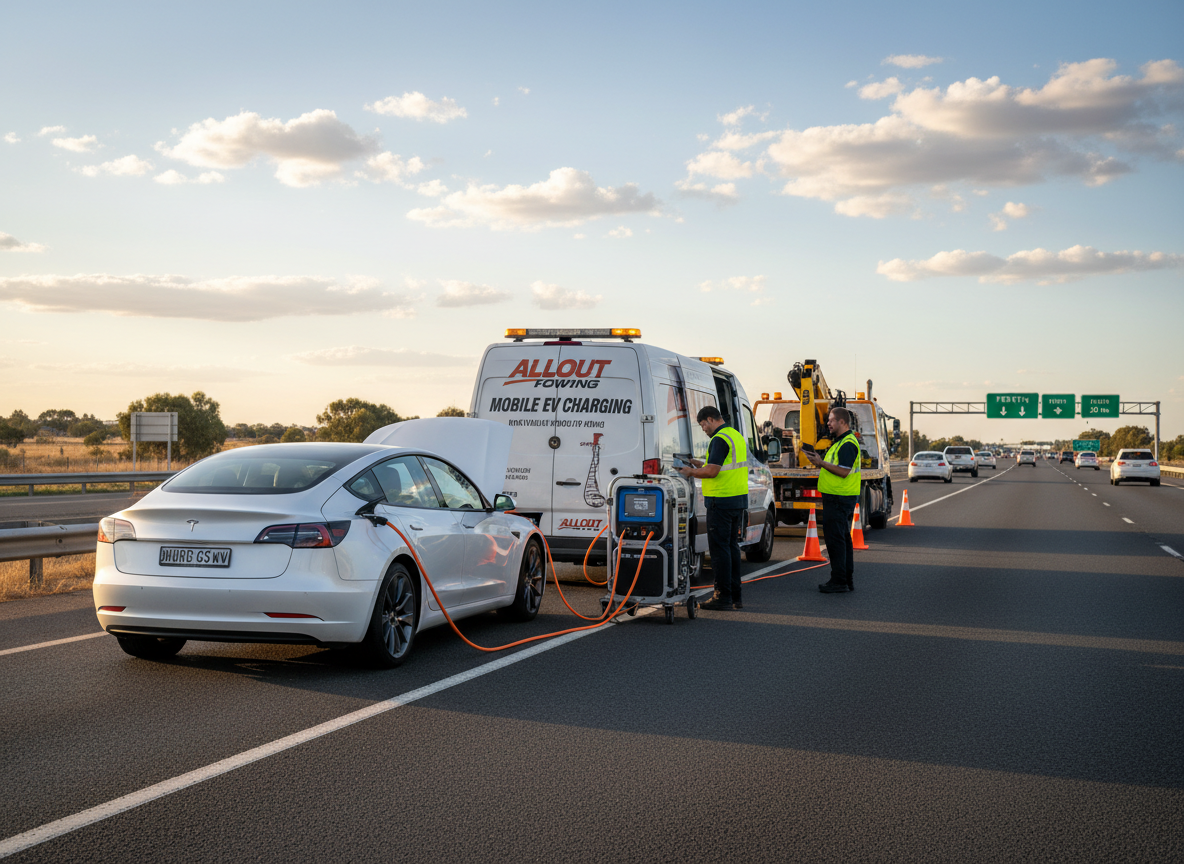
When we respond to an EV breakdown in the northern suburbs, we bring a tilt tray truck. Always.
A tilt tray (also called a flatbed) completely lowers to ground level. We don’t need to roll your car or spin the wheels. The vehicle is winched onto the tray while stationary, then secured with wheel straps and tie-downs. All four wheels stay locked in place during transport.
No spinning wheels. No motor rotation. No unexpected power generation. No drivetrain stress.
The entire vehicle sits flat and motionless, exactly as if it were parked in your garage. It’s the same method we use for vintage car towing because the risk of damage is virtually zero.
What About Wheel Dollies or Traditional Tow Trucks?
You might see older tow trucks using wheel dollies, small wheeled platforms that lift one axle while the other rolls. This works fine for some petrol cars. For EVs? Absolutely not.
Even with dollies under the rear wheels, if the front wheels (where many EVs have their motor) are rolling, you’re still spinning that motor. Same problem, same risk.
Hook and chain towing (the classic image of a car being dragged behind a truck) is even worse. Beyond the motor damage, you’re putting massive stress on the suspension and undercarriage of a vehicle that weighs significantly more than a comparable petrol car due to its battery pack.
Some EV owners ask about putting the car in neutral or “transport mode.” While certain models (like Teslas) have a transport mode that disengages the motor, this isn’t universal across all EVs, and it’s not foolproof. Tow operators can’t guarantee the electronics will behave as expected during a long tow. Why risk an $80,000 vehicle on a maybe?
Our tilt tray services remove the guesswork entirely.
Specific Challenges in Perth’s Northern Suburbs
The northern suburbs present unique challenges for electric vehicle towing Perth operations. Many homes in Ellenbrook, Yanchep, and Two Rocks are on larger blocks with narrow driveways, gravel paths, or steep inclines. Getting a tilt tray truck into position requires planning.
Underground car parks at shopping centres (Joondalup, Wanneroo), beach car parks with soft sand (Mindarie, Quinns Rocks), residential streets with tight turning circles, and construction zones in new housing estates all demand different approaches.
Sometimes we need to use a smaller tilt tray or coordinate with local councils to temporarily close a lane. The key is communication before we arrive.
If your EV breaks down in a tricky location, let us know the specifics when you contact us for a quote. We’ll bring the right equipment the first time.
What to Do When Your EV Breaks Down
First, stay calm. You’re not the first EV owner to face this, and you won’t be the last.
Here’s what to do immediately:
Get to a safe location if possible. If the vehicle still has some power or can roll in neutral, try to move it off the road. If you’re on a freeway or busy road like Marmion Avenue or Wanneroo Road, exit the vehicle safely and move behind the barrier.
Engage the parking brake. Most EVs have electronic parking brakes. Activate it to prevent any rolling. This also locks the wheels, which is what we want for loading.
Turn on hazard lights. Even if the main battery is dead, the 12V accessory battery usually keeps hazards running for a while.
Call for professional towing. Don’t accept help from a random tow truck that happens to drive past. Not all operators understand EV requirements. Call a service you trust, one that explicitly offers safe tilt tray EV transport with proper equipment.
Check your owner’s manual for transport mode. If your EV has a transport mode (Tesla, some Audis), activate it according to the manual. This usually puts the vehicle into a state where it can be moved more easily. But don’t assume this makes traditional towing safe. It doesn’t.
Document the situation. Take photos of your vehicle’s position and any damage if you’ve been involved in an accident. This helps with insurance claims later.
Insurance Considerations for EV Towing
Most comprehensive car insurance policies cover towing, but here’s the catch: they’ll often send the cheapest available tow truck. That might be a traditional hook-and-chain operator who doesn’t understand EVs.
When you call your insurer, be explicit: “I need a flatbed or tilt tray truck. My vehicle is an electric car and cannot be towed with wheels on the ground.”
If they push back, refer them to your owner’s manual. Every major EV manufacturer specifies flatbed transport. Your insurer is obligated to arrange appropriate towing that won’t damage your vehicle.
If you’re with RACWA, they’re generally well-equipped for electric vehicle towing Perth situations. But smaller or budget towing services might not be. It’s worth asking before they dispatch a truck.
Some EV owners add specific towing coverage to their policies that guarantees flatbed transport. If you’re driving a high-value EV (Porsche Taycan, Mercedes EQS, etc.), this is worth considering.
Common EV Towing Myths We Hear in Perth
Myth 1: “You can tow an EV for short distances with the wheels down.”
Technically, some manufacturers allow towing for up to 10 metres at walking speed. But “short distance” doesn’t mean “from Joondalup to Osborne Park.” Any distance over a few metres risks damage. It’s not worth it.
Myth 2: “If the battery is dead, the motor won’t generate power.”
The 12V accessory battery might be dead, but the high-voltage traction battery is separate. The motor can still generate voltage when spun, even if the car won’t start.
Myth 3: “My EV has a neutral mode, so it’s fine to tow.”
Neutral disengages the transmission in a petrol car. In an EV, there’s no traditional transmission. Neutral might allow the wheels to spin freely, but that’s exactly what we’re trying to avoid.
Myth 4: “I can just disconnect the battery before towing.”
EV batteries aren’t like the 12V battery in a petrol car. They’re high-voltage systems (400V to 800V) integrated into the vehicle’s structure. Disconnecting them requires specialised tools and training. Don’t attempt this yourself.
What Happens After We Tow Your EV
Once your vehicle is secured on our tilt tray, we’ll transport it to your chosen destination. Most EV owners request towing to authorised service centres (brand-specific dealerships like Tesla Service Centre in Osborne Park, Hyundai dealers, etc.), home if you have a mobile mechanic or electrician coming to assess the issue, or independent EV specialists (Perth now has several workshops that focus on electric vehicle repair).
We’ll need to know the destination before we start. EV service centres often have specific drop-off procedures, especially for vehicles with damaged batteries (if you’ve been in an accident). We’ll coordinate with them to ensure a smooth handover.
If your EV has been in a collision, there are additional safety protocols. Damaged lithium-ion batteries can pose fire risks, so we’ll assess the situation carefully and follow manufacturer guidelines for transport. In rare cases, this might involve isolating the vehicle or using fire-resistant containment.
Our team is trained in these procedures. We’ve worked with accident towing scenarios involving EVs and understand the risks.
The Future of EV Towing in Perth
As more Western Australians switch to electric vehicles (WA had over 15,000 EVs registered by mid-2024), the towing industry is adapting. We’ve invested in additional tilt tray trucks and trained our operators specifically for EV recovery.
Manufacturers are also improving. Newer EVs have better “transport modes” and clearer towing instructions. Some are even developing systems that allow limited flat-towing in emergencies, though we’re not there yet.
For now, if you own an EV in Perth’s northern suburbs, the message is simple: plan ahead. Know who to call, understand your vehicle’s requirements, and don’t let anyone tow your car with a method that’s not manufacturer-approved.
When You Need Help Right Away
Breakdowns don’t wait for business hours. Your EV might stop working at 2 AM on a Sunday, or during peak hour on Mitchell Freeway.
That’s why All Out Towing offers 24-hour emergency towing across Perth, including all northern suburbs. Our tilt tray trucks are ready to respond, and our operators know exactly how to handle electric vehicles safely.
If you’re stuck, don’t risk your vehicle with an inexperienced operator. Call a team that understands the stakes.
Conclusion
Towing an electric vehicle isn’t complicated, but it is specific. The rules are different, the risks are real, and the consequences of getting it wrong are expensive. Perth’s northern suburbs are growing fast, and EVs are becoming the norm rather than the exception. That means more EV owners will eventually face a breakdown or accident that requires professional towing.
The safest approach is always tilt tray EV transport. It eliminates every risk associated with spinning motors, drivetrain damage, and battery system failures. Whether you’re driving a budget-friendly MG ZS EV or a six-figure Porsche Taycan, the method is the same: all four wheels off the ground, secured and transported flat.
At All Out Towing, we’ve adapted our fleet and training to meet the demands of Perth’s electric vehicle boom. We understand what’s at stake when you call us, and we treat every EV with the care it deserves. Because when your car won’t start and you’re stuck on the side of the road, the last thing you need is more stress.
If you’re an EV owner in Joondalup, Wanneroo, Ellenbrook, or anywhere in Perth’s northern suburbs, save our number. When you need help, we’ll be ready with the right equipment and the right expertise. No guesswork, no shortcuts, just safe, professional transport that gets your vehicle where it needs to go.