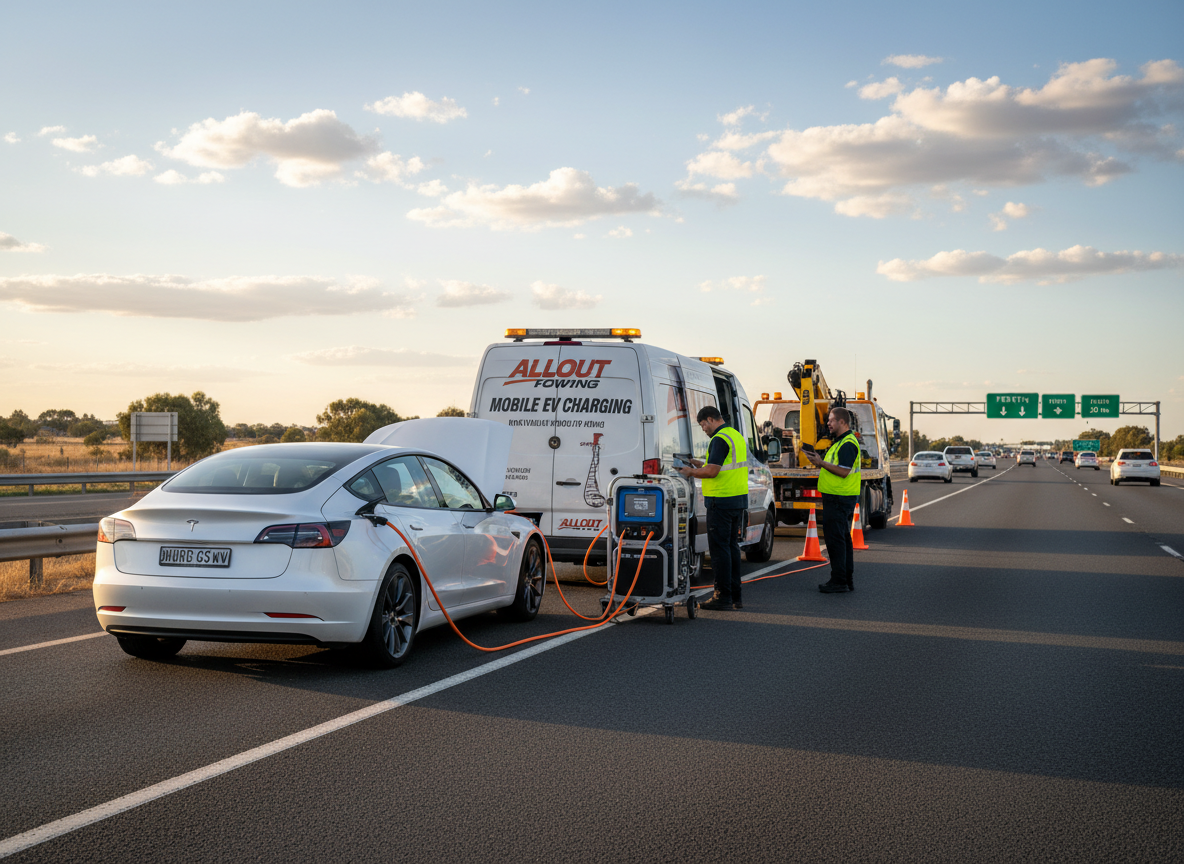
Electric vehicles are becoming more common on Perth roads, but they bring a challenge that’s completely new to most drivers: running out of charge far from a charging station. It’s not like running out of petrol where you can walk to a servo with a jerry can. When an EV’s battery hits zero, you’re stuck.
That’s where the towing industry has had to evolve quickly. At All Out Towing, we’ve watched this shift happen in real time over the past few years. What started as occasional callouts for stranded Teslas has become a regular part of our daily operations. And it’s pushed us to develop new solutions that didn’t exist even five years ago.
The reality is simple: Perth’s EV charging infrastructure is growing, but it’s not keeping pace with EV adoption. That gap creates genuine emergencies for drivers who miscalculate their range or encounter unexpected detours. The old playbook doesn’t work anymore.
Why EVs Run Out of Charge More Often Than You’d Think
Most EV owners are diligent about charging. They plan their routes, know where the charging stations are, and rarely cut it close. But Perth’s geography works against even the most careful drivers.
The city sprawls across a massive area. Head north to Yanchep or south to Mandurah, and you’re covering serious distance. Drive out to the Hills or down to Rockingham, and you’re relying on charging stations that might be occupied, broken, or simply not where the map said they’d be.
We’ve attended stranded electric vehicle assistance callouts where charging stations were out of service without any warning on the app, unexpected detours added 40-50km to a carefully planned route, battery degradation meant actual range was less than the dashboard predicted, cold weather reduced battery efficiency (yes, even Perth winters affect range), and highway speeds drained the battery faster than city driving would have.
It’s not usually driver error. It’s the reality of infrastructure that’s still catching up to demand.
The Traditional Towing Approach Doesn’t Solve the Problem
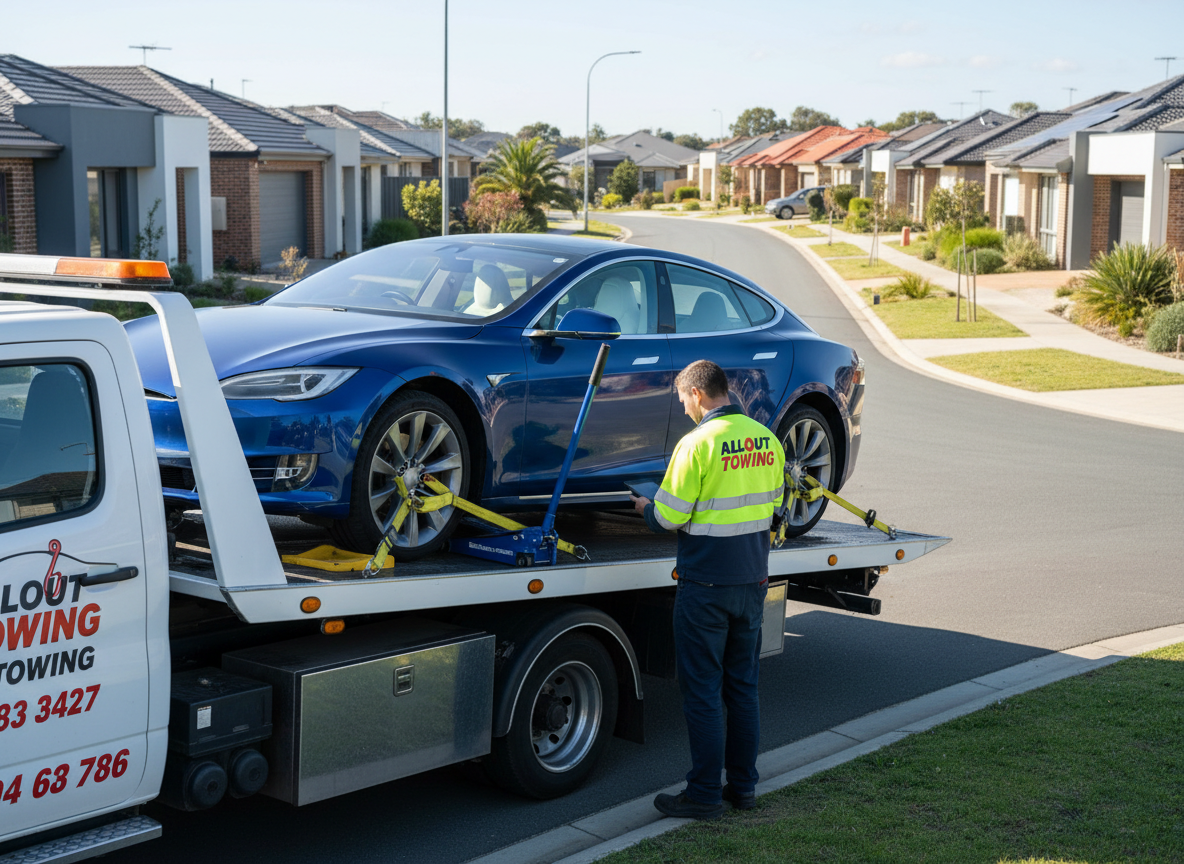
When an EV runs out of charge, the immediate instinct is to call a tow truck. And yes, we can absolutely tow your EV to the nearest charging station. Our tilt tray services are perfect for EVs because there’s no drivetrain stress, no wheel lift complications, and no risk of damage to the vehicle’s complex systems.
But here’s the issue: towing to a charging station means you’re then stuck there for 30 minutes to several hours, depending on the charger type and your battery size. If you’re on your way to work, an appointment, or trying to get home to your family, that’s not a solution. It’s just moving the problem to a different location.
That’s why we’ve had to think differently. The question became: what if we could bring the charge to the stranded vehicle instead of the vehicle to the charge?
Mobile EV Charging: The New Roadside Service
EV roadside charging Perth services are the answer we’ve been developing. Think of it like the old jerry can approach, but for electrons instead of petrol. We bring a portable charging unit directly to your stranded vehicle and give you enough charge to reach the nearest proper charging station or get home safely.
It’s not a full charge-that would take hours and require equipment the size of a small trailer. Instead, we deliver what’s called a “rescue charge” or “emergency boost.” Usually 10-20 kWh, which translates to roughly 50-100km of range depending on your vehicle and driving conditions.
That’s enough. You’re not stuck on the side of the road anymore, and you’re not losing half your day sitting at a charging station.
How the Technology Actually Works
The portable charging units we use are essentially large battery packs on wheels. They store DC power that can be fed directly into your EV’s battery through the same port you’d use at a public fast charger.
They provide 10-15 kW charging speeds (faster than a home charger, slower than a public fast charger), 20-30 kWh total capacity (enough for multiple rescues before needing a recharge), and universal compatibility with CCS2, CHAdeMO, and Type 2 connectors (covering virtually every EV on Australian roads).
The process is straightforward. We arrive, connect the unit to your vehicle, and start the charge. You can wait in your car with the air conditioning on (the charge unit powers that too), make some calls, or just relax. Within 20-40 minutes, you’ve got enough range to get moving again.
It’s not magic-it’s just applied logistics. The same way we’ve always solved problems for stranded motorists, now adapted for a different power source.
The Practical Challenges We’ve Had to Overcome
Rolling out EV roadside charging hasn’t been as simple as buying a battery pack and throwing it in the truck. The technical and operational challenges have been significant.
Weight and transport: These charging units aren’t light. A 30 kWh portable unit weighs between 150-200kg. That’s manageable with proper equipment, but it means we can’t just chuck it in the back of any vehicle. We’ve had to modify our fleet and train operators on safe handling procedures.
Recharging the units: After we use a portable charger for a rescue, we need to recharge it before the next callout. That means either returning to base (where we have dedicated charging infrastructure) or plugging into a public fast charger. Either way, it adds time and complexity to our operations.
Cost recovery: The equipment isn’t cheap, and the electricity isn’t free. We’ve had to work out pricing that covers our costs while remaining affordable for drivers who are already having a bad day. It’s a balance, and we’re still refining it.
Geographic coverage: Perth is huge. Keeping charged units strategically positioned across the metro area (and beyond) requires planning and coordination. We can’t be everywhere at once, but we’re working on response time targets that match our existing 24-hour emergency towing service.
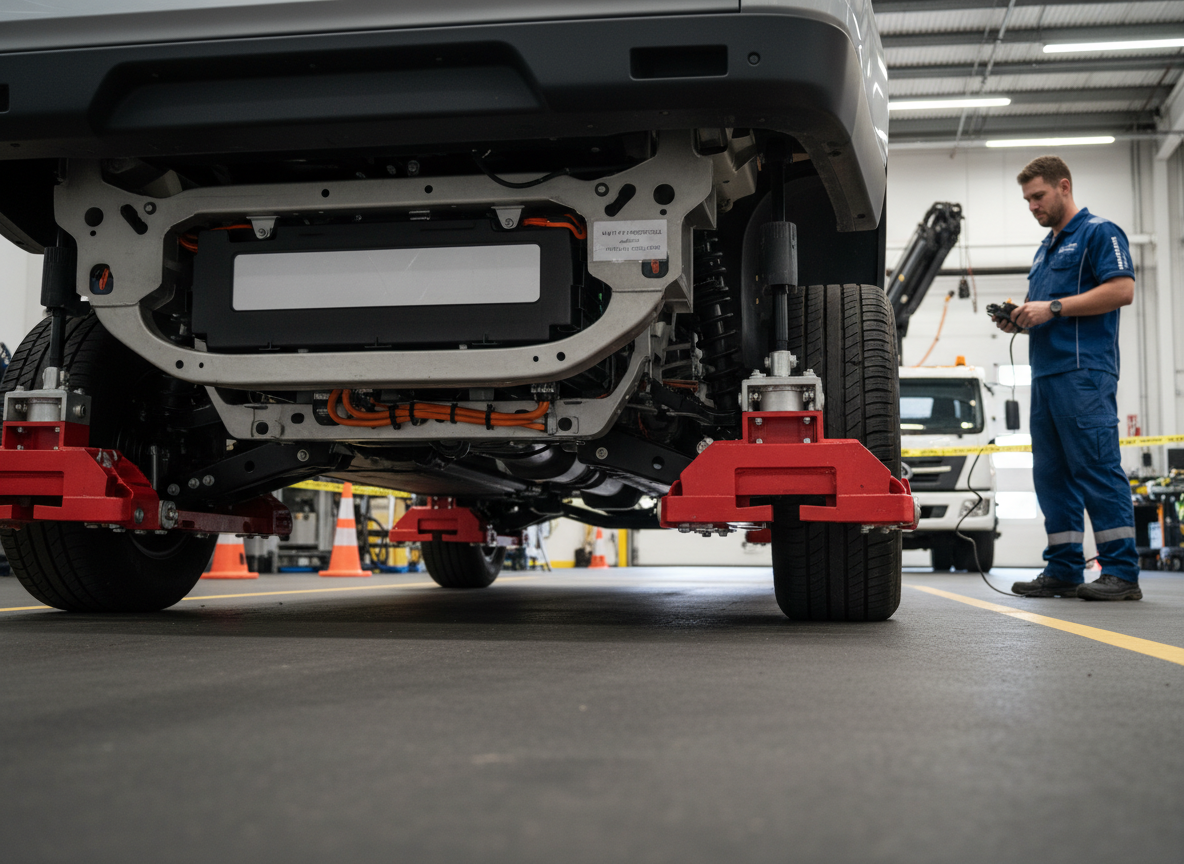
Training and safety: EV batteries operate at high voltages (400-800V). Our operators have undergone specialised training to handle the equipment safely and understand the specific risks associated with EV systems. This isn’t something you can learn in an afternoon.
What This Means for Perth EV Drivers Right Now
If you’re driving an EV in Perth today, here’s what you need to know about your options when you’re running low on charge:
Option 1: Plan ahead and you’ll rarely need us. Most EV drivers never experience a flat battery. Apps like PlugShare and A Better Route Planner make it easy to plan trips with charging stops. The infrastructure is improving steadily, with new fast chargers appearing regularly across the metro area and major highways.
Option 2: If you do get stranded, call for mobile charging. We’re not the only operator offering this service anymore, but we’re one of the few that operates 24/7 and covers the entire Perth metro area. When you contact us, we’ll dispatch a mobile charging unit to your location. You’ll be back on the road in under an hour in most cases.
Option 3: Traditional towing is still available. If you’d rather be towed to a charging station, or if your vehicle has other issues beyond just a flat battery, our car towing services are fully equipped to handle EVs safely. We use tilt tray transport exclusively for EVs to avoid any risk to the drivetrain or battery systems.
The key is knowing your options before you need them. Save our number. Understand what services are available. And don’t panic if you see the range dropping faster than expected-help is available.
How Other Cities Are Handling This
Perth isn’t alone in facing this challenge. Every city with growing EV adoption is grappling with the same question: how do you support drivers when the charging infrastructure can’t keep up?
In California, AAA (the roadside assistance giant) has deployed mobile charging trucks across major cities. They report thousands of EV charging callouts annually, with demand growing 30-40% year-on-year. Their model uses larger truck-mounted units that can deliver faster charges but require more significant investment in fleet modifications.
In Norway (where EVs make up over 80% of new car sales), mobile charging is now considered standard roadside assistance. Most major towing operators offer it, and response times average under 45 minutes in urban areas. The key difference: government subsidies helped offset the initial equipment costs, making it economically viable for smaller operators.
In Sydney and Melbourne, we’re seeing similar adoption patterns to Perth. Mobile EV charging is transitioning from “nice to have” to “essential service.” The operators who’ve invested early are capturing market share and building customer loyalty that will pay off as EV adoption accelerates.
Perth’s advantage is that we’re learning from these early movers. We don’t have to make the same mistakes or invest in dead-end technology. We can adopt proven solutions and adapt them to our local conditions.
The Future of EV Support Services in Perth
The next five years will see massive changes in how we support EV drivers. Here’s what we’re anticipating and preparing for:
Faster charging technology: The portable units available today deliver 10-15 kW. The next generation will push 30-50 kW, cutting rescue charge times in half. We’re tracking this technology closely and will upgrade our fleet as it becomes commercially viable.
Better battery management: Modern EVs are getting smarter about predicting range and warning drivers earlier when they’re at risk of running out. As these systems improve, we expect fewer true “stranded” situations and more “precautionary” callouts where drivers want a top-up before continuing a long journey.
Integration with charging networks: We’re exploring partnerships with charging station operators to provide backup support when stations are offline or overcrowded. Imagine calling ahead to a busy charging station and having us meet you there with a mobile unit to avoid the wait.
Expanded geographic coverage: Right now, mobile EV charging is primarily a metro service. As EVs become more common in regional WA, we’ll need to extend coverage to major highways and regional centres. That’s a significant logistical challenge, but it’s coming.
Specialised support for commercial EVs: Electric vans, trucks, and buses are starting to appear on Perth roads. These vehicles have much larger batteries (100+ kWh) and different charging requirements. We’re developing solutions specifically for commercial operators who can’t afford extended downtime.
Why This Matters Beyond Just Convenience
Mobile EV charging isn’t just about helping individual drivers-it’s about supporting the broader transition to electric transport. Every driver who has a bad experience with a stranded EV tells ten friends. Every driver who gets rescued quickly and easily tells ten friends too.
We’re in a critical adoption phase where public perception matters enormously. If people believe EVs are risky or impractical because “what if you run out of charge?”, adoption slows. If people know there’s reliable support available, that barrier disappears.
The towing industry has always been part of the safety net that makes driving practical. We’re the people you call when things go wrong. As vehicles change, our role doesn’t-but our methods must.
What to Do If You’re Stranded in an EV Today
If you’re reading this because you’re currently sitting in an EV with a dead battery, here’s your action plan:
Stay calm and stay safe. Pull as far off the road as possible. Turn on your hazard lights. If you’re on a freeway, consider whether it’s safer to stay in the vehicle or move behind a barrier.
Check your options: Is there a charging station within 5km that you could reach by driving conservatively? Can you call for mobile charging support? If mobile charging isn’t available or will take too long, request a tow to the nearest charging station.
Communicate clearly with the operator. Tell them your exact location, your vehicle make and model, and your charge level (even if it shows 0%, there’s usually a small reserve). This helps them bring the right equipment and estimate arrival time accurately.
Don’t try to push the vehicle or accept a tow from an unqualified operator. EVs are heavy, and their batteries can be dangerous if mishandled. Only work with operators who have specific EV training and equipment.
Learn from the experience. Once you’re sorted, take a moment to understand what went wrong. Was it poor planning, unexpected circumstances, or infrastructure failure? Adjust your approach for next time.
Moving Forward Together
The shift to electric vehicles is happening whether the infrastructure is ready or not. Drivers are making the switch for environmental reasons, running cost savings, and because the technology is genuinely impressive. Our job is to make sure that transition doesn’t leave people stranded and frustrated.
EV roadside charging Perth services are still evolving. The technology is improving, the economics are becoming clearer, and operators like us are building the expertise and coverage needed to support Perth’s growing EV fleet. It’s not perfect yet, but it’s getting better every month.
If you’re an EV driver, know that help is available when you need it. If you’re considering making the switch to an EV, don’t let range anxiety hold you back-the support systems are in place and improving rapidly. And if you’re ever in that situation where the battery hits zero and you’re miles from a charger, we’ll be there with the electrons you need to get moving again.
That’s what we do. We solve problems, we keep people moving, and we adapt to whatever challenges Perth’s roads throw at us. Electric or petrol, new technology or old, the core mission hasn’t changed: get you home safely, with as little stress as possible.