Heavy machinery doesn’t move itself, and the gap between “we need this excavator at the new site” and actually getting it there safely is where most businesses hit problems. The weight, the regulations, the securing methods, it’s a lot more complex than hooking up a trailer and hoping for the best.
All Out Towing has relocated everything from compact bobcats to 15-tonne excavators across Perth and regional WA. We’ve seen what works, what fails, and what puts expensive equipment at risk. The stakes are high when you’re moving machinery worth hundreds of thousands of dollars through suburban streets and busy highways.
This isn’t about scaring you off, it’s about giving you the straight facts on what safe heavy machinery transport Perth actually requires. Whether you’re a construction company relocating equipment to Malaga, a mining contractor moving gear to Kwinana, or a landscaping business shifting a loader between sites, the fundamentals don’t change.
Why Heavy Machinery Transport Demands Serious Attention
Moving a 10-tonne excavator isn’t like towing a car. The weight distribution alone can turn a routine job into a disaster if you get it wrong.
Then there’s the legal side. Permits, route approvals, escort requirements, all before you’ve even loaded the machine. WA’s transport regulations exist because people got hurt and infrastructure got damaged. They’re not bureaucratic nonsense; they’re lessons written in expensive mistakes.
Most businesses hesitate because they understand the stakes. One error with heavy equipment doesn’t just delay a project. It means damaged machinery, potential injuries, insurance headaches, and possibly a very public incident that shuts down a major road.
The anxiety you’re feeling? That’s your brain doing its job, telling you this requires proper planning and execution.
The Real Costs When Things Go Wrong
A loader shifted mid-transport near Tonkin Highway a few years back. The trailer tilted, chains failed, and six tonnes of machinery hung at an angle that made everyone nervous. The operator had used chains rated for the weight but hadn’t accounted for dynamic forces during braking.
That incident cost three days of downtime, emergency recovery fees, trailer repairs, and a machinery inspection before the equipment could be used again. Word spreads quickly in Perth’s construction and industrial sectors. Reputation damage often hurts more than the financial hit.
Main Roads WA doesn’t take kindly to unpermitted oversized loads or damage to road infrastructure. Fines start in the thousands and climb quickly. Your insurance might not cover incidents during non-compliant transport, leaving you personally liable.
Then there’s the human element. Heavy machinery accidents during transport can cause serious injuries. The responsibility of moving these loads safely isn’t just professional, it’s moral. When you’re hauling equipment through suburbs where families live, cutting corners isn’t an option.
Understanding What You’re Actually Moving
Heavy machinery isn’t one category. A compact excavator behaves differently on a trailer than a road roller. A telehandler presents different challenges than a bulldozer.
You need exact weight and dimension figures, not estimates. That includes operating weight, transport weight (sometimes different if you can remove attachments), height with booms or arms in transport position, width including mirrors or protruding elements, and overall length.
Centre of gravity determines how you’ll position the machine on your trailer. Top-heavy equipment like telehandlers requires different securing strategies than low-profile machinery like plate compactors. Get this wrong and you’re fighting physics every time you brake or turn.
Ground clearance affects loading and unloading. Some operators spend hours trying to drive a machine onto a trailer because they didn’t account for belly clearance when ramps created a steep angle. Sometimes you need different equipment or a loading dock.
The machinery’s condition matters during transport. Hydraulics that leak, tyres with uneven wear, or brakes that don’t hold become safety hazards when securing and moving equipment. What’s a minor maintenance issue on a worksite becomes critical during machinery transport Perth operations.
Legal Requirements You Cannot Ignore
Any load exceeding standard dimensions requires permits in WA. That typically means anything wider than 2.5 metres, higher than 4.3 metres, or longer than 19 metres. Most heavy machinery hits at least one threshold.
The Department of Transport WA manages these permits. You’ll need to apply well before your move date, these aren’t instant approvals.
Route surveys aren’t optional for genuinely oversized loads. You can’t assume your GPS route works for a 4-metre-wide load. Bridges have weight limits, some roads have overhead clearance restrictions, and certain areas prohibit heavy vehicles during peak hours.
Escort requirements kick in when your load exceeds certain dimensions. Generally, loads over 3.5 metres wide need a pilot vehicle in WA. Wider still, and you might need police escorts. These aren’t formalities, escorts manage traffic, warn other drivers, and help navigate tight sections safely.
Insurance coverage needs reviewing before any transport job. Your standard vehicle insurance probably doesn’t cover commercial haulage. Your machinery insurance might not cover transport-related damage. That’s a gap that can cost you everything if something goes wrong.
Choosing the Right Transport Method
Not every heavy machinery move requires the same approach. Your options range from self-drive (if road-legal and practical) to full professional transport services.
Self-drive works for some equipment. If your machine is road-registered, doesn’t exceed dimension limits, and the distance is reasonable, driving it might make sense. But consider the wear, the slow speed, and operator time. A bobcat maxing out at 15 km/h makes for a very long trip from Joondalup to Mandurah.
Trailer transport is most common. You’ll need a trailer rated for your machinery’s weight with adequate tie-down points and appropriate ramps. The towing vehicle must have sufficient capacity, not just for weight, but for controlled braking with that mass behind it.
Here’s the reality: using a standard tow hook on an all-wheel-drive vehicle is like trying to make two people walk in different directions when their shoes are tied together, it’ll wreck the drivetrain. That’s why proper equipment matters so much.
Professional transport services remove the complexity and liability from your plate. Companies specialising in heavy machinery transport Perth bring proper equipment, experienced operators, necessary permits, and comprehensive insurance. Our heavy machinery towing services handle the permits, compliance, and safe transport so you can focus on your project.
The decision often comes down to frequency. If you’re moving equipment monthly, investing in proper gear makes sense. For occasional moves, professional services typically cost less than the equipment investment, time, and risk of doing it yourself.
Loading and Securing: Where Most Mistakes Happen
This is where theory meets reality. Loading heavy machinery looks straightforward until you’re actually doing it with equipment that costs more than a house.
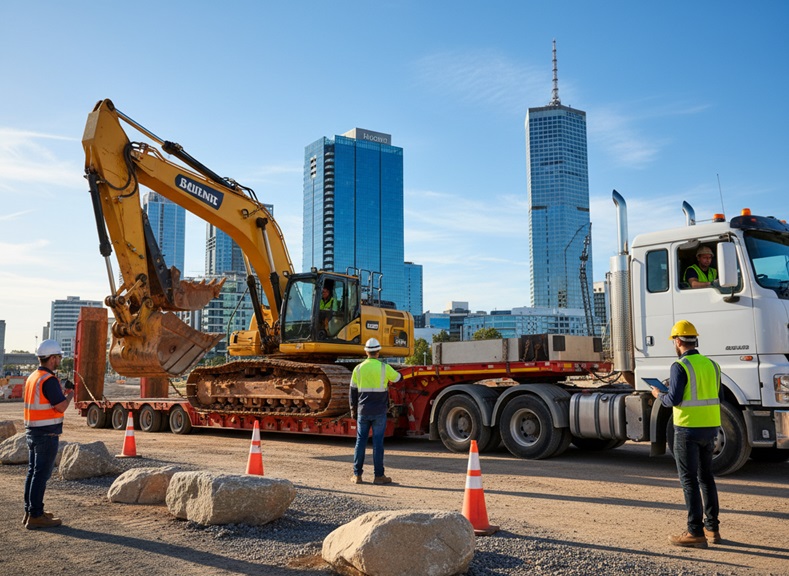
Ramp angle and stability matter enormously. Your ramps need to be rated for the machinery’s weight with a safety margin. They need to be wide enough that tracks or wheels stay centred. And they absolutely must be secured to the trailer so they don’t shift mid-load.
Weight distribution on the trailer determines road handling. You want roughly 60% of the load’s weight forward of the trailer’s axles for proper tongue weight. Too far back and the trailer becomes unstable, prone to sway. Too far forward and you’re overloading your vehicle’s rear axle.
Measure and mark your ideal position before loading. Once that excavator’s on the trailer, repositioning isn’t simple.
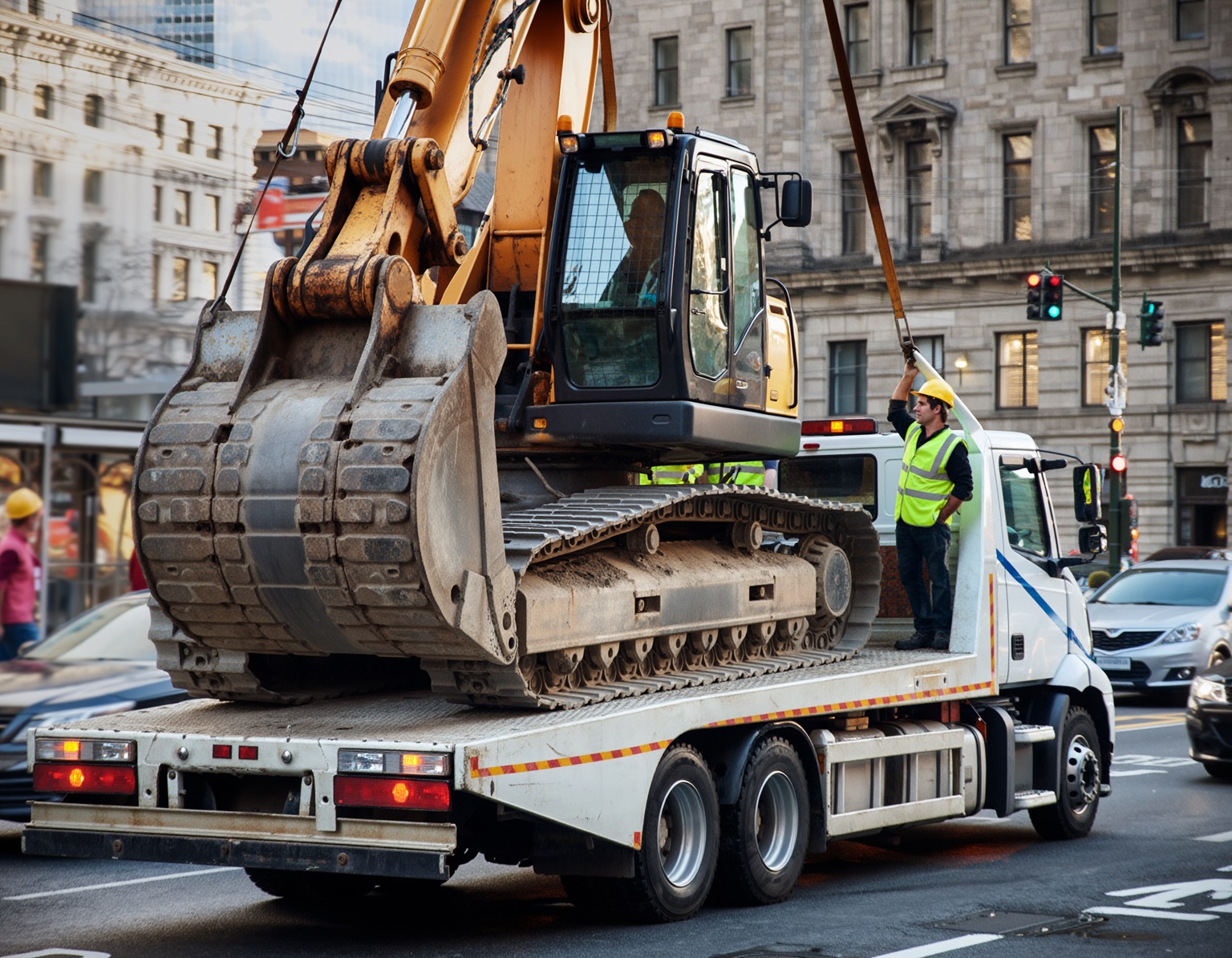
Securing the load requires proper chains or straps rated for the weight and proper attachment points on both machinery and trailer. The general rule: four points of attachment minimum, with chains creating downward and rearward tension to prevent forward movement during braking.
Use chains rated at least 1.5 times your load weight. Connect to structural points on the machinery, not hydraulic cylinders or sheet metal that might deform. Tighten until the suspension compresses slightly, you want the machine and trailer acting as one unit.
Boom and arm positioning for excavators means fully retracted and lowered. Extended booms raise the centre of gravity and create leverage that magnifies every bump and turn. Lock them with pins, not just hydraulics, because hydraulics can leak during transport.
Route Planning That Actually Works
Your route matters as much as your securing method. The shortest path isn’t always smartest when hauling oversized loads through Perth.
Avoid peak hours if possible. Heavy machinery transport during rush hour creates stress for everyone, you’re moving slowly, other drivers are impatient, and incident risk multiplies. Early morning or mid-afternoon typically offers clearer roads and more patient traffic.
Identify potential bottlenecks before leaving. Roundabouts with tight curbs, intersections with median strips, car parks with low-clearance entries, these become serious obstacles with a wide load. Sometimes a longer route with wider roads saves time and stress.
Check bridge and overpass clearances if your load is tall. Perth has several bridges with restricted clearance, particularly on older roads. Main Roads provides clearance information, but verify for your specific route. Hitting a bridge isn’t just embarrassing, it’s dangerous and expensive.
Plan for fuel and rest stops on longer hauls. You can’t pull into any service station with an oversized load. Identify wide parking areas where you can safely stop without blocking traffic. This becomes critical on routes to regional WA where facilities are sparse.
The Weather Factor People Forget
WA weather creates specific challenges that people from other states might not anticipate. Perth’s summer heat affects more than comfort.
Tyre pressure changes with temperature. Tyres properly inflated at 7 AM might be overinflated by midday when temperature’s climbed 15 degrees. Check pressure before departure and monitor during longer trips. Overinflated tyres reduce traction and increase blowout risk.
Hydraulic systems behave differently in extreme heat. Seals that are fine at moderate temperatures might weep or fail when machinery’s been sitting in 40-degree heat on a trailer. Check hydraulic systems before and after transport.
Bitumen softness on Perth roads during summer affects stability, particularly when loading or unloading. Trailer jacks can sink into soft bitumen on hot days, creating dangerous angles. Use wide base plates under jacks and stabilisers.
Wind affects tall or wide loads more than expected. A strong easterly pushing against a wide excavator creates lateral force that affects handling. On extreme wind days, postponing transport might be the smart call. It’s not overcautious, it’s recognising when conditions exceed your equipment’s capabilities.
When Professional Help Makes Sense
There’s no shame in recognising when a job exceeds your capability. That recognition is professionalism, not weakness.
First-time moves of expensive equipment justify professional help. The learning curve with heavy machinery transport Perth is steep, and mistakes are costly. Paying for professional service once while observing methods provides education worth far more than the service fee.
Unusual or particularly valuable equipment warrants specialist handling. If you’re moving machinery worth $200,000, spending $1,500 on professional transport is cheap insurance. Specialists know specific requirements for different equipment types and have encountered the edge cases that catch others off guard.
Long-distance or interstate moves add complexity that multiplies with distance. Different jurisdictions have different permit requirements, and route planning across hundreds of kilometres requires expertise. For 24-hour emergency towing and transport services, having professionals you can rely on makes moves far less stressful.
Time-critical relocations where delays cost serious money benefit from professional reliability. If your machinery needs to be on a new site by Monday morning for a contracted job, you can’t afford the risk of permit problems, loading difficulties, or route issues.
We’ve handled everything from compact excavators to industrial forklifts across Perth and regional WA. The difference professional service makes isn’t just about having the right trailer, it’s about knowing regulations, having established relationships with permitting authorities, and carrying insurance that protects everyone involved.
Emergency Preparedness on the Road
Even perfectly planned moves can encounter problems. How you respond determines whether it’s a minor inconvenience or a major incident.
Carry proper emergency equipment beyond standard roadside gear. Heavy-duty jack stands rated for your load, spare chains or straps, wheel chocks, warning triangles, and a comprehensive toolkit should be standard. A thermal camera or infrared thermometer helps identify overheating bearings or tyres before they fail.
Have contact information ready for emergency services, your insurance company, and professional recovery operators. If something goes wrong with a heavy load, you need help fast. For urgent situations, our roadside assistance team operates 24/7 across Perth.
Know your emergency procedures before problems occur. If a chain breaks, do you know how to safely stop and assess without creating a worse situation? If a tyre blows, do you know whether to continue to a safe stopping point or halt immediately? These decisions need making in advance, not during crisis.
Communication with other road users becomes critical if you encounter problems. Hazard lights, warning triangles placed at appropriate distances, and if necessary, someone directing traffic around your stopped vehicle protect everyone. Don’t assume other drivers will see you or understand the situation.
Post-Transport Inspection and Documentation
Your responsibility doesn’t end when machinery rolls off the trailer. Proper post-transport procedures protect you legally and ensure equipment’s ready for work.
Inspect the machinery thoroughly before putting it into service. Check for any damage that might have occurred during transport, hydraulic leaks, structural cracks, loose components, or electrical issues. Document everything with photos, even if everything looks fine. This documentation protects you if issues emerge later.
Test all functions before considering the move complete. Run through the machinery’s full range of motion, test hydraulics under load, and verify that everything operates as it should. Transport stress can reveal weaknesses that weren’t apparent before.
Document the entire process from loading through delivery. Photos of the securing method, the route taken, any incidents or challenges encountered, and final delivery condition create a record that protects you legally and helps improve future moves.
Maintain your equipment with extra attention after transport. Even uneventful moves create stress on machinery. A post-transport service, checking fluids, inspecting wear points, verifying nothing worked loose, prevents small problems from becoming expensive failures.
Building Your Transport Capability
If you’re moving equipment regularly, developing proper capability makes sense. But capability means more than buying a trailer.
Invest in appropriate equipment that exceeds your current needs. A trailer rated at exactly your heaviest machine’s weight leaves no safety margin. Buy equipment rated 20-30% above your maximum anticipated load. The same applies to your towing vehicle, adequate isn’t good enough when hauling heavy machinery.
Training matters more than equipment. Operators need proper instruction in loading procedures, securing methods, and road handling with heavy loads. This isn’t something you learn from videos. Proper training from experienced operators or formal courses through industry associations provides the foundation for safe operations.
Establish relationships with permitting authorities, professional transport companies, and recovery services before you need them urgently. Knowing who to call and having established accounts means faster response when time matters.
Document your procedures in written form. Create checklists for pre-transport inspection, loading procedures, securing methods, route planning, and post-transport verification. Written procedures ensure consistency across different operators and provide legal protection by demonstrating your commitment to safety.
The Honest Economics: DIY vs Professional
Here’s what nobody wants to say: most businesses moving heavy machinery occasionally are better off using professional services. The economics favour professionals unless you’re moving equipment weekly.
Consider the real costs of DIY. You need a suitable vehicle, a trailer rated for heavy loads, proper chains and securing equipment, permits for each move, insurance coverage, and operator time. That’s before accounting for the learning curve, risk of mistakes, and opportunity cost.
Professional machinery transport Perth services spread these costs across hundreds of moves annually. The per-move cost for professionals is typically lower than most businesses calculate for their DIY approach once you factor in everything honestly.
There’s also the hidden cost of stress and distraction. When you’re managing a construction project or running a business, spending half a day sorting permits and another day moving equipment yourself takes you away from higher-value activities.
But what’s the difference between professional transport and DIY for your specific situation? It comes down to frequency, equipment value, and your risk tolerance. For occasional moves of expensive equipment, professional services almost always make financial and safety sense.
Making the Right Decision for Your Business
Moving heavy machinery safely through Perth requires proper equipment, legal compliance, and genuine expertise. Whether you handle it yourself or use professional services, the fundamentals don’t change, weight distribution, securing methods, permits, and route planning all demand attention.
For businesses that need reliable heavy machinery transport Perth services, we’re here to help. Our tilt tray services and specialised transport solutions handle everything from compact excavators to industrial equipment, with all permits and insurance included.
Don’t risk your expensive equipment, your timeline, or your safety on guesswork. Contact us for a quote on your next machinery move, or to discuss the best transport solution for your specific equipment and situation.