Every tow truck that rolls out of our yard in Perth burns diesel. That’s the reality of heavy vehicle recovery and transport. But here’s what most people don’t know: the difference between a well-planned route and a poorly planned one can mean the difference between burning 40 litres of fuel or 60 litres for the same job.
We’ve been moving everything from broken-down sedans to 15-tonne excavators across Perth’s metro area for over 15 years. During that time, we’ve watched fuel prices climb, traffic patterns shift, and environmental expectations change. The question we kept asking ourselves was simple: how do we keep providing 24/7 emergency towing while reducing our environmental footprint?
The answer wasn’t buying smaller trucks (that would compromise safety and capability). It was getting smarter about how we use them. Fuel-efficient towing Perth practices have become one of the most effective tools we have for cutting emissions without cutting service quality.
Why Route Planning Matters More Than You’d Think
A tilt tray truck carrying a luxury vehicle isn’t like a courier van. We’re talking about vehicles that weigh 12 tonnes empty, pulling loads that can add another 3-5 tonnes. Every kilometre matters. Every stop-and-start traffic jam matters. Every unnecessary detour adds up.
Here’s the math we work with: our heavy-duty tow trucks average around 18-22 litres per 100km under normal conditions. But in stop-start traffic? That can blow out to 30+ litres per 100km. Multiply that across dozens of jobs per week, and you’re looking at thousands of extra litres burned annually just from poor routing.
The environmental impact isn’t abstract. Diesel combustion produces roughly 2.7kg of CO2 per litre burned. If we can save 500 litres per month through better routing (a conservative estimate based on our data), that’s 1,350kg of CO2 prevented from entering Perth’s atmosphere. Every month.
But it’s not just about emissions. Fuel efficiency directly impacts operating costs, which affects pricing for customers. When we reduce waste, everyone benefits.
How Modern GPS Technology Changed Everything
Ten years ago, route planning meant a driver’s local knowledge and a paper street directory. That worked for familiar jobs, but it left huge gaps. Traffic accidents, road works, peak-hour congestion – all of these could add 20-30 minutes to a job without warning.
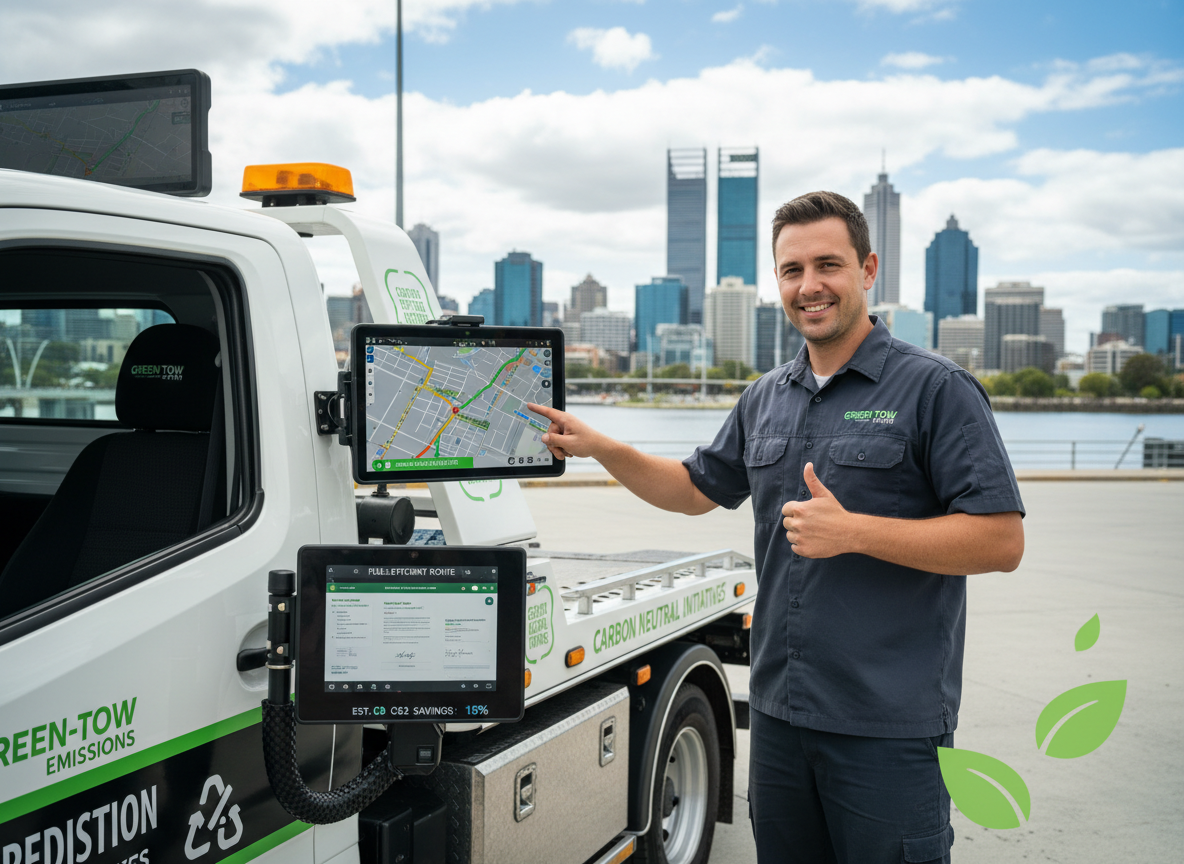
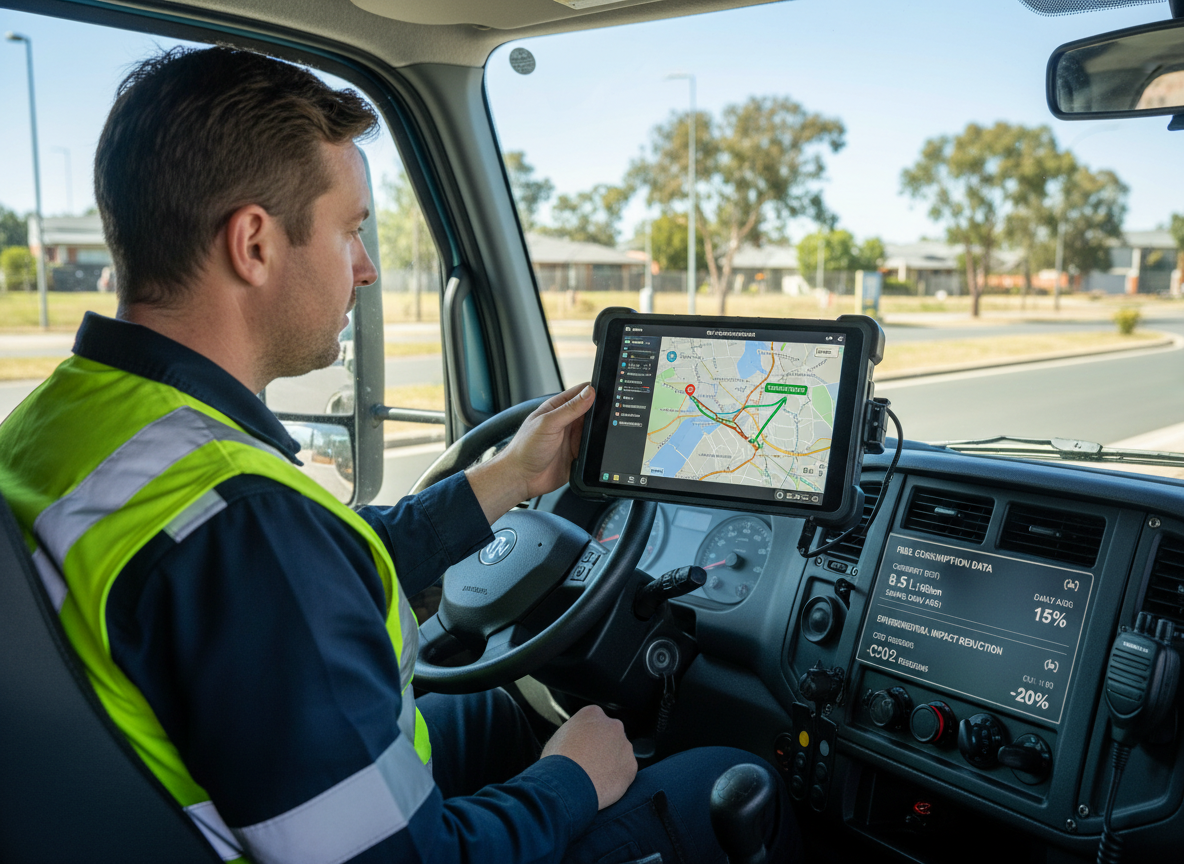
Now? We use real-time GPS routing systems that integrate live traffic data, road closure information, and historical traffic patterns. These systems don’t just find the shortest route – they find the most fuel-efficient one.
The difference is significant. The shortest route might send us through six sets of traffic lights and two school zones during peak hour. The most efficient route might be 2km longer but keeps us on arterial roads with better flow. Less braking. Less idling. Less fuel burned.
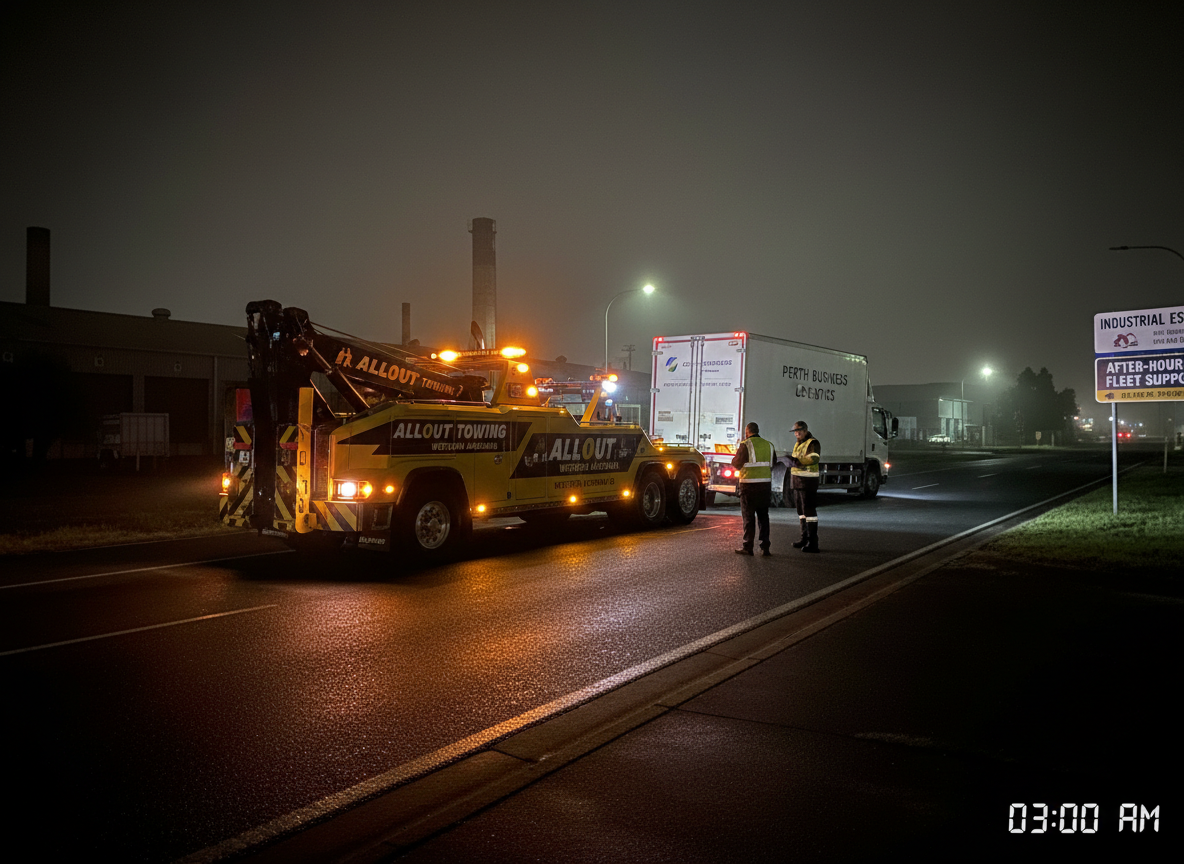
Our dispatch team monitors these systems constantly. When we get a call for 24-hour emergency towing, we’re not just sending the closest truck – we’re sending the truck that can reach you fastest while burning the least fuel. Sometimes that’s the same truck. Sometimes it’s not with route optimization towing strategies.
The Science Behind Fuel-Efficient Towing Routes
Think of fuel efficiency like water flowing downhill – it follows the path of least resistance. For towing, that means minimising three things: distance, stops, and load.
Distance is obvious. Fewer kilometres means less fuel. But it’s not always the primary factor.
Stops are the silent fuel killer. Every time a 12-tonne truck comes to a complete stop, it needs significant energy to get moving again. That’s diesel being converted to motion from zero. Highway driving at steady speed is exponentially more efficient than urban stop-start driving. We’ve measured the difference: a 30km highway run might use 6 litres, while a 20km urban route with 15 stops can use 8 litres.
Load affects aerodynamics and weight. A tilt tray carrying a sedan faces different wind resistance than an empty truck. We factor this into route selection for longer hauls – sometimes a slightly longer route with less elevation change saves fuel when you’re carrying a 2-tonne vehicle.
Our routing software weighs all three factors. It’s like having a fuel efficiency expert riding shotgun on every job.
Perth-Specific Routing Challenges We’ve Solved
Perth isn’t Sydney or Melbourne. Our city sprawls across a massive area with limited arterial roads. The Kwinana Freeway is often the only practical north-south route. Mitchell Freeway serves the northern suburbs. And everything east of the city turns into semi-rural roads quickly.
We’ve identified several routing patterns that consistently save fuel:
Avoiding peak-hour CBD transit: Between 7-9am and 4-6pm, cutting through the city adds 15-20 minutes and burns 30% more fuel than taking the freeway bypass. Unless a job is actually in the CBD, we route around it during these windows.
Using Tonkin Highway for eastern suburbs: Many operators still default to surface streets through Midland and Bassendean. The Tonkin Highway extension has changed that equation. It’s faster and more efficient for reaching Ellenbrook, The Vales, and Bullsbrook.
Timing southern runs around freight traffic: Kwinana and Rockingham see heavy industrial traffic during business hours. When we’re moving heavy machinery south, scheduling for early morning or late afternoon can cut 20 minutes off the job.
Beach suburbs access planning: Scarborough, Cottesloe, and Fremantle have limited access points. Choosing the right entry route prevents backtracking, which is pure wasted fuel when you’re carrying a loaded tilt tray.
These patterns didn’t come from a manual. They came from 15 years of drivers reporting back what worked and what didn’t. We’ve now coded that knowledge into our routing system.
How We Plan Routes for Different Types of Jobs
Not all towing jobs are created equal. A prestige car transport from a northern suburbs home to a southern suburbs workshop is planned differently than an accident recovery on Roe Highway.
Emergency breakdowns: Speed is the priority, but we still optimise. Our system calculates the fastest route that avoids known congestion. If a truck is already on the road returning from a job, dispatch checks whether diverting that truck is more efficient than sending one from the yard.
Scheduled transports: These give us the luxury of planning. We batch jobs geographically when possible – if we’re moving a container to Joondalup in the morning, we’ll schedule a return load or a second job in the northern corridor if available. This eliminates empty return runs, which are pure fuel waste.
Heavy machinery moves: These require the most planning. A 10-tonne excavator on our largest tilt tray means we’re at maximum weight. We select routes with minimal elevation change and avoid roads with weight restrictions. The fuel savings from proper route selection on these jobs can exceed 20 litres per job.
Multi-point jobs: Sometimes we’re picking up a vehicle and delivering it to a repairer, then collecting another vehicle from a different location. The order of stops matters enormously. Our system calculates the most efficient sequence, which isn’t always the obvious one.
The Role of Driver Training in Fuel Efficiency
You can have the best routing software in the world, but if the driver accelerates hard and brakes late, you’re still burning excess fuel. That’s why our driver training includes a significant focus on fuel-efficient driving techniques.
Here’s what we teach:
Anticipatory driving: Looking 200-300m ahead to spot traffic lights, merging traffic, or slowdowns early. This allows gradual speed reduction instead of hard braking. It’s smoother for the vehicle being towed and saves fuel.
Optimal gear selection: Modern trucks have 10-12 gears. Using them correctly keeps the engine in its most efficient RPM range. Lugging the engine in too high a gear or screaming it in too low a gear both waste fuel.
Cruise control on highways: Maintaining steady speed is more efficient than human throttle control. When road and traffic conditions allow, cruise control reduces fuel consumption by 5-10%.
Minimising idle time: A truck idling burns roughly 3-4 litres per hour. If we’re waiting more than 2 minutes, we shut down. The fuel used to restart is less than the fuel wasted idling.
These techniques combine with smart routing to compound savings. A well-planned route driven efficiently can use 25-30% less fuel than a poorly planned route driven aggressively.
Technology Integration: Dispatch, GPS, and Traffic Monitoring
Our dispatch system doesn’t operate in isolation. It pulls data from multiple sources to make real-time routing decisions:
Main Roads WA traffic feeds: Live incident data, road closures, and traffic flow speeds help us avoid delays before they cost fuel.
Weather monitoring: Heavy rain affects traffic flow and braking distances. We adjust routes during severe weather to prioritise safer, more efficient roads.
Historical traffic patterns: We know that Wanneroo Road northbound slows to a crawl between 4-6pm on weekdays. We know that Canning Highway is a parking lot during Sunday sessions at Fremantle. This historical data informs scheduling decisions.
Fleet GPS tracking: We know exactly where every truck is, what it’s carrying, and where it’s headed. This allows dynamic rerouting if a closer truck becomes available or if a more efficient job sequence emerges.
The system isn’t perfect. Traffic is inherently unpredictable. But it’s dramatically better than manual planning, and it improves every month as we feed more data into it.
Measuring Results: How We Track Fuel Efficiency
You can’t improve what you don’t measure. Every truck in our fleet has fuel monitoring systems that track consumption per job, per kilometre, and per driver.
We review this data monthly to identify:
- Routes that consistently burn more fuel than expected
- Drivers who might need additional training
- Times of day when certain routes become inefficient
- Opportunities to adjust our service area boundaries
Over the past three years, we’ve reduced our fleet’s average fuel consumption by 18% per kilometre travelled. That’s not from buying new trucks (though newer vehicles are more efficient). It’s from routing optimisation, driver training, and operational discipline with route optimization towing implementation.
The environmental impact is measurable. We’re burning roughly 12,000 fewer litres of diesel annually compared to 2021, despite handling more jobs. That’s 32,400kg of CO2 prevented from entering the atmosphere each year.
Why This Matters for Our Customers
Fuel efficiency isn’t just an environmental talking point for us. It’s embedded in how we price and deliver services.
When we burn less fuel, we can keep pricing competitive without compromising service quality. We’re not passing on the cost of wasted fuel through inefficient routing.
When we plan routes efficiently, we arrive faster. A customer with a broken-down vehicle on the side of Kwinana Freeway doesn’t care about our environmental initiatives – they care about getting help quickly. But here’s the thing: the same routing optimisation that saves fuel also minimises response time. Efficiency and service quality move together.
For scheduled jobs like container transport or specialised towing, efficient routing means we can offer tighter arrival windows. Less guesswork. More reliability.
The Bigger Picture: Towing Industry Environmental Responsibility
The towing industry doesn’t have the same environmental scrutiny as aviation or shipping, but that doesn’t mean we get a free pass. Every industry has a responsibility to minimise its environmental impact where practical.
For us, that means:
- Fuel-efficient route planning (which we’ve covered extensively)
- Regular vehicle maintenance to ensure engines run at peak efficiency
- Upgrading to Euro 6 emission standard trucks as older vehicles reach end-of-life
- Exploring alternative fuels as they become viable for heavy vehicles
- Recycling and proper disposal of automotive fluids and materials
We can’t eliminate our environmental impact – moving 15-tonne loads requires significant energy – but we can minimise waste. Route planning is the single most effective tool we have for doing that right now.
Looking Forward: What’s Next for Sustainable Towing
The technology we use today would have seemed like science fiction 15 years ago. Real-time traffic monitoring, GPS fleet tracking, automated route optimisation – none of this existed when we started.
What’s coming next? We’re watching several developments:
Electric heavy vehicles: Battery technology isn’t there yet for 12-tonne tow trucks with 400km+ daily range requirements, but it’s improving rapidly. When electric towing becomes viable, we’ll transition.
Hydrogen fuel cells: More promising for heavy vehicles than batteries in the medium term. Several European manufacturers are testing hydrogen tow trucks. We’re monitoring those trials closely.
AI-enhanced routing: Current systems use algorithms based on fixed rules. The next generation will use machine learning to identify efficiency patterns humans might miss.
Vehicle-to-vehicle communication: Future trucks will communicate directly with each other and with infrastructure to optimise traffic flow at a system level, reducing congestion for everyone.
We’re not waiting for perfect solutions. We’re implementing the best available technology today while preparing for better technology tomorrow.
How We Balance Speed and Efficiency
Here’s a common question: doesn’t prioritising fuel efficiency slow down response times?
The short answer is no. Not when it’s done right with fuel-efficient towing Perth strategies.
Think of it like this: the fastest route and the most fuel-efficient route are usually the same route. Both avoid congestion. Both minimise stops. Both prioritise free-flowing arterial roads over congested surface streets.
Where they occasionally diverge is in edge cases. Maybe the fastest route is 2km shorter but goes through a school zone during pickup time. The efficient route adds 3 minutes but saves 2 litres of fuel and avoids the risk of delays.
In emergency situations – someone’s broken down in a dangerous location, or there’s been an accident – we prioritise speed absolutely. But even then, our routing system finds the fastest route, which is typically also efficient.
For scheduled jobs, we have more flexibility. That’s where we can optimise heavily without any service compromise. A customer scheduling car towing for next Tuesday doesn’t care if we arrive at 10am or 10:15am, but that 15-minute window might allow us to batch two jobs efficiently.
Why Choose All Out Towing for Your Perth Towing Needs
When you need a tow truck in Perth, you’re probably not thinking about route optimisation or fuel efficiency. You’re thinking about getting your vehicle moved safely and quickly.
But here’s why our approach matters to you: it means we’re running a tight operation. We’re not wasting resources. We’re not cutting corners on safety or capability. We’re using technology and expertise to deliver better service at fair prices.
Our commitment to fuel-efficient operations is part of a broader commitment to operational excellence. The same discipline that drives our routing optimisation shows up in our vehicle maintenance, our driver training, and our customer service.
Whether you need urgent roadside assistance, safe transport for a valuable vehicle, or movement of heavy equipment, we bring that same operational discipline to every job.
Want to know more about how we can help with your specific towing needs? Contact us for a quote or to discuss your requirements. Our team is available 24/7 to help.
Conclusion
Fuel-efficient route planning isn’t a marketing gimmick for us. It’s an operational necessity that delivers measurable environmental benefits, cost savings, and service improvements.
Every litre of diesel we don’t burn is a litre we didn’t need to burn. Every kilometre we don’t drive is time saved and emissions prevented. Every route we optimise is a small improvement that compounds across thousands of jobs annually.
The towing industry moves Perth. We recover broken-down vehicles, clear accident scenes, transport heavy machinery, and move valuable assets safely across the metro area. That work requires significant energy, but it doesn’t require wasted energy.
Through smart routing, driver training, technology integration, and operational discipline, we’ve proven that it’s possible to reduce environmental impact while improving service quality. It’s not about choosing between efficiency and effectiveness – it’s about recognising that they’re two sides of the same coin.
We’ll keep refining our approach as technology improves and as we learn more from every job we complete. Because at the end of the day, being a responsible operator means constantly asking: how can we do this better?