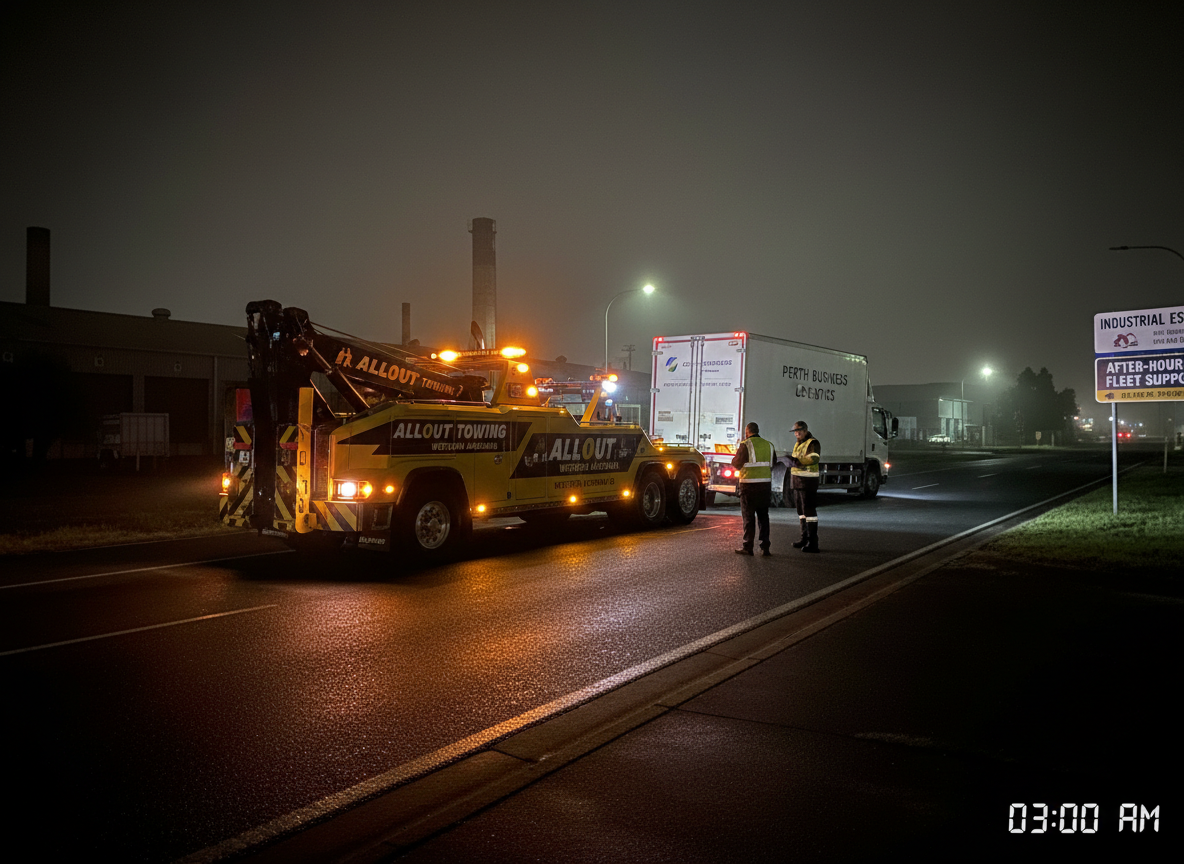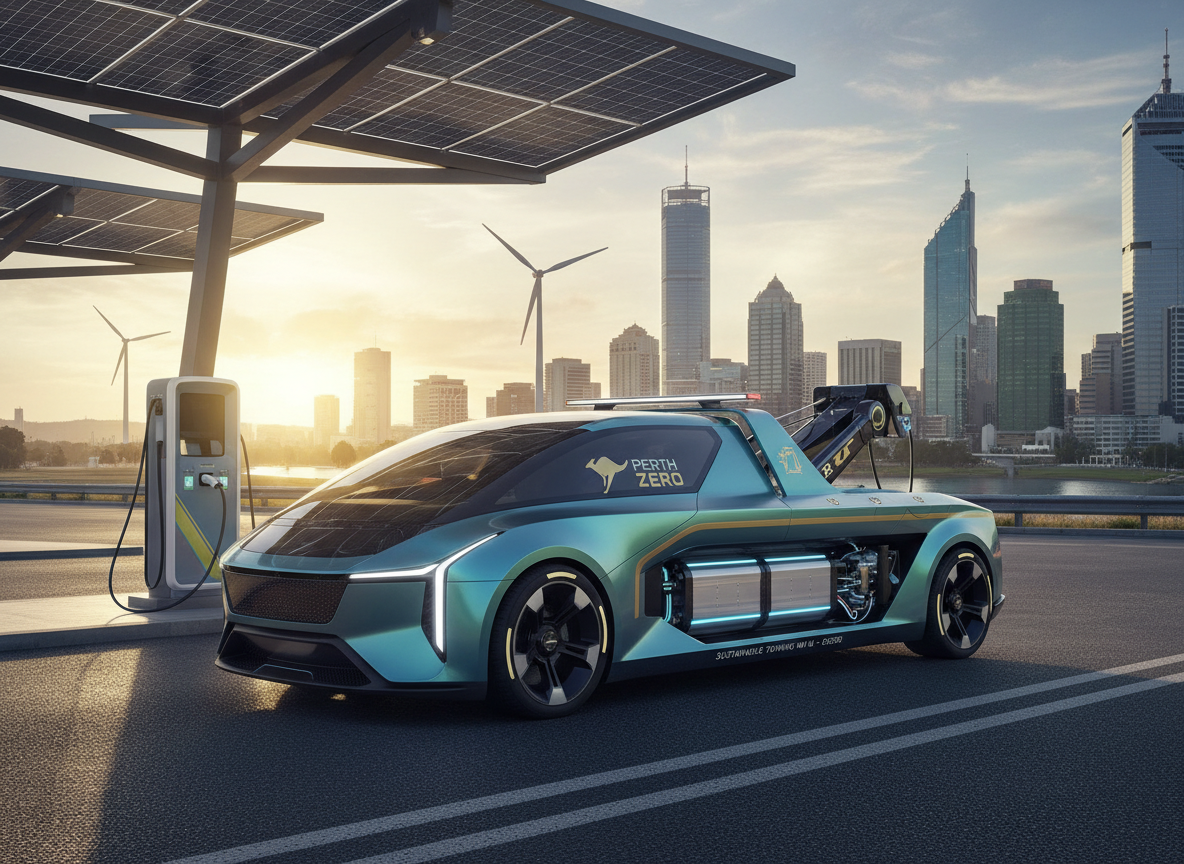
The towing industry in Australia is watching battery-electric vehicle (BEV) technology with cautious optimism. While electric passenger cars are becoming common on Perth roads, the transition to electric tow truck Australia operations presents unique challenges that go far beyond simply swapping a diesel engine for a battery pack.
We’ve operated diesel-powered recovery vehicles for over 15 years, and we’re often asked when Perth will see battery-powered recovery vehicles responding to breakdowns. The honest answer? It’s complicated. The technology exists, but the practical realities of towing operations – particularly in Western Australia’s vast distances and extreme conditions – mean we’re likely years away from seeing widespread adoption.
Let’s look at what’s actually happening with electric recovery vehicles globally, what the real barriers are in Australia, and when Perth operators might genuinely be able to make the switch.
The Current State of Electric Tow Trucks Globally
Battery-electric tow trucks aren’t science fiction. They’re operating right now in several countries, though in very limited numbers.
Volvo Trucks launched the FL Electric chassis in Europe in 2019, and several European towing companies have converted these into recovery vehicles. These trucks work well in dense urban environments where the average tow distance is 15-20 kilometres and operators return to base multiple times per day for charging.
BYD (Build Your Dreams), the Chinese manufacturer, produces electric trucks with towing capability that are being trialled in parts of Asia. These vehicles demonstrate that the fundamental engineering challenge – creating an electric powertrain strong enough to move disabled vehicles – has been solved.
The catch? Almost every successful deployment shares the same characteristics: short distances, predictable routes, and immediate access to high-speed charging infrastructure.
Think of it like the difference between running a local courier service and operating long-haul freight. The former works brilliantly with current EV technology. The latter? Not yet.
Why Towing Demands More Than Passenger EVs
When someone suggests we simply “go electric,” they’re usually thinking of passenger vehicles. But towing operations place demands on vehicles that are fundamentally different from normal driving.
Weight and Energy Consumption
A standard tilt tray truck weighs approximately 8,000 kg unladen. Add a disabled 4WD (around 2,500 kg) and you’re moving 10,500 kg. Now consider that we regularly transport excavators, trucks, and shipping containers – loads that can push total vehicle weight beyond 15,000 kg.
Battery range in electric vehicles drops dramatically under load. Where a passenger EV might lose 20-30% of its range when fully loaded with people and luggage, a tow truck can see energy consumption increase by 60-80% when carrying a heavy load. That’s not a minor inconvenience – it’s the difference between completing a job and being stranded.
Unpredictable Job Locations
Our 24-hour emergency towing service responds to breakdowns wherever they occur. We’ve recovered vehicles from Yanchep in the north to Mandurah in the south, and out to the Perth Hills.
Unlike a delivery van that follows planned routes, we don’t know where we’ll be called until the phone rings. You can’t strategically position yourself near charging stations when you’re responding to an accident on Tonkin Highway at 2am.
This unpredictability means we need significant range buffer – probably 400-500 km minimum – to confidently accept any job without range anxiety affecting our response decisions.
Charging Time vs Diesel Refuelling
Refuelling a diesel tow truck takes five minutes. We’re back on the road immediately, ready for the next callout.
Even with the fastest DC charging currently available in Australia (350 kW), you’re looking at 30-45 minutes to charge a commercial vehicle battery from 20% to 80%. That’s assuming the charging station is working, available, and not occupied.
For a business that operates 24/7 and needs to respond to emergencies within minutes, that charging time creates serious operational complications. It’s not insurmountable, but it requires completely rethinking how we schedule vehicles and crews.
The Infrastructure Gap in Perth and Regional WA
Western Australia presents unique challenges that make electric commercial vehicles harder to deploy than in eastern states.
Charging Network Limitations
Perth’s public charging infrastructure is improving for passenger vehicles, but high-capacity commercial vehicle charging is virtually non-existent. The charging stations you see at shopping centres are designed for cars, not 15-tonne trucks.
Commercial charging requires:
- Physical space for large vehicles to manoeuvre and park
- 150-350 kW DC fast charging (minimum)
- Multiple charging bays to avoid queuing
- 24/7 accessibility and reliability
As of 2024, Perth has perhaps a handful of locations that meet even half these criteria. For comparison, a single All Out Towing depot would need at least 3-4 dedicated high-capacity chargers to support a small fleet.
Regional Coverage
Perth’s metropolitan area is one thing. Regional WA is another challenge entirely.
We regularly transport heavy machinery to mining sites and construction projects in the Wheatbelt and South West. These jobs can involve 300+ kilometre round trips through areas with zero charging infrastructure.
Until regional charging networks are established – which could take a decade or more – electric tow trucks will be confined to metropolitan operations only.
What Would Need to Change for Electric Tow Trucks to Work in Perth
The transition to electric tow truck Australia operations isn’t impossible, but it requires several significant developments.
Battery Technology Improvements
Current lithium-ion battery technology delivers approximately 150-200 Wh/kg (watt-hours per kilogram). To match the practical range of diesel tow trucks while carrying heavy loads, we’d need either:
- Battery density to increase to 300+ Wh/kg, or
- Dramatically lighter vehicle construction to offset battery weight, or
- Significantly larger battery packs (which adds weight and cost)
Solid-state batteries promise higher density and faster charging, but commercial availability for heavy vehicles is likely 5-10 years away.
Charging Infrastructure Expansion
Perth would need a network of commercial-grade charging stations positioned strategically around the metropolitan area and major highways. We’re talking dozens of locations, each with multiple high-capacity chargers.
This requires substantial investment from government and private operators – investment that won’t happen until there’s demand from commercial operators, creating a classic chicken-and-egg problem.
Grid Capacity and Depot Upgrades
Our depot would need significant electrical upgrades to support multiple 150+ kW chargers running simultaneously. Many industrial areas in Perth have limited grid capacity that would require expensive infrastructure upgrades.
The power demand for charging a fleet of electric tow trucks overnight is substantial – potentially equivalent to powering hundreds of homes.
Cost Parity
Currently, an electric truck chassis costs 2-3 times more than an equivalent diesel vehicle. For small operators, this capital cost difference is prohibitive, especially when the operational benefits (lower fuel and maintenance costs) take years to offset the initial investment.
Government incentives or subsidies would likely be necessary to accelerate adoption in the commercial towing sector.
The Hybrid Stepping Stone
Before Perth sees fully electric tow trucks, we’ll likely see hybrid recovery vehicles become more common.
Hybrid tow trucks combine a diesel engine with electric motors and a smaller battery pack. They offer several advantages:
- Reduced fuel consumption: Electric motors assist during acceleration and low-speed manoeuvring
- Quieter operation: Useful for residential breakdowns and night work
- No range anxiety: The diesel engine eliminates range limitations
- Lower emissions: Typically 20-40% reduction in CO2 compared to pure diesel
Several European manufacturers now offer hybrid truck chassis suitable for towing applications. These could arrive in Australia within 2-3 years and represent a more realistic near-term pathway to reducing emissions.
For operators, hybrids offer a way to gain experience with electric drivetrains without the operational compromises of pure battery-electric vehicles.
Environmental Considerations: Is Electric Actually Cleaner?
It’s worth addressing a common question: would electric tow trucks actually be better for the environment in WA?
The answer depends largely on how the electricity is generated. Western Australia’s grid is still heavily dependent on natural gas and coal. When you charge an EV from WA’s grid, you’re indirectly using fossil fuels – just at a power station instead of in your vehicle.
The emissions reduction from switching to electric in WA is currently around 30-40% compared to efficient modern diesel engines. That’s meaningful, but it’s not zero emissions.
As WA’s grid incorporates more renewable energy – and we’ve seen significant solar and wind expansion in recent years – the emissions benefit of electric vehicles will improve. By 2030, if renewable penetration increases as projected, electric tow trucks could offer 60-70% emissions reduction.
There’s also the question of battery production and disposal. Manufacturing large commercial vehicle batteries has significant environmental impact, and end-of-life recycling infrastructure in Australia is still developing.
We’re not arguing against electrification – we’re simply being realistic about the environmental equation. Electric tow trucks will be cleaner, but the benefit in WA is more modest than in states with greener electricity grids.
What We’re Watching: The Technologies That Could Accelerate Adoption
Several emerging technologies could change the timeline for electric tow trucks in Perth.
Vehicle-to-Grid (V2G) Technology
V2G allows electric vehicles to feed power back into the grid during peak demand, potentially creating a revenue stream for operators. If tow truck batteries could earn money during idle periods, the business case improves significantly.
Battery Swapping
Instead of charging vehicles, some companies are developing standardised battery packs that can be swapped in minutes at dedicated stations. This would eliminate charging downtime entirely.
China has deployed battery swap stations for commercial vehicles with some success. If this model proves viable and comes to Australia, it could be a game-changer for towing operations.
Hydrogen Fuel Cell Range Extenders
Some manufacturers are developing hydrogen fuel cell systems as range extenders for electric trucks. You’d have a smaller battery for everyday operation, with a hydrogen fuel cell providing additional range for longer jobs.
Hydrogen infrastructure in Perth is currently minimal, but several pilot projects are underway, particularly targeting commercial vehicle applications.
The Realistic Timeline for Perth
Based on current technology trajectories, infrastructure development, and commercial vehicle replacement cycles, here’s our realistic assessment:
2024-2026: Hybrid tow trucks may appear in limited numbers with early-adopter operators in metropolitan Perth. Pure electric tow trucks remain impractical for most operations.
2027-2029: First-generation electric tow trucks become viable for inner-city operations with limited range requirements. Charging infrastructure begins expanding to support commercial vehicles. Specialised towing operations with predictable routes may pilot electric vehicles.
2030-2033: Electric tow trucks become a genuine option for metropolitan operators, though likely still representing less than 20% of the fleet. Diesel remains dominant for truck towing and long-distance work.
2035+: Electric tow trucks potentially reach cost parity with diesel. Charging infrastructure matures. Electric becomes the default choice for new metropolitan recovery vehicles, though diesel persists for regional and heavy-duty applications.
This timeline assumes steady technological progress and infrastructure investment. Regulatory changes – such as emission standards or diesel phase-out mandates – could accelerate adoption, though likely with significant industry disruption.
What This Means for Customers
If you’re calling for car towing services or prestige car towing in Perth today, you’ll be recovered by a diesel-powered vehicle. That’s not going to change in the immediate future.
But here’s what you can expect as the industry evolves:
Quieter operations: Hybrid and electric recovery vehicles will be significantly quieter, particularly appreciated during night-time callouts in residential areas.
Smoother ride: Electric motors provide incredibly smooth power delivery, which means gentler loading and transport for your vehicle – particularly beneficial for tilt tray services carrying prestige vehicles.
Reduced emissions: As operators transition to electric or hybrid vehicles, the environmental impact of each tow will decrease.
Potentially higher costs initially: Early electric tow trucks will be expensive, and those costs may be partially passed to customers. Over time, as technology matures and fuel savings accumulate, this should reverse.
The core service – safe, professional recovery of your vehicle when you need it – won’t change. The technology powering that service will simply evolve.
Our Approach: Watching, Learning, and Ready to Adapt
We’re actively monitoring developments in electric commercial vehicles. We’ve attended industry conferences, spoken with manufacturers, and studied early deployments overseas.
When electric tow trucks become genuinely practical for Perth operations – when the technology, infrastructure, and economics align – we’ll be ready to make the transition. But we won’t compromise service reliability or response times for the sake of being first.
Our commitment is to be there when you need us, whether that’s for accident towing at 3am or container transport for your business. The power source matters less than the outcome: getting you or your vehicle to safety quickly and professionally.
If you’ve got questions about our current fleet, our capabilities, or anything else related to towing in Perth, you can contact us anytime. We’re always happy to discuss the work we do and how the industry is changing.
The Bottom Line
Electric tow trucks in Australia are coming, but Perth operators won’t be deploying them at scale for several years yet. The technology exists, but the practical realities of towing operations – heavy loads, unpredictable locations, 24/7 availability, and limited charging infrastructure – create barriers that haven’t been solved.
Hybrid vehicles will likely arrive first, offering a stepping stone that reduces emissions without compromising operational capability. Pure electric tow trucks will follow, probably starting with inner-city operators handling shorter jobs before expanding to full metropolitan coverage.
Regional and heavy-duty towing will likely remain diesel-powered for a decade or more, simply because the energy density and refuelling speed of diesel can’t yet be matched by batteries.
The transition will happen, but it’ll be gradual, practical, and driven by genuine capability rather than marketing. When we can offer you the same reliable service with an electric vehicle that we currently provide with diesel, we’ll make that change. Until then, we’ll keep watching, learning, and preparing for a cleaner future in towing.